People entertaining several guests
You’re looking for a jar in a size that suits the number of people you’re serving, without opening several containers or leaving a large jar unused afterwards.


For a coffee-and-dessert treat served to several people, a 750 g to 1 kg jar is best suited if you also plan to use it after the meal. A smaller jar helps you limit how much you open or offer a different recipe. Before choosing, check the allergens, nutritional information per 100 g and storage instructions after opening: the jar size won’t answer these questions.
You’re looking for a jar in a size that suits the number of people you’re serving, without opening several containers or leaving a large jar unused afterwards.
You compare the ingredients list, sugars and fat per 100 g, rather than choosing based on a single claim on the front of the jar.
Before serving, check the label on the exact product you’re buying. Products listed by Nutella and the retailers contain hazelnuts, and may also list milk, soya or traces of other allergens.
First, work out how much you’ll use during and after your coffee-and-dessert treat. Then compare recipes by checking their labels, and check guests’ allergens before anything else if needed.
| Criteria | What to check | Who is it for? |
|---|---|---|
| Size for sharing | Check the net weight and instructions for use after opening. A 750 g to 1 kg jar is only worthwhile if you’ll use its contents. | When I’m serving several plates and plan to use the jar again, I want enough to go round without needing several containers. Around 33% of consumers would put this need for a larger size first. |
| Nutritional values | Compare the sugars, fat and energy per 100 g, then consider the amount you’ll serve. | If I’m sharing the spread between several desserts, I want to compare recipes on the same basis and decide how much to serve. For around 27% of consumers, this nutritional information would be the priority. |
| Allergens | Read the ingredients and may-contain statements on the exact jar, particularly for hazelnuts, milk and soya. | Before serving someone with an allergy or who avoids certain ingredients, I need to know whether the recipe is suitable for them. This would be the top priority for around 20% of consumers. |
| Recipe and sourcing | Check the hazelnut percentage if it’s stated, and any recipe or sourcing details actually shown on the packaging. | If I want to offer a different recipe, I can prioritise its ingredients or a sourcing detail, without assuming this tells me its nutritional values. Around 20% of consumers would put this choice of recipe first. |
The size of the container tells you nothing about the sugars in the recipe or how much you’ll serve on each plate.
Compare the nutritional values per 100 g, then decide how much to serve.
According to Santé publique France, producers display Nutri-Score voluntarily. If it’s not shown, that doesn’t mean the nutritional information required by labelling rules is missing.
If the logo appears on comparable products, use it alongside the ingredients list and nutritional values.
A hazelnut spread may also contain milk or soya, or carry a may-contain statement. A claim such as “no palm oil” doesn’t tell you anything about allergens.
Keep the label of the jar you’re serving to hand, and have an alternative ready if the recipe isn’t suitable for a guest.
The size will only be practical if you can use what’s left in accordance with the manufacturer’s instructions.
Estimate how much you’ll need and check the storage instructions on the jar you choose.
An opened jar left unused can lead to waste.
Nutella offers jars weighing 750 g, 800 g, 825 g and 1 kg. These sizes are worth considering if you’ll serve the spread more than once.
Carrefour lists a 750 g jar, while Auchan describes this chocolate and hazelnut spread as palm-oil-free.
E.Leclerc lists a 400 g jar whose recipe contains 35% hazelnuts.
Aldi France lists Tartichoc hazelnut spread in a 750 g jar.
E.Leclerc lists organic Bio Village hazelnut spread in a 350 g jar.
These jars offer two ways to plan your coffee-and-dessert treat: choose a larger amount for several occasions, or open a 400 g jar for a smaller gathering or to try a different recipe. Choose according to how much you’ll actually need, and check the label of the product you serve.
 Image unavailable
A size to consider if you’re serving several guests and plan to use the jar again. Check the allergens and instructions for use after opening on the packaging you receive.
 Image unavailable
This 3 kg container is intended for larger gatherings or repeated use. If you’re planning a one-off coffee-and-dessert treat, think ahead about what you’ll do with the rest. Check the allergens and instructions for use after opening.
 Image unavailable
A size to consider for several portions if you plan to finish the jar after serving. Check the label on the product you receive for allergen and storage information.
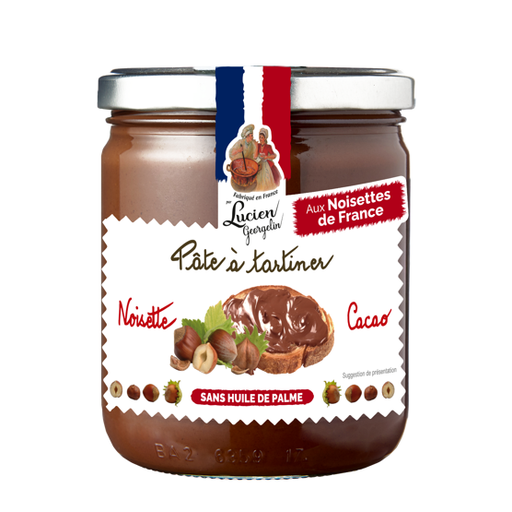 Image unavailable
This 400 g jar may suit a smaller gathering or give you the chance to serve a different recipe. Check that it’s enough for the number of portions you’re planning, and check the allergens.
 Image unavailable
A 400 g jar to consider if you’d like to offer this organic recipe in a moderate amount. The organic claim doesn’t tell you the sugar content or allergens, so check the label.
No. In France, Santé publique France explains that producers display Nutri-Score voluntarily. It complements the nutritional information and ingredients list, but doesn’t replace them.
Check the label on the spread you’re going to serve, including any may-contain statements. Products listed by Nutella and the retailers mentioned contain hazelnuts, and may also list milk, soya or other allergens depending on the recipe.
Follow the instructions for the jar you’ve chosen. For the Jardin Bio Étic product listed by Auchan, the retailer says not to refrigerate it and recommends consuming it within a month of opening. Don’t assume the same instructions apply to another recipe.
No: these claims alone don’t tell you the sugar content. To compare two spreads, read the nutritional values per 100 g on each pack.
No, not as part of the spread category. The French Ministry of the Economy describes this levy as applying to sugary drinks, so it isn’t a factor when choosing between these jars.