For a cycling trip, choose an individually wrapped portion if you want to decide how much to take before you set off. A jar works if you portion it yourself into a suitable container. Then compare the ingredients, allergens and nutritional values per 100 g for the product you’re considering. Neither a mini pack nor a possible Nutri-Score tells you whether a spread is suitable during exercise.
Who are these formats for?
Cyclists who want a portion that’s ready to take
If you want to decide how much to take before setting off, without carrying an opened jar, look for genuinely individual packaging. For example, Rigoni di Asiago lists Nocciolata L’Originale in a 5 × 20 g pack.
Cyclists who prepare their own snacks
A jar lets you choose your own recipe, as long as you portion out what you need before your trip and bring a clean, resealable container. The products listed by Carrefour and E.Leclerc include jars, which are not individual portions.
Shoppers who check ingredients and allergens
If certain ingredients affect your choice, read the label for each product rather than relying on the brand alone. Carrefour and E.Leclerc product listings mention hazelnuts, milk, soya or possible traces of other nuts, depending on the recipe.
What should you check before buying?
First decide how you’ll carry your portion, then compare the label on the product you actually plan to take. The DGCCRF reminds shoppers that prepacked food must include a nutrition declaration. Santé publique France describes Nutri-Score as a complementary logo, which is voluntary.
| Criteria |
What to check |
Shoppers it matters to |
| Portion size and carrying |
Check the weight per unit and distinguish individually wrapped portions from small jars. |
I want to know how much I’m taking before I set off, without having to portion it out on the way; around 36% of consumers put this need first. |
| Use during the ride |
Plan how much you’ll take and what you’ll have it with, then try that combination during training. |
I’d rather know how I’ll use this snack on my rides than try the recipe for the first time on event day; around 29% of consumers say this is their top priority. |
| Ingredients and allergens |
Compare ingredients, allergens and nutritional values per 100 g; check the Nutri-Score if it appears on the product. |
Specific ingredients affect what I buy, so I need to read the label on the product I choose; this is a priority for around 21% of consumers. |
| Available format |
Check which pack your shop stocks, and bring a suitable container if you choose a jar. |
I prepare my portions at home and first look for a format I can buy for this purpose; around 14% of consumers prioritise this. |
Mistakes to avoid
-
Confusing Nutri-Score with a nutrition declaration
In France, the DGCCRF says a nutrition declaration is compulsory for prepacked food. Nutri-Score, as presented by Santé publique France, is a voluntary, complementary label. Its absence does not, by itself, mean that a product fails to meet regulations.
Compare the values per 100 g and read the ingredients and allergen information. If Nutri-Score is shown, treat it as additional information; it doesn’t mean the product meets your needs during a ride.
-
Assuming a jar is a portion that’s ready to go
A jar, even a small one, doesn’t determine how much you’ll take with you. By contrast, Rigoni di Asiago lists Nocciolata L’Originale in five 20 g portions.
If you choose a jar, portion it out before setting off and put it in a clean, resealable container. If you want a ready-packed portion, check that each one is wrapped separately.
-
Assuming a spread is a sports nutrition product
The Fédération française de cyclotourisme notes that what you eat depends on the type of ride, and mentions digestibility for some mountain efforts. This doesn’t confirm that any particular spread is suitable to eat during exercise.
Decide how to use it based on your ride, and try the recipe, portion size and what you’ll have it with during training rather than on event day.
-
Assuming two recipes contain the same allergens
Carrefour and E.Leclerc product listings show that ingredients and ‘may contain’ warnings vary between products, even among hazelnut spreads.
Read the label on the product you buy, including its allergens and any stated traces. Don’t assume that the ingredients in one jar apply to an entire brand.
Brands to compare
These products illustrate differences in packaging and labelling. A brand appearing here doesn’t guarantee that a particular format is available in your shop.
Rigoni di Asiago / Nocciolata
Rigoni di Asiago lists Nocciolata L’Originale in a 5 × 20 g pack, which is different from its jarred products.
- The five 20 g portions let you choose how many to take with you.
- Before buying, check the ingredients, allergens, nutritional values and availability of the exact product.
Nutella
Carrefour lists Nutella hazelnut and cocoa spread in a 230 g jar, among other products; Auchan also lists a 1 kg jar.
- A jar may suit you if you want to prepare your own portion before setting off.
- Auchan says its 1 kg product doesn’t contain individual sachets. Nutella says it uses palm oil in its recipe, so check the ingredients for the product you choose.
NUSTIKAO
E.Leclerc lists NUSTIKAO spread in a 1 kg jar, with an ingredients list and nutritional values per 100 g.
- The E.Leclerc listing shows a Nutri-Score E and 58 g of sugars per 100 g, among other details to check for this specific product.
- The 1 kg jar isn’t an individual portion. You’ll need to portion out what you’re taking separately and check availability with the shop.
Jardin Bio étic
Carrefour lists Jardin Bio étic hazelnut and chocolate spread in a 300 g jar, with an ingredients list and nutritional information.
- The Carrefour listing states that it contains 20% hazelnuts and lets you check the ingredients for this product.
- This jar isn’t a mini portion. The listing mentions milk and possible traces of soya and other nuts, so read the label on the product you buy.
An individual portion on Joybuy
This individually wrapped hazelnut and cocoa spread suits anyone who wants a set amount for a ride. The packaging alone doesn’t tell you whether it’s suitable during exercise: check the label and decide how you plan to eat it.
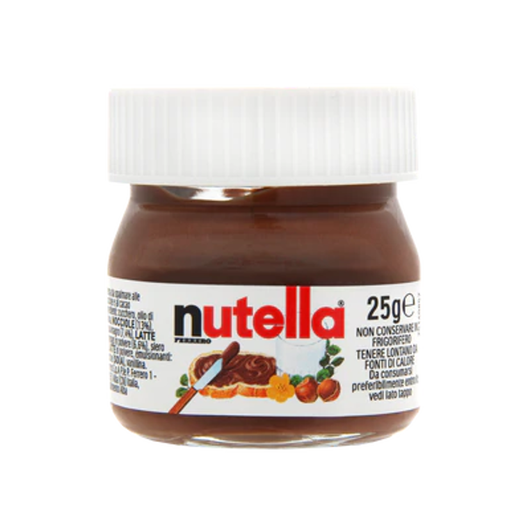 Image unavailable
Nutella hazelnut and cocoa spread, 25 g
The individual 25 g portion lets you decide how much to take before you set off.
Before deciding how to use it on your ride, check the ingredients, allergens and nutritional values on the packaging for this product.
View on Joybuy
Frequently asked questions
Is Nutri-Score compulsory for spreads in France?
No. Nutri-Score is a voluntary, complementary label in France. The DGCCRF says a nutrition declaration is compulsory for prepacked food. Compare the values per 100 g and check the Nutri-Score if it appears on the product, but don’t mistake it for approval for cycling.
Is a mini portion of spread automatically suitable for a cycling trip?
No. A pre-portioned pack settles how much you’ll take, but not whether it’s suitable during exercise. The Fédération française de cyclotourisme says that what you eat depends on the type of ride. Try the recipe, portion size and what you’ll have it with during training rather than on event day.
Which allergens should you check before choosing?
Read the allergen information and any ‘may contain’ warnings for the exact product you’re buying. Depending on the recipe, Carrefour and E.Leclerc listings mention hazelnuts, milk, soya and possible traces of other nuts. Don’t assume that one product has the same ingredients as another jar from the same brand.


