
Livraison le jour même ou le lendemain

Qualité garantie

Débloquez vos offres de bienvenue: Livraison GRATUITE | Jusqu'à -80 % | 30 jours d'essai gratuits à JoyPlus
Téléchargez l'application
Whether you're a professional tradesperson or a passionate DIYer, you know that a good tool bag is more than just a container. It's a true work partner that protects your equipment, organises your job site, and saves you precious time. Yet, the market is flooded with models that promise the world but are a bitter disappointment in practice. Punctured bases, failed seams, chaotic organisation... these are just a few of the letdowns that are surprisingly easy to avoid.
This guide will scrutinise the essential features of a reliable and durable tool bag, with a focus on hard-bottom models. We'll break down the three most common pitfalls to help you invest in the right equipment, with no unpleasant surprises.
Before you fall for an impressive number of pockets or an eye-catching design, you need to know how to spot the weak points that condemn a bag to a premature demise.
To avoid falling into these traps, focus on objective and verifiable criteria. Here are the three non-negotiable points to inspect before you pull out your credit card.
The number one criterion: the nature of the base. A hard-bottom tool bag worthy of the name has a moulded base made of hard plastic (usually polypropylene). This single-piece shell serves three essential functions:
The durability of a heavy-duty tool bag depends directly on its shell. Two points should be checked carefully:
A good portable tool storage solution must, above all, be designed for efficiency in the field.
We have analysed several models based on these criteria. Here is a selection of products that meet the needs of distinct user profiles.
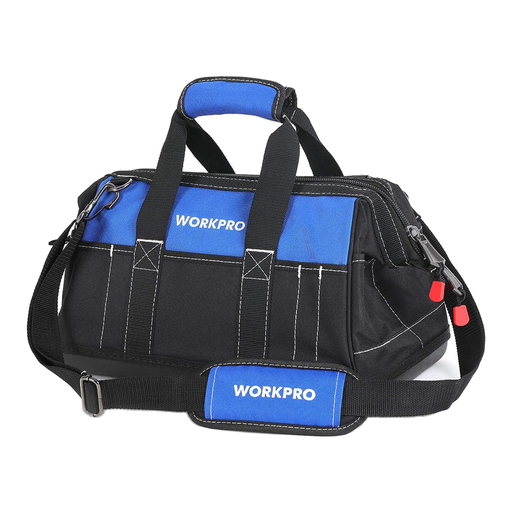
Why we chose it: This bag is the archetype of a well-balanced professional tool bag. Its 40 cm size is perfect for carrying the essentials without being bulky, a major plus for the daily use of electricians, plumbers, or maintenance technicians.
Its moulded, waterproof hard base eliminates any risk of a soaked or punctured bottom. The 600D polyester fabric and reinforced stitching prevent tears, even under heavy loads. Finally, its 21 pockets (8 internal, 13 external) and wide opening prevent the "catch-all" effect.
Its perfect balance of durability (hard base, 600D fabric), storage capacity (21 pockets), and ergonomics (padded handle, shoulder strap) makes it a formidably versatile model.
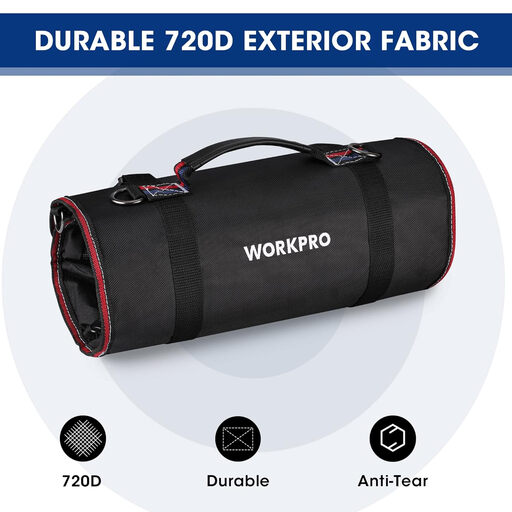
Why we chose it: Perfect for those who don't need to carry heavy, bulky tools but must keep an assortment of wrenches, screwdrivers, and pliers on hand. Ideal for quick service calls, mechanical work (car/motorcycle), or as a supplementary kit in a vehicle.
It bypasses the "catch-all" trap with its 6 zippered pouches that keep small tools and accessories perfectly in place. Its 720D polyester fabric, even more durable than the 600D standard, is a guarantee of excellent longevity.
Unbeatable compactness and organisation. Once rolled up, it has a minimal footprint and fits anywhere: in a backpack, under a car seat, or inside a larger toolbox.
We have compiled a complete and up-to-date selection of products that meet our demanding specifications for durability and practicality.
What size tool bag should I choose? The ideal size depends on your trade and work habits. A 40 cm (16-inch) tool bag is an excellent compromise for general use. Electricians or HVAC (Heating, Ventilation, Air Conditioning) technicians will often prefer larger models (50 cm / 20 inches) to accommodate their specific equipment. For home DIY or a supplementary kit, a 30-35 cm model is more than enough. The easiest way? List your longest and bulkiest tools to determine the minimum size required.
How do I maintain a tool bag to maximise its lifespan? A few simple steps are all it takes to extend your bag's life. Remember to empty and clean it regularly (with a brush and a damp cloth) to remove debris and dust that can damage the seams. Also, avoid overloading it beyond the manufacturer's recommended weight. Finally, inspect the seams and shoulder strap attachments from time to time to spot any signs of wear before it's too late.
Is a hard-bottom tool bag truly waterproof? This is an important distinction. The moulded plastic hard bottom itself is 100% waterproof: it perfectly protects the contents from water seeping up from the ground. However, the polyester fabric body of the bag is most often water-repellent (water beads off it) but not fully waterproof in case of heavy rain or immersion. For complete protection during a downpour, it's best to move it to a sheltered area.