
Livraison le jour même ou le lendemain

Qualité garantie

Débloquez vos offres de bienvenue: Livraison GRATUITE | Jusqu'à -80 % | 30 jours d'essai gratuits à JoyPlus
Téléchargez l'application
Lack of closet space is a common headache in many apartments and studios where every square inch is precious. The hanging closet shelf emerges as the perfect solution: simple and budget-friendly, it allows you to create vertical storage without drilling a single hole. But be warned, the market is flooded with models of widely varying quality. One wrong choice guarantees buyer's remorse: shelves that sag, fasteners that give way…
As a Product Manager at Joybuy, I analyze these products daily. Let me guide you through avoiding the pitfalls and choosing a model that won't disappoint.
Before you jump on the first model you see, let's review the two design flaws that can turn a great idea into a total disaster.
To optimize your closet space for the long haul, a few technical details make all the difference. They distinguish a mere gadget from a true organizational ally.
The choice of materials is, of course, crucial. Most models are made of non-woven fabric, usually polypropylene. It's a lightweight and breathable material, but its sturdiness depends on its density and design.
The absolutely essential point to check for is the presence of rigid inserts at the bottom of each shelf. These inserts, often made of thick cardboard or plastic, prevent the shelf from bending under weight. A good hanging closet organizer must guarantee shelves that remain perfectly flat, even when full.
The hanging system must be able to support the total weight of the shelf and its contents. The two main options are:
Don't just trust the photos! Take the time to check the maximum load capacity recommended by the manufacturer, whether per shelf or for the entire product.
A flexible wardrobe shelf should adapt to your space, not the other way around. Before you check out, take out your tape measure and measure three key points in your closet:
Make sure the product's dimensions are compatible. Also, consider the height of the compartments: are they tall enough for a stack of sweaters, or are they designed more for t-shirts and accessories? 6-shelf fabric models often offer a good compromise for different types of clothing.
To illustrate these criteria in practice, here are a few products that meet different needs.
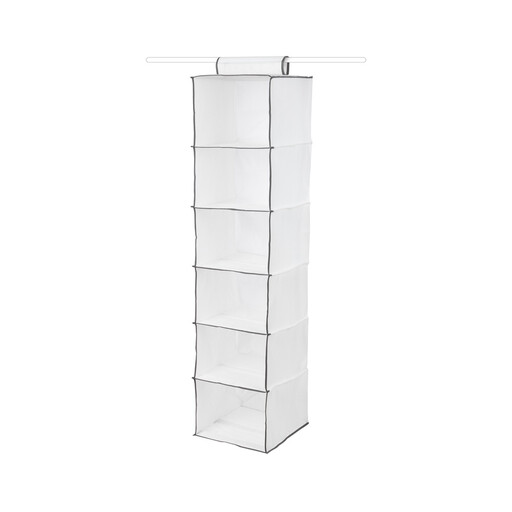
Why it's a great fit: Ideal for students or a first apartment. This user is looking for a functional, simple, and economical solution to organize a small space without any fuss.
Its hook-and-loop fastening system is designed for quick and reliable installation on a standard closet rod. The seams are reinforced and the non-woven polypropylene is well-made, reducing the risk of premature sagging with normal use.
Installs in seconds with no tools required. Folds flat for storage when not in use. Its square dimensions (30x30 cm) are highly versatile.
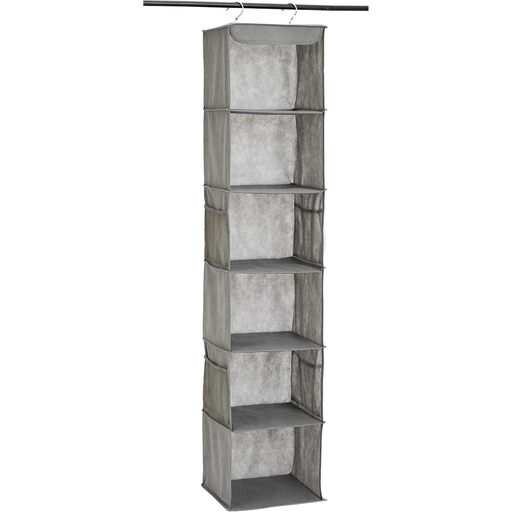
Why it's a great fit: This user wants to store heavy items: jeans, thick sweaters, handbags... Their priority is load capacity and sturdiness to exploit every vertical inch without worrying about collapse.
The manufacturer highlights a " reinforced structure " designed to support significant weight. This promise directly addresses the problem of sagging shelves and provides peace of mind for storing heavier items.
Its robust design allows for a higher load capacity. The side pockets are a real bonus for storing small accessories (belts, socks, scarves).
![[Wardrobe Organization Set] 6 Solid Wood Hangers + 6-Tier ANQI Organizer](https://images4.joy-sourcing.com/product/s512x512_jfsintlpro-000-product/t1/4294967296/5308416/61098171099646/81308/6a7d9fe0Ed59cbba8/42b10752b5083d5e.png)
Why it's a great fit: For those who want to not only organize but also harmonize their closet. This user loves visual consistency and is looking for an all-in-one solution to transform their wardrobe's appearance.
This bundle avoids the pitfall of mismatched purchases. The included ANQI organizer has a reinforced structure, and the solid wood hangers are built to last and support heavy garments (up to 12 kg according to the brand), unlike cheap plastic hangers.
An " all-in-one " solution that is as stylish as it is functional. The wooden hangers with a non-slip bar preserve the shape of clothes. The set creates a visually clean and organized look.
Explore our full selection of products that meet our standards for quality and durability.
The maximum load varies tremendously. Entry-level models rarely hold more than 1 to 2 kg per shelf, just enough for t-shirts. Reinforced versions perform much better. Our advice: always check the manufacturer's technical specifications and distribute the weight by placing the heaviest items at the bottom.
The best way is to choose a model with rigid shelf bottoms from the start. If the damage is already done, you can DIY a reinforcement by cutting pieces of thick cardboard or thin plastic to the correct dimensions and sliding them into the bottom of each compartment.
Yes, it's compatible with almost any closet that has a rod. Its biggest advantage is that it requires no drilling. The only thing to do before buying is to measure the available height under the rod to ensure the shelf won't end up dragging on the floor.