Travellers with one or two outfits to freshen up
For light creases caused by a suitcase or bag, start by looking at handheld steamers. Before you travel, check the weight, storage space, power supply and your carrier’s transport rules.


To smooth a few light creases in an outfit taken out of a suitcase or storage, a handheld steamer is the most suitable choice, provided its weight and water tank suit your needs. If you regularly treat several garments at home, consider an upright model. For sharper creases or a complete pressed finish, opt for a steam iron or steam generator instead. UFC-Que Choisir makes the same distinction between light touch-ups and full ironing.
For light creases caused by a suitcase or bag, start by looking at handheld steamers. Before you travel, check the weight, storage space, power supply and your carrier’s transport rules.
If a shirt or dress has been left folded, choose a manageable appliance that heats up quickly enough for occasional use. Also check the garment’s care label and the appliance instructions.
If you want to work through several items without getting out an ironing board, compare upright steamers and their run time. Their size matters less at home than in a suitcase, but they don’t provide the same finish as an iron or steam generator.
Start with the finish you want and the number of garments you need to treat, then check the specifications of the model you’re considering. A steamer designed for light creases won’t necessarily do the job of an iron.
| Priority | What to check | Your needs |
|---|---|---|
| Finish you want | For light creases after travel or storage, look at handheld steamers. If you need sharp creases and a complete pressed finish, compare steam irons and steam generators instead. UFC-Que Choisir distinguishes between these uses. | I want to smooth creases in a hanging outfit, or I need a crisp, properly ironed finish. |
| Number of garments | Compare the tank capacity, steam output and stated run time of each model. An upright steamer may suit several garments at home, while a small tank means checking how often you’ll need to refill it. | For a single outfit, I’d rather keep things compact; if I’m steaming several garments, I want to avoid frequent breaks. |
| Travel | Check the weight, packed dimensions, supported voltage and transport rules for your journey. Don’t assume an appliance is allowed in cabin baggage just because it’s portable. | My appliance should be easy to take with me and compatible with the power supply at my destination. |
| Fabrics | Read the care label and check the positions recommended in the instructions. With an iron, adjust the setting to suit the fabric; with a steamer, don’t assume it can be used flat unless the instructions say so. | I want to freshen up a garment while following the precautions for its fabric. |
| Steam and heat-up time | Compare the heat-up time, steam output in g/min where stated, and tests carried out on comparable fabrics. Wattage alone isn’t enough to predict steaming results, as Joybuy Insights points out. | I want to know when the appliance is ready and assess how it performs using more than its electrical wattage alone. |
UFC-Que Choisir describes a steamer primarily as an appliance for smoothing light creases caused by travel or storage, not as a universal replacement for full ironing.
If sharp creases or a crisp ironed finish are essential, choose a steam iron or steam generator instead.
Electrical power on its own doesn’t tell you how much steam reaches the garment or what finish you’ll get. Joybuy Insights advises against treating wattage as a measure of steam output.
Also check the stated steam output, heat-up time and weight, as well as any tests that specify the fabrics and methods used.
A small tank needs more frequent refills during a longer session, while an upright appliance with a large tank takes up more space for the occasional touch-up.
Think about how many garments you usually treat, then compare the capacity and stated run time of the models you’re interested in.
A hygiene claim doesn’t tell you how well an appliance will smooth creases in a garment, and shouldn’t be confused with the garment-care functions described in its instructions.
Base your choice on the finish you want, fabric compatibility and usage precautions. Don’t treat the appliance as a replacement for washing.
Philips offers handheld steamers for touch-ups, among other products. For the STH7020/20, the brand states a 30-second heat-up time and a removable 100 ml tank; for the GC800/80, it lists a 230 ml tank and a 60-second heat-up time.
The range includes both handheld and upright models. SteamOne states a 15-second heat-up time and tank capacities of 80 ml and 150 ml for the James 2; the George 2 product details list a 2 L tank and a 35-second heat-up time.
Calor also offers portable Access Steam steamers for touch-ups without an ironing board.
These handheld appliances are suited to occasional touch-ups after travelling or taking clothes out of storage. If you regularly want to treat several garments or do a full ironing session, compare upright steamers, steam irons and steam generators to find the right option for your needs.
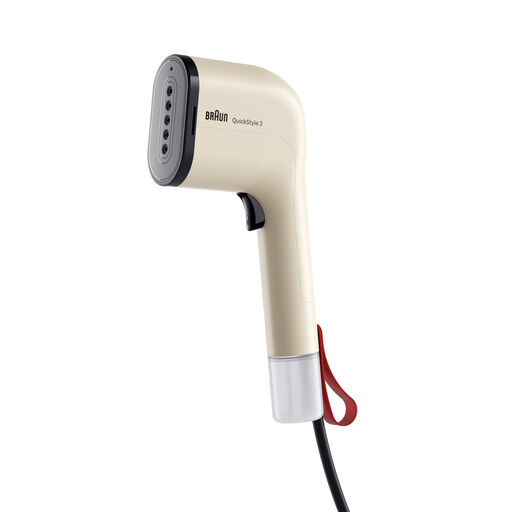 Image unavailable
Worth considering for the occasional touch-up to a hanging garment. Before taking it with you, check that its weight, tank capacity and power supply suit your journey. Also read the instructions and check the fabric care label.
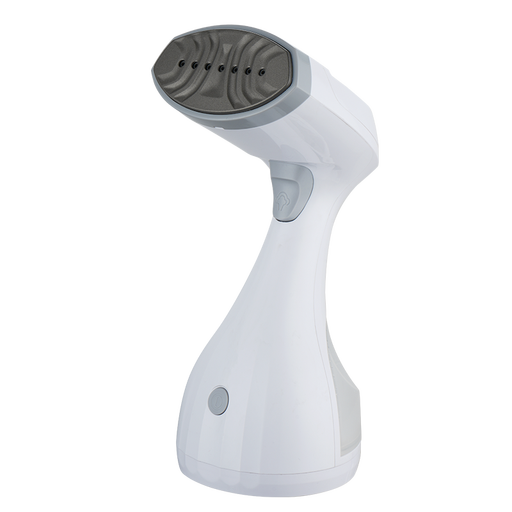 Image unavailable
Its stated 300 ml tank capacity is worth comparing with the number of garments you freshen up in each session. The 1500 W rating alone doesn’t predict the results; also check its size if you plan to take it with you.
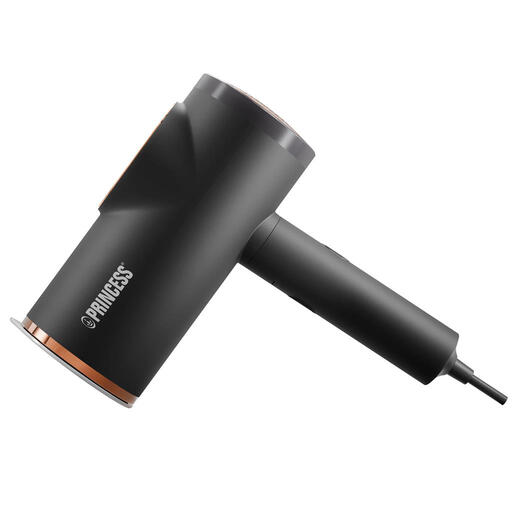 Image unavailable
The foldable design could be useful if you’re putting the appliance away between touch-ups or taking it with you. The lint remover is separate from the steaming function; check the instructions and care label before treating each garment.
Not if you want sharp creases or a complete pressed finish. UFC-Que Choisir describes a steamer mainly as a way to smooth light creases caused by travel or storage. For a crisp finish, choose a steam iron or steam generator instead.
Start by checking the garment’s care label, then follow the appliance instructions. UFC-Que Choisir mentions synthetic fabrics, cotton and linen among the materials that can be steamed; the precautions for each individual garment are still essential.
A small tank may be enough for one or a few garments, while a larger capacity means fewer refills during a longer session. As examples of manufacturers’ stated figures, the Philips STH7020/20 has a 100 ml tank, SteamOne lists 80 ml and 150 ml for the James 2, and 2 L for the upright George 2. Tank capacity alone doesn’t tell you how long the appliance will run.
Check the model details, its power supply, the instructions and any warnings relevant to how you plan to use it. In France, the DGCCRF points out that CE marking is not a certification mark, so don’t mistake it for the result of an independent test.
No. For household appliances in France, the DGCCRF distinguishes between the statutory guarantee of conformity, the guarantee against hidden defects and any commercial guarantee offered. If you’re offered an extended guarantee, read the terms to see what it adds to your statutory rights.