
Livraison le jour même ou le lendemain

Qualité garantie

Débloquez vos offres de bienvenue: Livraison GRATUITE | Jusqu'à -80 % | 30 jours d'essai gratuits à JoyPlus
Téléchargez l'application
Making a soup, purée, compote or smoothie without hauling out a bulky appliance – that’s the beauty of a hand blender. But you still need to pick the right model. A high wattage on the spec sheet doesn’t always mean a pleasant experience, and a mountain of accessories often ends up forgotten at the back of a drawer.
Before comparing models, it’s best to focus on what really matters day to day: power, the design of the blending shaft, the accessories included, ease of cleaning and safety instructions.
A powerful hand blender can handle cooked vegetables, thick mixtures or large quantities with ease. But the number of watts alone isn’t enough to judge its performance. The shape of the bell, how ingredients circulate around the blades and the precision of the speed control all play a crucial role.
A 600 W motor is generally sufficient for everyday soups and sauces. A 900 W hand blender or higher offers more reserve for substantial preparations. Also remember to check the maximum continuous operating time stated in the manual to avoid overheating.
A multifunctional hand blender may come with a whisk, chopper, potato masher and bowl. This versatility makes sense if you regularly prepare sauces, whipped cream, chopped onions or purées. If you mainly plan to blend soups, a blending shaft with a beaker may be perfectly adequate.
Check the exact contents of the box, the compatibility of the accessories and the attachment system. A button or quick-twist mechanism makes it easier to switch between the blender, whisk and chopper.
The blades are extremely sharp, and splashes can quickly redecorate your worktop. An anti-splash bell and a detachable shaft make using the blender much simpler. Parts that are dishwasher-safe also cut down on cleaning time.
The motor block, cord and plug must never be submerged. For hot preparations, always check the maximum temperature allowed by the manufacturer. Some Philips models, for instance, specify a limit of 80 °C, while other appliances have different guidelines.
For everyday use, a power rating between 600 and 700 W is generally suitable for soups, compotes, sauces and smoothies made with sufficiently soft ingredients. If you often cook thick purées or large quantities, you might look at a model with 800 to 1,000 W.
The number of speeds is worth considering, but keep it in perspective:
Electrical power alone doesn’t tell you the total energy consumption. A 900 W appliance used for one minute may consume less than a less powerful model used for several minutes. To estimate the cost, focus on the operating time and how often you use it.
The shaft needs to be long enough to reach the bottom of a saucepan or deep container. According to its spec sheet, the Kenwood Triblade XL has a 20% longer shaft and a 35% wider bell. These dimensions could be useful for a family that makes soups in a large pot.
A graduated beaker lets you prepare a sauce or smoothie directly. Check its capacity: the models featured here offer containers of 500, 600 or 800 ml. For a large soup, it’s often more practical to blend directly in a saucepan that’s compatible with the temperature specified by the manufacturer.
An appliance that’s comfortable to hold reduces fatigue, especially during longer blending sessions. Look for a non-slip handle, buttons within easy reach of your thumb and a weight that suits your needs. Depending on the model, the blenders selected weigh approximately 0.63 to 1.17 kg.
To choose a hand blender that’s easy to clean, go for:
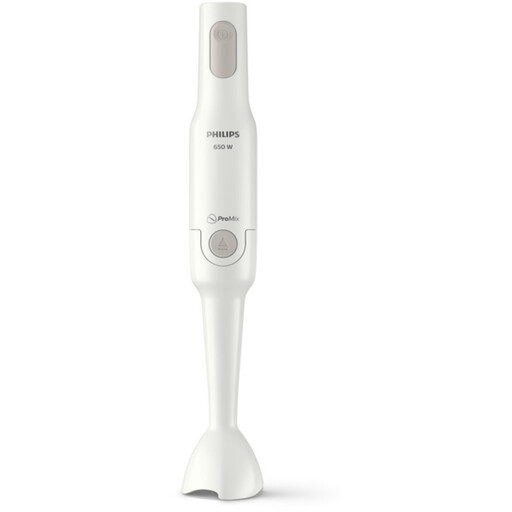
Why this choice suits this profile: With its 650 W, simple controls and beaker, it handles everyday preparations without unnecessary settings.
The setup keeps things simple: a blending shaft, a bowl and a single speed, with no superfluous accessories.
ProMix technology, anti-splash design and a plastic shaft that’s said to be easy to rinse.
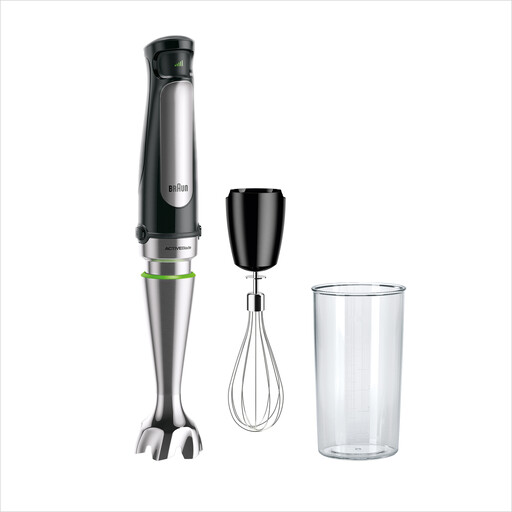
Why this choice suits this profile: Its 1,000 W motor and accessories are aimed at kitchens where the blender replaces several appliances.
The box clearly lists the shaft, whisk, chopper, potato masher and beaker.
SmartSpeed control, EasyClick Plus system and multiple accessories for blending, whisking, chopping and mashing.

Why this choice suits this profile: It combines a blending shaft, whisk, chopper, 500 ml bowl and 800 ml beaker.
The list of accessories lets you check their usefulness before buying, especially for soups, purées and chopped preparations.
Two speeds, detachable parts and a complete setup with whisk and chopper.
We’ve put together a comprehensive, real-time updated list of products that fully meet these strict selection criteria and European safety regulations.
For a smooth texture, cut large ingredients into similarly sized pieces and fully submerge the bell before starting. Use short pulses for thick foods and don’t exceed the continuous operating time stated in the manual.
After each use, unplug the hand blender, remove the shaft and rinse the removable parts quickly. Never touch the blades while they’re spinning and wait for them to stop completely before lifting the appliance out of the container. With hot soup, protect your hands from splashes and stick to the maximum temperature allowed by the manufacturer.
A 600 to 700 W model is suitable for most soups, compotes, sauces and smoothies made with soft ingredients. A power rating of 800 to 1,000 W can offer more comfort for thick preparations, but the blade design and operating time are just as important.
Yes, if the manufacturer allows it. The bell must be fully submerged to minimise splashing, and the saucepan must be compatible with the blades to avoid scratching its coating. Also follow the maximum temperature stated in the manual.
It depends on how often you use it, whether you respect the rest periods, how you clean it and the quality of the accessories. Avoid ingredients that are too hard if the appliance isn’t designed for them, never force a jammed blade and let the motor cool down between cycles.