
Livraison le jour même ou le lendemain

Qualité garantie

Débloquez vos offres de bienvenue: Livraison GRATUITE | Jusqu'à -80 % | 30 jours d'essai gratuits à JoyPlus
Téléchargez l'application
A homemade soup, a purée, a compote or a sauce can be prepared in just a few minutes with a hand blender. But not all models are created equal, and they don't all meet the same needs. A high wattage doesn't necessarily guarantee a perfectly smooth texture, while a long list of accessories is more likely to end up at the back of a drawer.
Before you buy, there are three traps worth watching out for:
For soups, sauces, compotes and purées, a power rating of 450 to 650 W is generally sufficient for typical home use. A 1000 W hand blender offers more reserve for thick mixtures, fibrous vegetables or heavy-duty use, but it can also be heavier and noisier.
The control system is almost as important as the power:
Names like ACTIVEBlade, PowerBell VPlus, ProMix or Triblade refer to technologies specific to each range. They don't replace the need to look at the concrete details: power, accessories, materials, recommended usage time and maintenance requirements.
A stainless steel hand blender is generally valued for its resistance to stains and its contact with food. However, check whether the stainless steel applies only to the shaft or also to the bell and blades.
The shape of the bell affects how ingredients circulate and how well it protects against splashes. To blend directly in a saucepan, the shaft needs to be long enough and the blade must be fully submerged before you switch it on. Very hot preparations require extra care: the maximum permitted temperature varies according to the instructions. Philips, for example, states a limit of 80 °C for certain ProMix models.
A multifunction hand blender can replace several small appliances for preparing:
A set marketed as a 4-in-1 hand blender needs to be examined in detail: check the number of accessories actually included, their capacity and their compatibility with the motor unit. Removable parts that are dishwasher-safe make cleaning easier, but the motor unit, cord and plug must never be submerged.
If you're looking for a versatile appliance, compare models that come with a hand blender with whisk and a hand blender with chopper by looking at the bowl capacities, not just the number of accessories advertised.

Why this choice suits this profile: its 600 W, two speeds, whisk, 500 ml chopper and 800 ml bowl cover the everyday needs of both a single person and a family.
The product page details the accessories and their capacity. This lets you check the real versatility of the set, rather than relying on the "4-in-1" label alone.
A set with blending shaft, whisk and chopper, plus detachable parts that are said to be easy to clean.
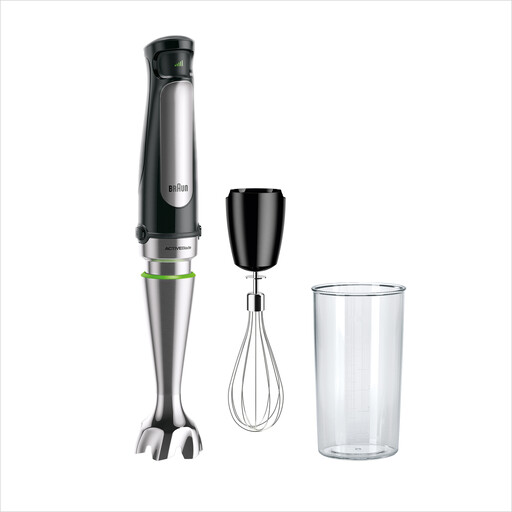
Why this choice suits this profile: its 1000 W motor, SmartSpeed control and equipment including a whisk, chopper, potato masher and beaker are ideal for cooks who regularly prepare a variety of recipes.
The power is paired with an adjustable speed and several clearly identified accessories. This limits the risk of buying a powerful but not very versatile appliance.
ACTIVEBlade technology, SmartSpeed control and EasyClick Plus system for quickly changing accessories.
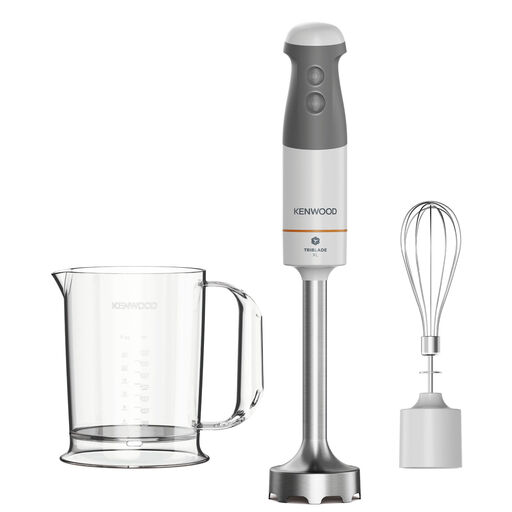
Why this choice suits this profile: its shaft, claimed to be 20% longer, and its bell, 35% wider, are designed for large saucepans and family-sized preparations.
The shaft dimensions are specified, so you can check its compatibility with a deep stockpot before buying.
850 W motor, adjustable speed, Turbo function and accessories said to be dishwasher-safe.
The Philips ProMix HR2534/00 is a simple and effective option for soups, sauces and smoothies: it offers 650 W, a single speed and a metal shaft. If you're looking for something even more basic, the Braun MultiQuick 1 at 450 W focuses on a lightweight design and a single button. Conversely, a hand blender with accessories like the Tristar MX-4829 combines an 800 W motor with a whisk and a chopper.
We've put together a comprehensive list, updated in real time, of products that fully meet these demanding selection criteria and European safety regulations.
Yes, provided the instructions allow it and the shaft is fully submerged before you switch it on. Allow preparations to cool in line with the limit stated by the manufacturer, use a stable saucepan and avoid sudden movements to reduce splashes.
For everyday use, 600 to 800 W gives you a comfortable margin. A 1000 W model can be useful for thick preparations and repeated use. However, the texture also depends on the blades, the bell, the quantity of food and the speed selected.
Follow the operating cycles stated in the instructions, let the motor cool down if necessary and don't force it on foods that are too hard. Always unplug the appliance before releasing a part or changing an accessory. Clean the removable parts promptly and wipe the motor unit with a damp cloth.