
Livraison le jour même ou le lendemain

Qualité garantie

Débloquez vos offres de bienvenue: Livraison GRATUITE | Jusqu'à -80 % | 30 jours d'essai gratuits à JoyPlus
Téléchargez l'application
A hallway coat rack should hold coats, bags, shoes and accessories without turning the corridor into an obstacle course. Some models, however, focus more on their appearance or a wealth of features than on practicality. Before placing your order, take the time to check the dimensions, stability and storage capacity.
A coat stand covered in hooks may look practical on paper. In reality, it can quickly become unstable if its base is narrow or if you hang heavy coats from it. Check the maximum load stated for each hook and make sure the base provides sufficient stability. Distributing garments across several points also reduces the risk of tipping.
In a narrow corridor, a unit that is too deep may prevent a door from opening fully or dangerously reduce the width of the passageway. Measure the available space, including skirting boards, then compare it with the unit’s actual depth. A wall-mounted coat rack and a freestanding model are subject to different constraints.
Open shelves let you quickly reach your shoes or bag, but they leave all their contents on display. Doors and drawers create a tidier entrance, but require additional space to open. In a family home, a multifunctional hall tree can be a good compromise, provided it does not restrict movement.
Note down the width, depth and height of the hallway coat rack. In a small flat, a vertical structure makes better use of the available ceiling height. A wider unit, on the other hand, will provide more room for jackets, bags and shoes.
For hallway storage, also remember to check:
Steel is well suited to slim structures and an industrial style. Wood, MDF and chipboard provide a practical surface for shelves and benches. However, the material is not the only consideration: the shape of the feet, the presence of adjustable feet and any anti-tip system also play a decisive role.
Always observe the stated static load limits and do not exceed them. In a passageway, place the unit on a level floor and distribute items across the different levels.
A coat rack with shoe storage should be suited to the number of people who will use it. A few hooks may be enough in a studio flat. A family will generally need several levels, a hanging rail or a bench.
In particular, examine:
The models below are suited to different uses. The specifications shown are based on the information available on each product page.
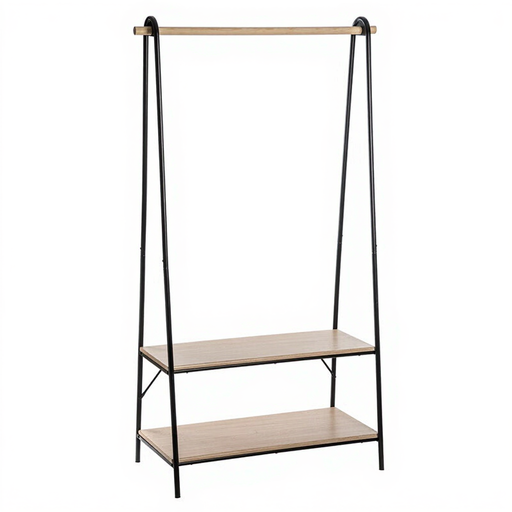
Why this choice suits this profile : Measuring 95.5 × 46.5 × 165 cm, it fits easily in a bedroom, small dressing room or entrance that mainly needs a compact hanging rail.
The dimensions and maximum load of 40 kg are clearly stated. This allows you to check that the unit suits the available space and the weight of the clothes you want to hang.
Two MDF shelves, a 120.5 cm pine rail and a steel frame. The product page also states that the wood is FSC-certified.
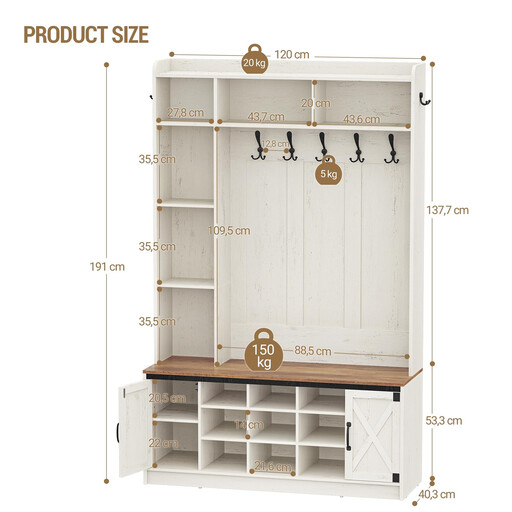
Why this choice suits this profile : This multifunctional hall tree combines seating, shoe storage, hooks and lighting in a single structure.
Its vertical structure, measuring 40.8 × 120.5 × 191.5 cm, combines several functions without the need for multiple pieces of furniture. The lower shelves are removable and adjustable, making them suitable for shoes or boxes.
15 open compartments, 7 hooks, a bench rated to support 150 kg, and RGB lighting offering 25 colours, six brightness levels and three modes.
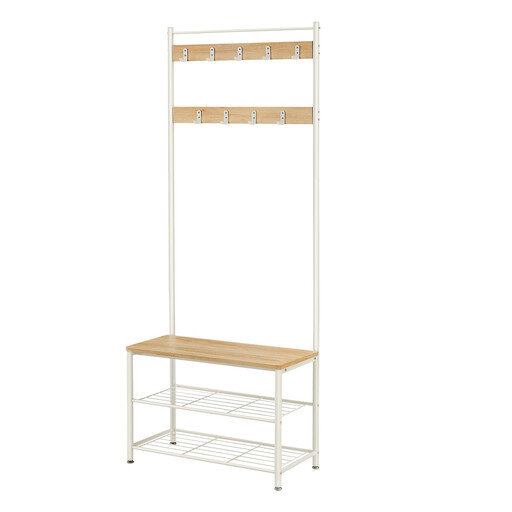
Why this choice suits this profile : Measuring 32 × 70 × 177 cm and featuring a 3-in-1 design, it is ideal for a family entrance where coats, bags and shoes are used every day.
The load limits are clearly detailed: 3 kg per hook, 10 kg per wire shelf and 136 kg for the bench. The manufacturer also supplies an anti-tip kit for wall fixing.
Nine hooks arranged across two rows, a bench with shelves and four adjustable feet. A variant is also available with a rustic walnut and black finish.
Before starting assembly, gather all the parts and read through the instructions. For a tall structure, ask someone to help you during assembly and use the supplied fixing kit when one is provided. Also avoid installing the coat rack near a heat source, in a damp area or on an uneven floor.
A slightly damp cloth is usually sufficient for cleaning metal surfaces and panels. Remember to regularly remove shoes and items you no longer use, so that the shelves are not left permanently loaded beyond the limits stated on the product page.
We have put together a comprehensive, real-time selection of products that meet these demanding selection criteria while complying with European safety regulations.
Start by measuring the width of the corridor and make sure you retain a comfortable passageway. Compare the unit’s depth with the available space in front of doors and other features. In a narrow corridor, a tall, shallow model or a wall-mounted coat rack will minimise the amount of space taken up.
A bench lets you sit down to put on your shoes and may include additional shelves. However, it takes up more space than a simple clothes rail. Check its maximum load, depth and whether it has an anti-tip device if you plan to use it every day.
Distribute clothes between the different hooks, place heavy items in the lower compartments and install the unit on a level floor. For tall models or those with a bench, use the supplied wall fixing if the manufacturer provides one.