Hosts planning one bar per person
Whether you’re putting together treat bags or laying bars out on a buffet, check the weight and kcal in each bar. The value per 100 g then lets you compare recipes sold in different sizes.


If you’re handing out cereal bars at a Halloween party, first compare the kcal in the bar you’ll be serving, then check the value per 100 g. A smaller portion isn’t necessarily a less energy-dense recipe when compared at the same weight. Fibre and protein claims don’t replace this comparison; if several people will be helping themselves, check the ingredients and allergens for each product too.
Whether you’re putting together treat bags or laying bars out on a buffet, check the weight and kcal in each bar. The value per 100 g then lets you compare recipes sold in different sizes.
If these factors matter to you, check the stated values, but don’t assume that a bar contains fewer calories as a result. The oat-based and High Protein recipes from Kellogg’s featured by Auchan show why you need to check each variety separately.
To make sure you have enough bars, compare the number of servings and the weight of each multipack. Carrefour and E.Leclerc, for example, offer recipes in six-bar packs, and each product needs to be checked individually.
First decide how much you plan to serve each person. Then compare recipes on the same basis, and don’t forget to check the ingredients if you’re serving the bars to several guests.
| What matters | What to check | Who is it for? |
|---|---|---|
| Calories per serving | Weight and kcal per bar; kcal per 100 g to compare different sizes. | If I’m serving one bar to each guest, I want to know the energy content of that portion rather than judge the recipe by its size. Around 33% of consumers put kcal per bar at the top of their list. |
| Fibre and protein | Declared nutritional values, followed by kcal and sugars on the same label. | If I’m primarily looking for a recipe based on its fibre or protein content, I don’t want to confuse this with a reduction in calories. This is a priority for around 27% of consumers. |
| Number of servings | Number of bars in the multipack and the weight of each bar. | When I’m preparing a buffet, I need enough portions and a pack that’s easy to share out. The number of bars is the main consideration for around 20% of consumers. |
| Allergens and exclusions | Ingredients list and allergens highlighted on the pack you buy. | Before offering a recipe to guests with known dietary restrictions, I need to be able to check its exact ingredients. Around 20% of consumers prioritise this. |
Auchan’s product listings show that Kellogg’s oat and chocolate bar contains 186 kcal per 40 g and 466 kcal per 100 g, while the salted caramel High Protein bar contains 173 kcal per 35 g and 494 kcal per 100 g. These figures relate to two different recipes and two different bar sizes.
Choose the factor that matters to you, then check the kcal per bar and per 100 g for the recipe you’ve picked.
Auchan’s listing for the Kellogg’s Salted Caramel High Protein bar mentions peanuts, almonds, cashews and hazelnuts, as well as milk and soya. The ingredients may differ in another variety.
Keep the packaging so you can check the allergens on the product you’ve bought before serving it to guests who need to avoid them.
The same number of packs doesn’t guarantee the same number of portions or the same total weight: pack sizes vary between recipes and ranges.
Start with the number of people you’re serving, then check the number and weight of the bars shown on each pack.
The size of a portion alone isn’t enough to justify this claim. Regulation (EC) No 1924/2006, published on EUR-Lex, sets a maximum of 40 kcal per 100 g for solid foods described as having a “low energy value” or using a claim with the same meaning.
When describing your choice, use the factual kcal per bar figure and check the value per 100 g separately.
The products featured by Auchan include individually wrapped Special K bars, an oat and chocolate recipe, and a salted caramel High Protein bar.
The retailer offers several ranges of cereal bars. Its selection includes a Classic’ dark chocolate product in a pack of six 21 g bars.
The Eco+ and Marque Repère ranges include a variety of cereal bar recipes. E.Leclerc offers packs of six bars weighing 126 g in total in these ranges, among other products.
This pack of six Granola Extra Cookie Bars could be a handy option when planning portions for your party. To see whether it meets your calorie criteria, check the nutritional information for the product you buy.
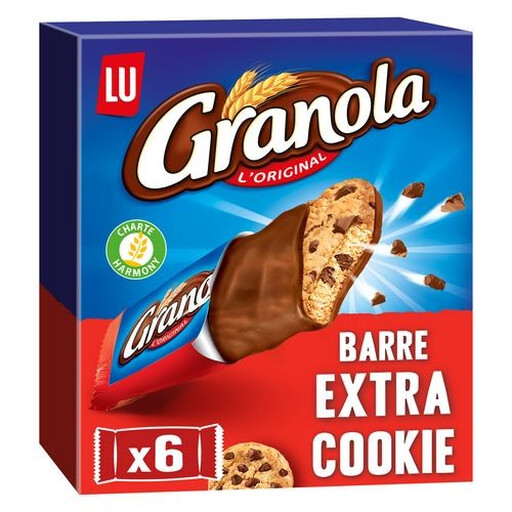 Image unavailable
This pack of six bars makes it easy to plan how many portions you can hand out. The stated total weight is 168 g; check the kcal per bar and allergens on the packaging before serving.
No. A small bar may contain fewer kcal per serving without being less energy-dense per 100 g. For the “low energy value” claim on a solid food, Regulation (EC) No 1924/2006, published on EUR-Lex, sets a maximum of 40 kcal per 100 g.
Check both: kcal per bar tells you about the portion intended for each guest, while the value per 100 g lets you compare recipes with different weights. The French Directorate-General for Competition Policy, Consumer Affairs and Fraud Control explains that nutritional information is given per 100 g or 100 ml to make comparisons easier.
No. Santé publique France says that displaying it is voluntary. To choose a portion to serve, check the kcal per bar and the nutritional information; if any guests have known dietary restrictions, check the ingredients and allergens too.
Read the ingredients list on the packaging for the product you’ve bought and check the highlighted allergens. According to Auchan’s listing for the Kellogg’s Salted Caramel High Protein bar, this recipe contains peanuts, almonds, milk and soya, among other ingredients. Don’t assume the ingredients are the same in another bar.