Livraison le jour même ou le lendemain

Qualité garantie

Débloquez vos offres de bienvenue: Livraison GRATUITE | Jusqu'à -80 % | 30 jours d'essai gratuits à JoyPlus
Téléchargez l'application
The entryway is a transitional space, a physical and psychological threshold. It's our first point of contact with our home when we return, and our last when we leave. Every day, this area is the silent stage for our comings and goings, a decompression zone where we shed the weight of the outside world—coats, bags, wet shoes—to rediscover the tranquillity of home. Yet, in apartments where every square foot is precious, this space is often neglected, reduced to a narrow corridor where clutter takes over in the blink of an eye. Transforming this passageway into a calming introduction to our personal world is less a matter of size and more a question of clever design.
Designing an entryway is about composing a grammar of welcome. The key lies in multifunctionality and verticality. Rather than cluttering the space with multiple small pieces of furniture, the trick is to invest in a centrepiece that serves several needs at once. A well-designed hall tree is more than just furniture; it's a ritual. It invites a sequence of gestures that structure the transition from outside to inside.
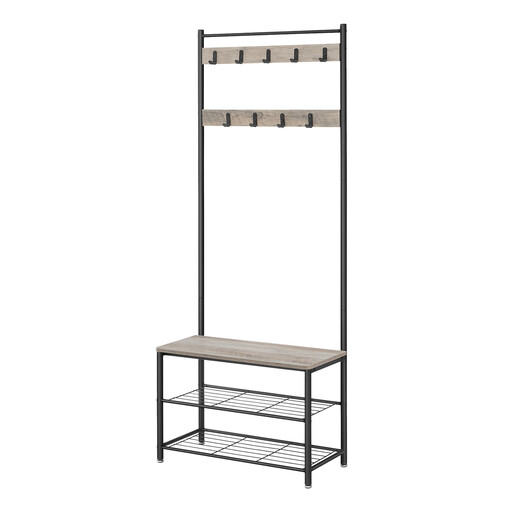
Industrial design, with its clean aesthetic that highlights structure and raw materials like steel and wood, perfectly meets this dual demand for style and function. An industrial hall tree displays its purpose without artifice. Its clear lines and robust construction bring a sense of order and permanence. The integration of an entryway unit with a bench is fundamental. Sitting down to take off one's shoes is a simple but essential act. It offers a moment of pause, a gentle transition. This entryway bench with a coat rack then becomes the heart of the entrance, a functional and symbolic anchor point.
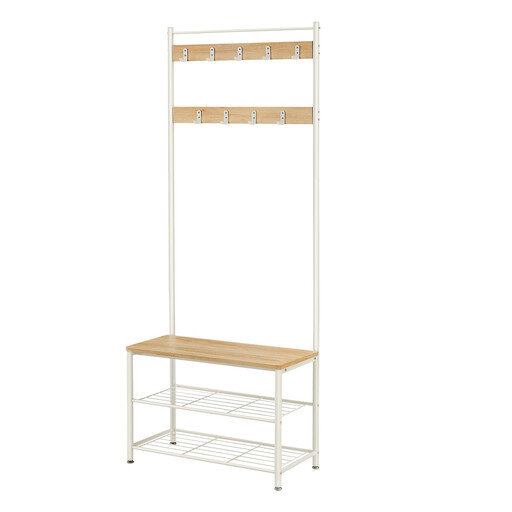
Shoe organisation is often the real puzzle. A coat rack with shoe storage built-in, featuring grid shelves or solid panels, frees up the floor and maintains visual clarity. Everything finds its place: coats up high, bags on intermediate hooks, and shoes at the bottom. The shoe bench with seating epitomises this philosophy: it condenses utility into a single object, optimising space without overwhelming it.
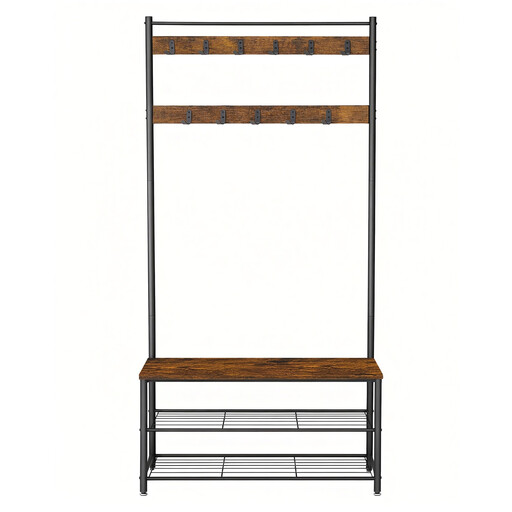
The choice of entryway furniture should adapt to the architecture of the space and the atmosphere you wish to create. For an interior with warm, natural tones, a model like the Ochama hall tree in a rustic walnut and black finish integrates with understated elegance, blending the warmth of wood with the rigour of metal. Its vertical structure leverages ceiling height, while its bench and lower shelves provide essential storage functions. For more confined spaces or for families needing a more targeted solution, modular options are a smart avenue. A simple 3-tier metal shoe rack can be stacked or placed side-by-side to adapt to changing needs, offering a discreet and effective solution. Its availability in black or grey allows it to harmonise with most colour palettes.
In an approach that prioritises softness and comfort, a piece like the HaluPeit shoe bench with seat offers an interesting alternative. With its white frame, grey cushion, and a mix of open and closed compartments, it conceals clutter while providing comfortable seating. The adjustable shelves can accommodate everything from ankle boots to sandals, a detail that reflects a design conceived for daily life. For those with limited floor space, the solution is to go vertical. An Ochama 4-tier shoe stand offers significant storage capacity on a minimal footprint, thereby clearing the walkway and creating a sense of space and flow.
Each of these objects, through its design and function, helps to make the entryway a truly welcoming, thoughtful, and functional space. It's no longer just about storage, but about composing a harmonious prelude to domestic life—a space that, through its order and simplicity, welcomes us home.
For those who wish to explore a wider selection of objects designed in this spirit, the complete collection of entryway and hall tree furniture is an excellent source of inspiration.