
Livraison le jour même ou le lendemain

Qualité garantie

Débloquez vos offres de bienvenue: Livraison GRATUITE | Jusqu'à -80 % | 30 jours d'essai gratuits à JoyPlus
Téléchargez l'application
Drying curly, wavy or frizzy hair without disrupting its definition requires more than just a powerful appliance. A concentrated airflow can separate strands, increase frizz and flatten the roots. Conversely, a well-designed diffuser distributes the air and helps dry the hair gradually, without disturbing the curls.
Before buying a hairdryer with a diffuser attachment, certain criteria deserve careful consideration. The promises printed on the box don’t always reflect the comfort of use, the precision of the settings or the lifespan of the appliance.
A power rating of 2,200 or 2,400 W can reduce drying time, but it doesn’t guarantee a result that respects the natural shape of your curls. An overly intense airflow creates turbulence and encourages unruly strands. For curly hair, the presence of a long-pronged diffuser, multiple speed settings and precise temperature control often matters more than raw power.
An ionic hairdryer can help reduce static electricity, depending on the appliance’s design and the conditions of use. However, the term “ionic” does not replace a suitable drying technique, a gentle setting or proper heat protection. The claims made by a brand should be taken for what they are: marketing information, not a guarantee of identical results on all hair types.
A heavy appliance quickly becomes uncomfortable when drying strand by strand. A removable diffuser that doesn’t fit securely can also shift during use. Check the stated weight, the cable length, the stability of the attachment and the accessibility of the controls. A model with an integrated diffuser, like some appliances designed for curly hair, reduces the risk of the accessory coming loose.
An effective diffuser should distribute the air rather than concentrating the flow on a small area. The prongs support the curls, while the perforated grille helps spread the heat more evenly. For wavy hair, a shallow attachment can make it easier to dry the roots without adding too much volume to the lengths. For frizzy or very thick hair, long, well-spaced prongs can better accommodate the strands.
Also check whether the diffuser is included, magnetic or integrated. A hairdryer with an integrated diffuser saves you from having to search for the accessory every time you use it. Conversely, an appliance supplied with several attachments will suit people who alternate between curls, blow-drying and targeted drying.
An appliance intended for curly hair should offer at least two temperature levels and two speeds. Gentle settings are generally suitable for fine, damaged or short hair. A higher speed can be useful on long, thick hair, provided you keep the diffuser moving and don’t direct hot air at the same spot for too long.
The cool shot function allows you to finish styling and set the shape without adding heat. It can also make the final step more comfortable for the scalp. An independent cool shot button is more practical than a setting that requires several adjustments.
A DC motor is often found in consumer appliances and generally allows for a relatively lightweight design. An AC motor is more commonly associated with professional hairdryers and powerful appliances, but the weight and noise level should be assessed separately. Brushless motors, which have no mechanical brushes, are sometimes presented as more durable and quieter. However, these results can vary significantly from one model to another.
The electrical power, expressed in watts, affects consumption when the appliance is running at full power. To compare two models, also look at the stated drying time, the available settings and how you intend to use it. A lightweight, powerful appliance can be practical for daily use, while a 700 W model designed for curly hair will meet a different need, with a more targeted airflow.
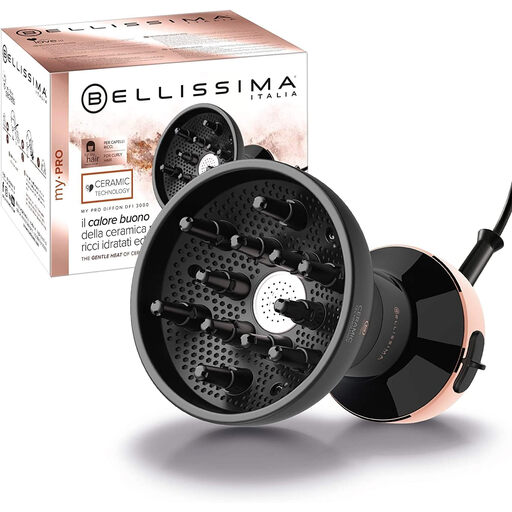
Why this choice suits this profile: This appliance was specifically designed for drying and defining curly hair. At 510 g and with a 2.2 m cable, it’s well suited for home use.
The integrated diffuser prevents unpleasant surprises from an attachment that comes loose. The two temperatures and two speeds allow you to start with a gentle airflow.
Stated ceramic technology, 12 long prongs, cool shot function and a grille designed to minimise hair snagging.
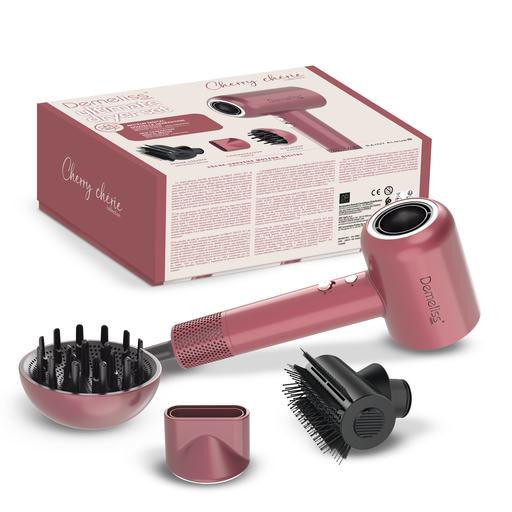
Why this choice suits this profile: This set is designed for those who want to switch between a diffuser for curly hair, precise drying and root styling.
The magnetic accessories cover multiple uses. There’s no need to buy a diffuser or concentrator nozzle separately.
BLDC motor, three speeds, four temperatures, magnetic diffuser and smoothing-volumising brush included.
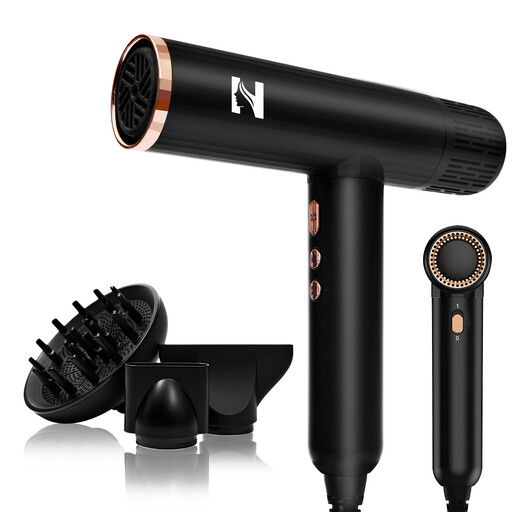
Why this choice suits this profile: With its numerous settings, stated brushless motor and weight of 570 g, it’s suitable for frequent drying as well as long or thick hair.
The four temperatures, three speeds and cool shot button prevent you from relying on a single setting that’s too hot or too powerful.
Stated power of 1,900 W, motor at 110,000 rpm according to the spec sheet, stated noise level below 65 dB and three magnetic attachments.
We’ve put together a comprehensive, real-time updated selection of products that meet these demanding criteria, while complying with European safety regulations.
In the UK, use a plug compatible with the voltage stated on the appliance, typically 220–240 V. Never use a hairdryer near a bath, a filled sink or on a wet surface. Unplug it after each use.
The time depends on the length, density, moisture level and amount of product applied. Work in sections where possible and stop when the hair is almost dry, rather than increasing the temperature significantly.
Yes, provided the airflow remains moderate and the diffuser doesn’t disrupt the shape of the waves. The speed settings and the design of the attachment matter just as much as the ionic function. For fine hair, start with the lowest temperature and power settings.
This varies depending on the motor, frequency of use, maintenance and cable quality. Regularly removing hair and dust from the grille, avoiding tightly coiling the cord and letting the appliance cool down before storing it all help preserve its performance. Also check the warranty period and the availability of spare parts before purchasing.