
Livraison le jour même ou le lendemain

Qualité garantie

Débloquez vos offres de bienvenue: Livraison GRATUITE | Jusqu'à -80 % | 30 jours d'essai gratuits à JoyPlus
Téléchargez l'application
A hairbrush can detangle, smooth, dry, curl or add volume. But relying solely on its shape or the promises on the packaging is the surest way to end up disappointed: bristles that are too rigid, poorly controlled heat or an appliance that is impractical for everyday use.
The right choice starts with your hair type, styling habits and desired result. A detangling brush does not serve the same purpose as a round brush, heated brush or hot air brush.
A heated brush is generally used on dry hair. It relies on a heating element to smooth, wave or add movement. A hot air brush, on the other hand, distributes hot air and can be used on towel-dried hair to dry and style it at the same time.
The difference is far from insignificant. The Wavytalk Thermal Brush, for example, is designed for dry hair and cannot replace a drying brush. Conversely, a hot air brush such as the RAF combines airflow with styling.
A very high temperature does not guarantee better results. On fine, damaged or colour-treated hair, moderate heat and quick passes are generally easier to control. For thick hair, power and airflow settings may be more important than the advertised maximum temperature.
Check for several heat settings, a cool-shot button and an easy-to-read display. These settings allow you to adapt the appliance to your hair instead of working with a single temperature.
Bristles that are too close together may catch on curly or thick hair. Conversely, bristles that are too short may not be effective on dense hair. With a round brush, the diameter directly affects the result: a smaller model makes it easier to work on fringes and short hair, while a larger diameter is better suited to lengths and softer styling.
On a conventional brush, nylon bristles generally offer a good balance between flexibility and durability. A pneumatic cushion or flexible base follows your movements and may be more comfortable for a sensitive scalp. Wood provides a different feel in the hand, but it should be cleaned without being submerged in water.
For heated appliances, a ceramic coating is intended to promote more even heat distribution. This does not mean you can skip the instructions, choose an unsuitable temperature or repeatedly pass over the same section of hair.
For a heated, hot air or straightening brush, check the following:
Never place an electrical appliance near a bath or sink. Allow it to cool completely before putting it away.
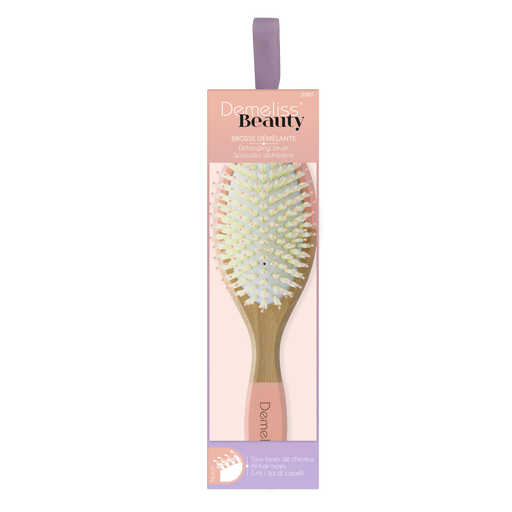
Why this choice suits this profile : This flat wooden brush is suitable for a simple detangling routine on dry or slightly damp hair. It requires neither a power connection nor any particular settings.
Its design does not promise to do everything: it remains dedicated to everyday detangling and regular grooming.
A flat wooden base and double-height nylon bristles, in a format suited to everyday brushing.
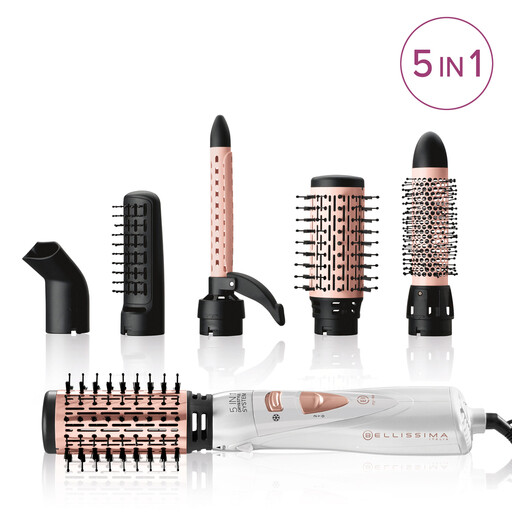
Why this choice suits this profile : This five-in-one system is aimed at anyone who wants to combine drying, straightening, volume, waves and curls in a single appliance.
Each attachment has a clearly defined function: concentrator nozzle, flat brush, two round brushes and a 19 mm curling iron.
1,000 W of power, two speeds, two temperatures, a cool-shot button and a 1.8 m swivel cord.
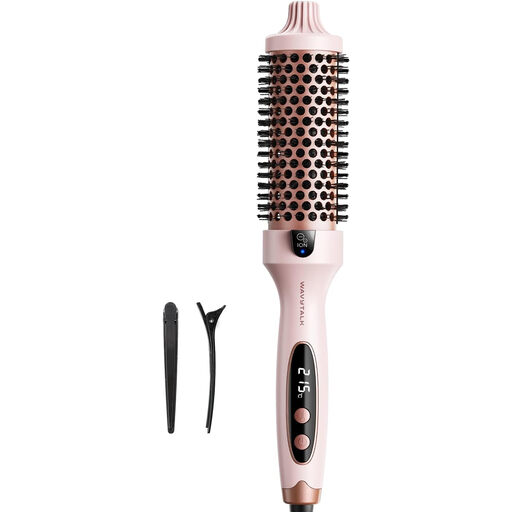
Why this choice suits this profile : This heated brush is designed for people who are used to styling dry hair and want waves or volume with a medium-sized barrel.
The product details make it clear that this is not a hot air brush, so it is suited to targeted use on dry hair.
Five displayed temperature settings, a 38 mm barrel and a swivel cord. Check the plug specifications before ordering.
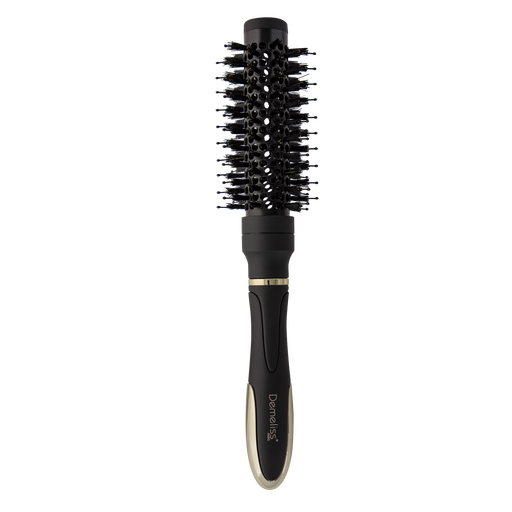
Why this choice suits this profile : Its 25 mm barrel makes it easier to work on fringes, contours, the nape of the neck and short hair when blow-drying.
Its clearly stated diameter prevents it from being confused with a round brush designed for working on long sections of hair.
A 25 mm diameter, flexible nylon bristles and a stated weight of 92 g.
We have put together a complete, real-time updated selection of products that meet these demanding criteria and European safety regulations.
Start by detangling the ends, then gradually work your way up towards the roots. Work in small sections and avoid pulling on knots. A hairbrush should be cleaned regularly to remove hair, dust and styling product residue.
With a heated appliance, dry or towel-dry your hair in accordance with the manufacturer’s instructions. If you usually use one, apply a heat-protection product and never leave the appliance still on a section of hair. Regularly inspect the bristles, cable and attachments; stop using the appliance if any part is loose, sharp or damaged.
For fine hair, choose soft bristles and several heat settings. For thick hair, a wide surface, sufficiently long bristles and suitable power can make styling easier. A conventional detangling brush is sufficient for grooming, while a hot air brush is better suited to drying and styling.
Not necessarily. Some heated brushes are designed only for dry hair, as stated in the Wavytalk Thermal Brush product details. A hot air brush may be suitable for towel-dried hair, but the instructions for the specific model should always be followed.
It depends on how often it is used, how well it is maintained and the condition of the bristles or cable. Replace a conventional brush when its bristles become misshapen, come loose or cause irritation. For an electrical appliance, any sign of overheating, a damaged cable or irregular operation should result in immediate discontinuation of use. Then check the warranty or contact the after-sales service.