
Livraison le jour même ou le lendemain

Qualité garantie

Débloquez vos offres de bienvenue: Livraison GRATUITE | Jusqu'à -80 % | 30 jours d'essai gratuits à JoyPlus
Téléchargez l'application
A multi-styling hair tool can replace several appliances: a hair-dryer styler, hot air brush, hair straightener, automatic curler or straightening brush. But a mountain of attachments doesn’t guarantee an enjoyable everyday styling routine. Some tools are bulky, heat unevenly or offer too few settings to suit both fine hair and thicker locks.
So before you buy, look beyond the marketing promises and check a few practical details.
A 6-in-1 or 7-in-1 styler may come with a whole host of attachments, but not all of them will necessarily earn a place in your routine. If you mainly straighten your hair, a dedicated tool will often be simpler and more comfortable to use than a model that claims to do everything — at least on paper.
Start by checking that it has the functions you actually need: drying, volume, straightening, curling, a diffuser for wavy hair or a concentrator nozzle. Also consider how easy it is to change and store the attachments. These details can make all the difference in everyday use.
Claims such as ‘no heat damage’ or ‘professional results’ are no substitute for proper technical information. Temperature, airflow speed, heat-up time and the way you use the tool all have a direct impact on comfort and results.
Any tool can dry out your hair if it’s used at too high a temperature or for too long, whatever technology it uses. Look for a model with several temperature settings and adjust how you use it to suit your hair type.
A tool you use several times a week needs to be easy to handle. But take care when checking the weight on the product page: it may refer to the tool alone or to the tool with its attachments. Check before comparing models.
The filter, air intakes and brushes also need regular cleaning. A clogged filter reduces airflow and can make the tool less comfortable to use. If you’re choosing a tool for travel, check its voltage compatibility and size, and whether it comes with a case.
For a hair-dryer styler or hot air brush, power alone doesn’t tell you how good it is to use. Speed and temperature settings are much more useful for adapting drying to fine, thick, curly or damp hair.
For a straightener, adjustable temperature settings help reduce the need for repeated passes. Floating plates and a ceramic coating can help the tool glide smoothly, but they don’t mean you can use it on wet hair if the instructions recommend styling only when dry.
A styling tool with the Coanda effect uses airflow to draw a section of hair around the barrel. This design can make curling easier, particularly if you’re new to styling. Having two curling directions is also handy for creating a balanced look on either side of your face.
If you have curly or wavy hair, a diffuser is a real plus. For extra volume, choose a round brush or volumising attachment. Attachments should lock securely into place and be easy to remove once the tool has cooled down.
Look for clear information about automatic shut-off, attachment locks, a swivel cord and voltage compatibility. A travel tool that works with several voltages won’t necessarily come with the mains adaptor you need for your destination.
Electrical appliances sold in the European Union must display the required markings and regulatory information. Before using your tool for the first time, read the instructions, check the contact details of the responsible person established in the European Union, and follow the cleaning guidance.
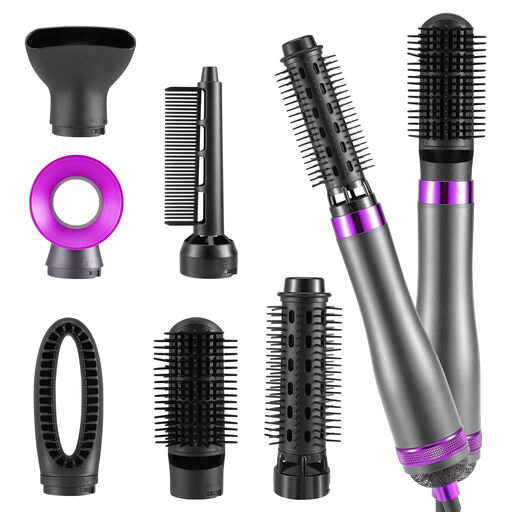
Why it suits this profile : It combines drying, straightening and curling in a design described as portable, with six attachments and three airflow settings.
The product details list all six attachments and the different airflow modes, so you can assess its versatility rather than relying on the name alone.
1 000 W power, six attachments, dimensions of 22,6 × 5,2 × 5,2 cm and a stated one-year warranty.
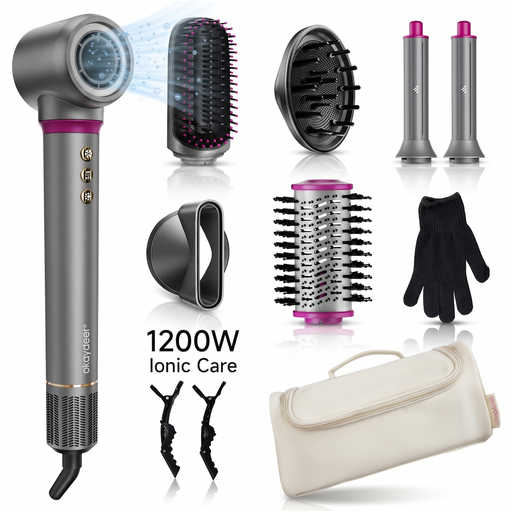
Why it suits this profile : For a range of styles, it comes with two automatic curling barrels, a volumising brush, a straightening brush and a diffuser.
The product details specify two speeds, three temperature settings, a double locking system and a washable magnetic filter.
A motor rated at 130 000 rpm, stated airflow of 27 m/s, a travel case and attachments for creating a range of styles.
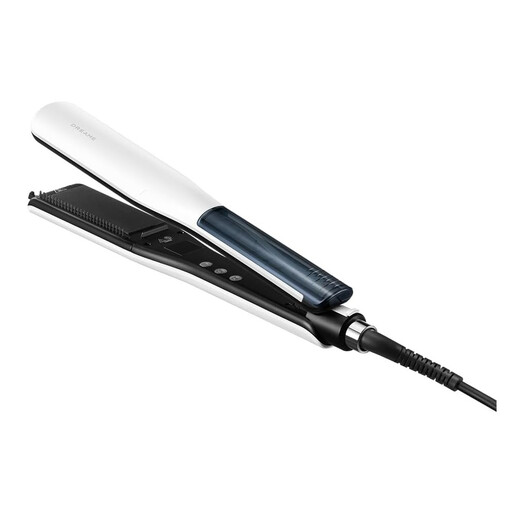
Why it suits this profile : This steam straightener is for anyone looking for precise temperature control and a consistent straightening routine.
You can choose from four temperature settings. The instructions say to fill the reservoir with distilled or purified water only.
Settings of 160, 180, 210 and 230 °C, 100–240 V power supply and a 360° swivel cord.
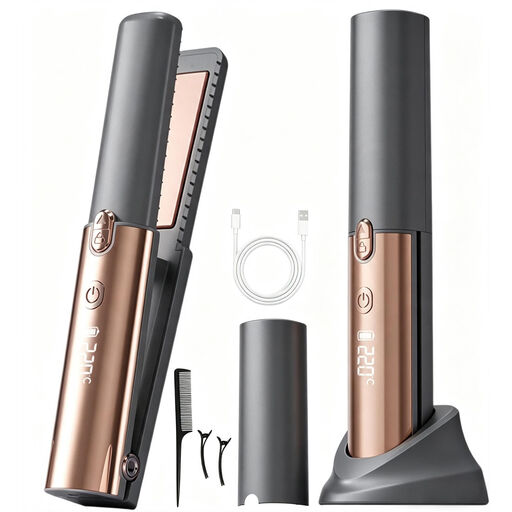
Why it suits this profile : Its cordless design makes it handy for touch-ups at the office, while travelling or in accommodation where sockets are limited.
The display shows the temperature and battery level, while the lock makes it easier to carry.
Built-in 4 500 mAh battery, USB-C charging, seven temperature settings from 160 to 220 °C and ceramic plates.
We’ve put together a comprehensive, real-time list of products that meet these demanding selection criteria and comply with European safety regulations.
Yes, as long as you choose a moderate temperature and speed, and limit the number of passes. With a straightener, start with the lowest setting suitable for your hair type. Apply a heat-protecting product and follow the instructions.
It depends on how often you use it, how well you maintain it and how you store it. Clean the filters and attachments when the tool is cool, make sure the air intakes aren’t blocked and never put it away while it’s still hot. A damaged cord, unusual smell or uneven heating are signs that you should stop using it straight away.
Not necessarily. Compare its price with the number of attachments you’ll actually use, the length of the warranty, the availability of spare parts and how easy it is to maintain. If you only use one straightening or drying function, a simpler tool may turn out to be the better choice.