
Livraison le jour même ou le lendemain

Qualité garantie

Débloquez vos offres de bienvenue: Livraison GRATUITE | Jusqu'à -80 % | 30 jours d'essai gratuits à JoyPlus
Téléchargez l'application
A hair straightener does more than simply tame your hair. It can also create waves or define curls. Yet some purchases fall short after just a few uses: the appliance gets too hot, the plates snag, the battery life disappoints or the settings are too imprecise. So when comparing models available in France, it is better to look beyond the number of ions or the promise of « no frizz ».
A high maximum temperature is not necessarily suitable for every hair type. Fine, damaged or bleached hair often needs gentler heat, while a hair straightener for thick hair should offer even, sufficiently powerful heating. Without precise controls, the appliance may therefore lack versatility.
An ionic hair straightener can help reduce static electricity while styling. However, the advertised number of ions is not enough to assess the quality of the results. You should also consider the type of plates, temperature stability and how smoothly the appliance glides through the hair. Claims about protection or shine are the manufacturer’s indications, not a guarantee that applies to every hair type.
A corded appliance can be highly effective, but less convenient in a small bathroom or when travelling. By contrast, a cordless hair straightener gives you greater freedom, provided you keep an eye on its battery life, charging time and the power actually available. A steam hair straightener, meanwhile, requires particular filling and maintenance: some reservoirs only accept distilled or purified water.
For versatile use, choose a hair straightener with adjustable temperature. A range starting at around 120 to 150 °C generally allows you to use gentler heat. Higher settings may be suitable for some thick or very curly hair. In all cases, the temperature should be adjusted to the condition of your hair and the speed at which you move through each section.
Heat-up time also matters for everyday use. Some models claim to heat up in around 20 to 30 seconds, while others take close to a minute. This figure refers to the time needed to reach the selected temperature; on its own, it cannot predict the results you will achieve.
A ceramic hair straightener generally distributes heat well across the contact surface and is suitable for versatile styling. Wide plates can reduce the number of passes needed on long or thick hair. However, they are less easy to handle on small sections and tight curls.
Floating or slightly curved plates follow the movement more naturally. If you are looking for an appliance that can also be used as a straightener and curling iron, examine the shape of its outer casing: a rounded body makes it easier to wrap sections around the appliance, while an overly angular shape may leave marks in the hair.
For a model intended for travel, check its weight, plate-locking system, cable length and electrical compatibility. Dual-voltage appliances are convenient when travelling abroad, although you may still need a plug adaptor.
Some models offer an automatic shut-off after 60 minutes. This feature does not replace essential precautions: unplug the appliance after use, place it on a heat-resistant surface and keep it away from water. Steam appliances require extra care: never direct the jet towards your skin and empty the reservoir after use if the instructions recommend it.
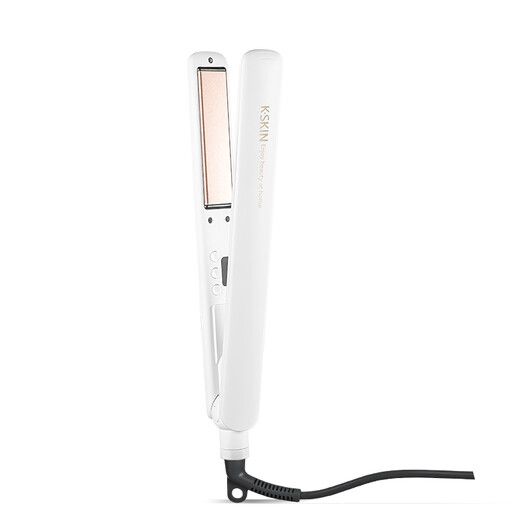
Why this choice suits this profile : its nine temperature settings, from 120 °C to 200 °C, let you start gently. It is advertised as heating up in around 30 seconds.
The temperature is not limited to a single setting, reducing the risk of starting with excessive heat.
Nine settings, advertised ionic functionality and the ability to straighten or curl your hair.
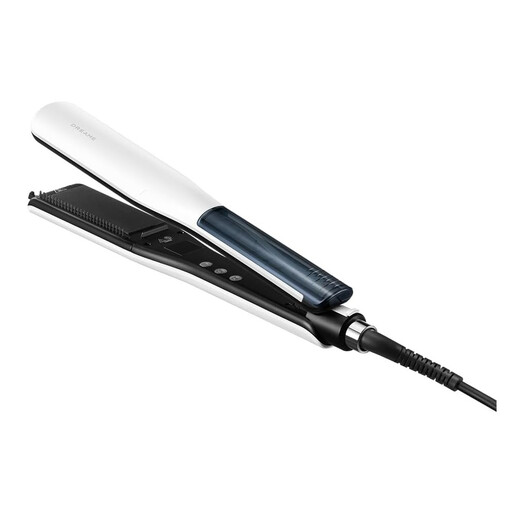
Why this choice suits this profile : its micro-steam generator and four temperature settings are suited to people looking for a more comprehensive styling routine.
The temperature can be adjusted from 160 °C to 230 °C instead of relying on a single heat setting.
Ceramic-coated plates, a 360° swivel cord and 100-240 V power supply.
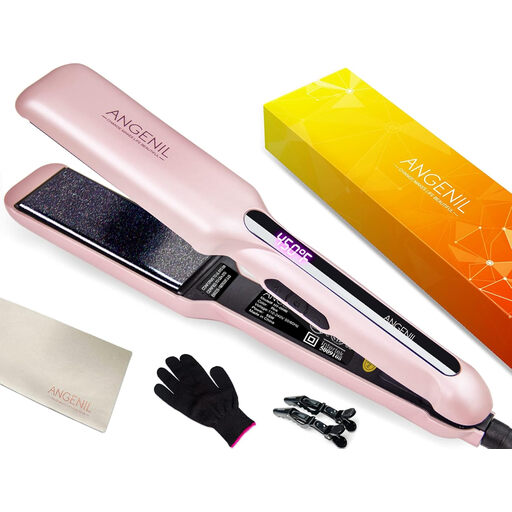
Why this choice suits this profile : its 4.5 cm-wide plates are designed for long or thick hair, while the 160 °C to 240 °C range gives you plenty of control.
The wide plates reduce the need to work section by section through dense hair, while still requiring you to adjust the temperature.
4.5 cm titanium plates, nine temperature settings, advertised 15-second heat-up time and dual voltage.
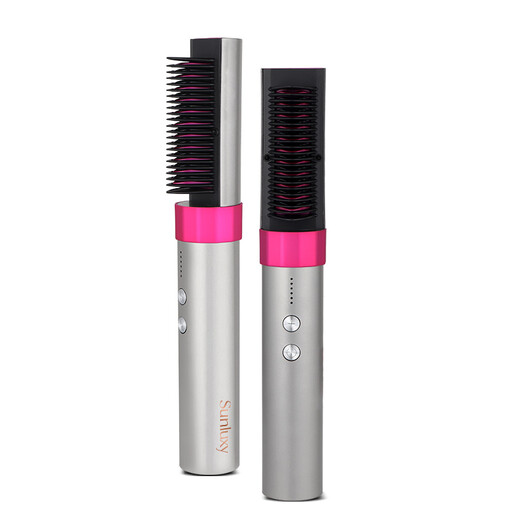
Why this choice suits this profile : its cordless design and comb-shaped format are ideal for touch-ups while you are out and about, or for anyone who prefers styling without a cable.
Its advertised battery life of around 30 minutes lets you plan how much styling time is available before recharging, rather than relying on continuous availability.
PTC ceramic plates, six settings from 130 °C to 200 °C and comb teeth designed to limit direct contact with the hot surface.
We have put together a complete, real-time updated selection of products that meet these demanding criteria as well as European safety standards.
Choose stable heating, adjustable temperature and plates wide enough to cover a suitable section. A model such as the Angenil with wide plates may suit this type of hair, depending on its length and density. Passes should be slow and even, without holding the plates in the same place for too long.
It can be perfectly suitable for touch-ups or a quick routine, but the advertised battery life must match the amount of time you need for styling. For a longer session or very dense hair, a corded model is generally more suitable. Remember to recharge the appliance after each use.
Its lifespan depends on how often it is used, how well it is maintained, the condition of the cable or battery, and the quality of the plates. Stop using the appliance if the cord is damaged, the heat becomes uneven or the casing develops a crack. Check the product’s warranty terms and follow the instructions for disposing of electrical appliances at the end of their life.