
Livraison le jour même ou le lendemain

Qualité garantie

Débloquez vos offres de bienvenue: Livraison GRATUITE | Jusqu'à -80 % | 30 jours d'essai gratuits à JoyPlus
Téléchargez l'application
Drying, straightening, curling and adding volume with a single device can simplify your morning routine. You still need to choose the right model: not every device marketed as a hair multi-styler meets the same needs. Some can be used on damp hair, while others are intended for dry hair only. The included attachments, power, weight and temperature settings all have a direct impact on ease of use and results.
Here are the key criteria to consider before buying, along with a selection of models suited to different needs.
A 5-in-1 or 7-in-1 styling device may appear exceptionally comprehensive. However, some kits count several attachments with very similar functions. Before focusing on the advertised number, first check that the attachments match your routine:
A hair dryer brush with three genuinely useful attachments can prove more practical than a better-stocked kit that is awkward to store and uncomfortable to handle.
Coanda technology uses airflow to draw strands around an attachment. It can make it easier to wrap hair, particularly with an automatic curler. However, the result depends on several factors: the hair’s moisture level, the size of each section and the degree of hold you want.
Terms such as “ionic”, “intelligent control” or “styling without extreme heat” describe a design feature or operating mode. They are neither a medical guarantee nor a promise that applies to every hair type. It is still essential to choose a suitable temperature and limit heat exposure.
A device weighing 1.5 kg with its attachments can quickly become tiring, particularly when styling long hair. Check the weight of the main unit, but also how well-balanced the complete device feels once an attachment is fitted. A swivel cord makes movement easier, while an easily accessible filter simplifies maintenance.
Hair and dust can reduce airflow. Always unplug the device before cleaning it, allow it to cool down and never block its air inlets or outlets.
A hot air brush and a hair dryer brush are generally designed to dry and style towel-dried or slightly damp hair. A classic heated brush, such as the Wavytalk Thermal Brush, is intended for use on dry hair. Using the wrong type of device on wet hair reduces styling control and may increase heat exposure.
If your hair is fine, coloured or fragile, choose a model with several temperature levels and a cool-shot button. For thick, curly or very long hair, more powerful airflow can shorten drying time.
Wattage alone is not enough to distinguish between two models: airflow design, motor performance and attachments also matter. According to the product specifications, the models featured here offer power ratings between 1,000 and 1,650 W.
For use in France, check compatibility with a 220–240 V power supply and confirm the type of plug supplied. The product listing should also provide safety instructions, the manufacturer’s contact details or those of the responsible person in the European Union, and the applicable warranty terms.
Never use an electrical device near a sink or bathtub, with wet hands or if its cord is damaged. Heated attachments must be kept out of children’s reach. For younger children, a styling head is a different type of activity and must not be confused with using an electrical appliance.
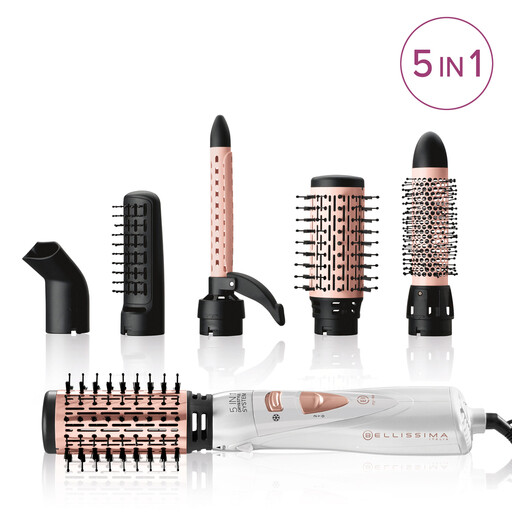
Why this model suits this profile: It combines targeted drying, straightening, volumising, waving and curling with interchangeable attachments. A practical setup for anyone who wants to switch up their hairstyles at home.
The product listing clearly details the five attachments, two speeds, two temperature settings and cool-shot button, rather than relying solely on the number of attachments.
1,000 W of power, a stated weight of 607 g with attachments, ceramic coating and a 1.8 m swivel cord.
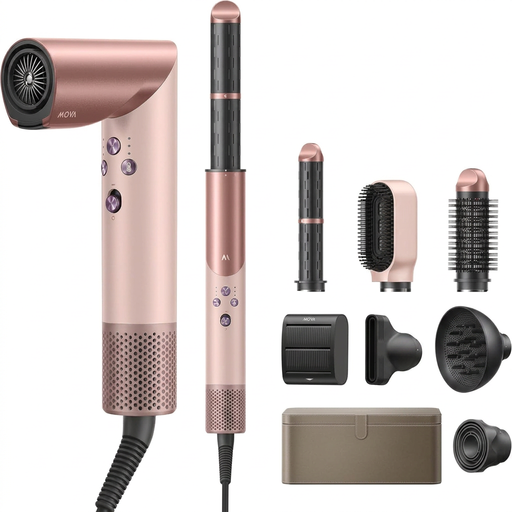
Why this model suits this profile: Attachment recognition and setting memory may appeal to people who regularly switch between drying, volumising, straightening and curling.
The selection details the available settings—four temperatures, three speeds and cool shot—as well as the dedicated attachments, rather than making a vague claim of versatility.
Motor rated at 110,000 rpm, 1,600 W of power, a 2.8 m cable and a storage case included.
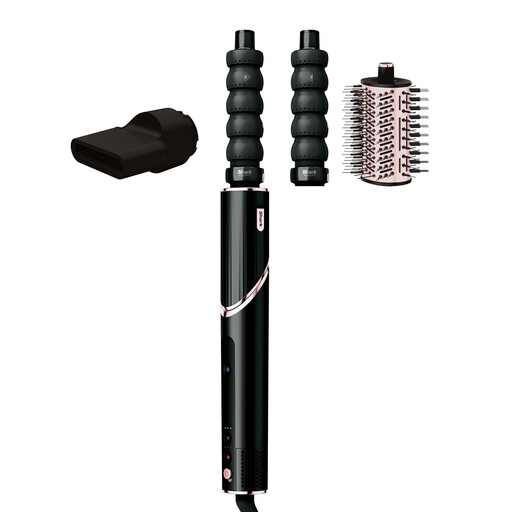
Why this model suits this profile: Its ability to switch between a hair dryer and a 3-in-1 styling device is ideal for anyone who wants to keep the number of bathroom tools to a minimum.
The product listing specifies the two Auto-Wrap attachments, oval brush and concentrator nozzle. With a stated weight of 700 g, it also gives you a clearer idea of handling comfort before you buy.
1,650 W of power, adjustable temperature and speed settings, an adjustable handle and manufacturer-stated temperature measurement.
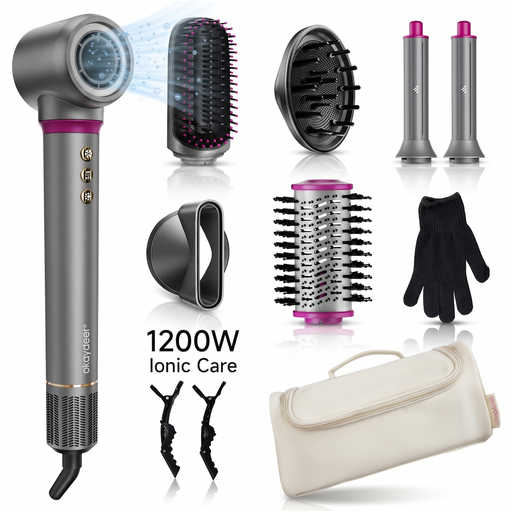
Why this model suits this profile: Anyone who wants a broad range of attachments or styles curly, thick or wavy hair can make good use of the diffuser, brushes and curling attachments.
The product listing details the two speeds, three temperature settings, attachment system and magnetic filter, which should be cleaned regularly.
The kit includes a diffuser, volumising brush, smoothing brush and two automatic curling attachments.
We have brought together an updated selection of products to help you compare the available attachments, uses and formats.
Use it only in accordance with the manufacturer’s instructions. Hot air brushes are generally designed for towel-dried or slightly damp hair, while a classic heated brush is intended for dry hair. In every case, detangle the sections and remove excess water before starting to style.
Its lifespan depends on how often it is used, filter maintenance, storage conditions and the condition of the cord. Allow the device to cool down before storing it, clean the attachments as instructed and avoid tightly winding the cable around the main unit. Also check the warranty period and whether replacement parts are available.
Energy consumption depends primarily on the device’s power rating and how long it is used. In practice, a 1,600 W model used for 10 minutes consumes approximately 0.27 kWh. Efficient airflow and a shorter drying time can reduce consumption, regardless of whether the device is described as “ionic”.