
Livraison le jour même ou le lendemain

Qualité garantie

Débloquez vos offres de bienvenue: Livraison GRATUITE | Jusqu'à -80 % | 30 jours d'essai gratuits à JoyPlus
Téléchargez l'application
Driving at night with yellowish halogen headlights is like watching a low-definition movie: you spend more time guessing than actually seeing. If this feeling of insecurity is familiar, you're not alone. Faced with poor visibility, a growing number of drivers are opting for a modern upgrade: replacing their old halogen bulbs with an LED kit. It's a simple procedure that promises to transform your driving comfort and safety.
But how do you navigate the jungle of available options? As automotive experts, we've analysed the market for you. This guide will help you choose the perfect H7 LED bulb (or any other format) for your car, based on clear, objective criteria.
Before making a purchase, a few checks are in order. These technical points are essential for finding the automotive LED kit that will perfectly match your vehicle and your requirements.
This is the essential starting point: identifying the base type of your original bulbs. Without the correct reference, you can't go any further. The most common are?:
The easiest way? Check your car's manual or remove a bulb to read the reference engraved on it. Only an identical base type will guarantee a plug-and-play installation, meaning no modifications are needed.
Here, two key figures determine the performance of your future lighting?:
Contrary to popular belief, LEDs generate heat. This heat must be dissipated to maintain performance and ensure longevity. There are two main systems: active fans or passive aluminium heat sinks. Efficient cooling is the key to a record-breaking lifespan, often exceeding 50,000 hours. By comparison, a halogen bulb rarely lasts more than 1,000 hours.
To guide you, our editorial team has reviewed several flagship models on the market. Here is our selection, designed to meet different needs and budgets.
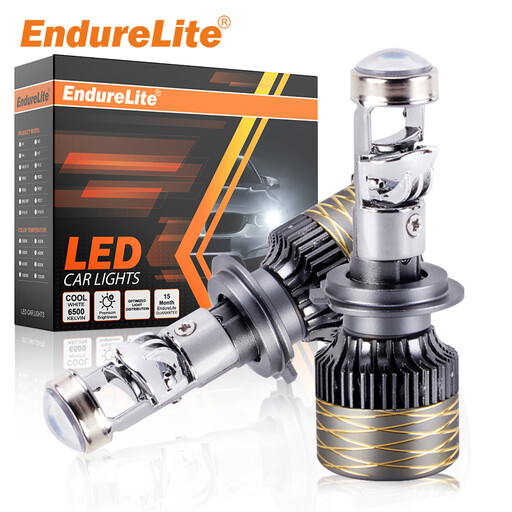
Why this model stands out? This kit shines with its versatility, being compatible with a multitude of base types, including the very common H7. With an advertised 20,000 lumens per pair and a 6000 K temperature, it promises powerful and precise white lighting. Its fan-based cooling system is designed to ensure consistent performance and excellent longevity.
Advantages:
Who is it for? For drivers who want a spectacular brightness boost for their automotive LED headlight and are looking for an easy-to-install solution compatible with a wide range of models.
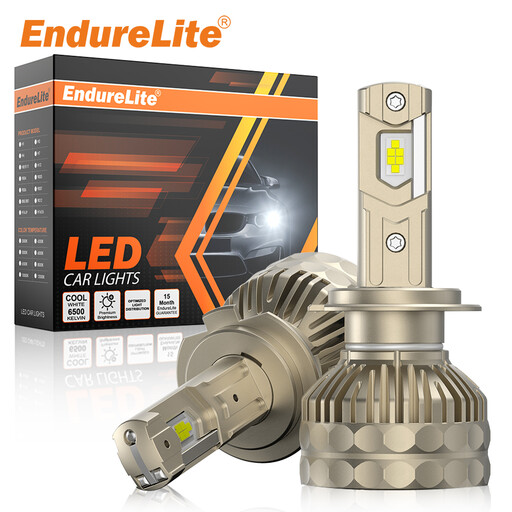
Why this model stands out? Specifically developed for H1-base optics, this model prioritises a discreet profile. Its key asset? A design that is identical in every way to a classic halogen bulb. This not only guarantees a perfect fit but also an ideally focused beam pattern, without needing to adjust the headlight.
Advantages:
Who is it for? The ideal option for owners of H1-equipped vehicles who want a hassle-free installation and the guarantee of a flawless beam pattern.
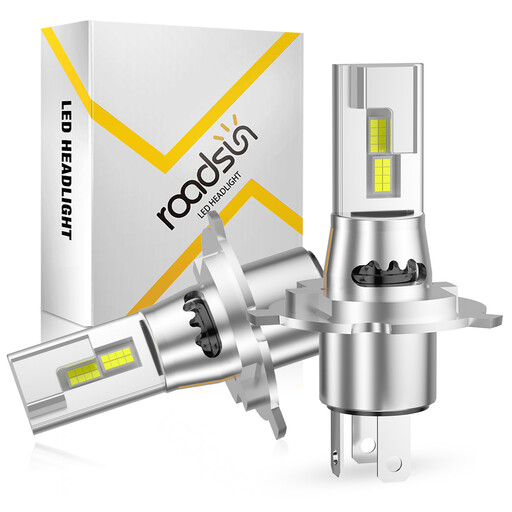
Why this model stands out? This H4 LED bulb is the ultimate all-in-one solution, managing both low and high beams in a single unit. The manufacturer promises up to 500% more brightness than halogen, with a very modern cool white of 6500 K. Its compact 1:1 design greatly simplifies installation.
Advantages:
Who is it for? The perfect solution for drivers with H4-equipped vehicles who want a radical and integrated upgrade, without the complexity of separate bulbs for each function.
If none of these models suit you, or if your vehicle regularly faces extreme conditions (rain, mud, dust), a waterproof certification becomes a non-negotiable criterion.
? Discover our selection of IP68-certified lamps for rock-solid reliability.
This is the million-dollar question. Regulations are often very strict: to be legal on public roads, replacement bulbs must be ECE-approved for the specific headlight assembly in which they are installed. However, most aftermarket LED kits are sold with a disclaimer like "for off-road or private circuit use only." Driving with a non-approved kit could expose you to a fine and, crucially, cause you to fail a technical inspection. Always research the product's homologation status before purchasing.
The CAN bus is essentially your car's nervous system. An LED bulb consumes much less power than a halogen one. The on-board computer (OBC), not detecting the usual power draw, may think the bulb is burnt out and display a warning on the dashboard. To counter this, "CAN bus ready" or "error-free" bulbs integrate a resistor that "tricks" the system. Most modern kits are equipped with this, but it's a point to verify for newer vehicles.
This is one of their biggest advantages. A classic halogen bulb gives up after 500 to 1,000 hours of service. For LEDs, manufacturers claim impressive figures, ranging from 25,000 to over 50,000 hours. In short, they are designed to last as long as your car. Be aware, however: this promise only holds if the cooling system (fan or heat sink) is of high quality. It is the guarantor of their longevity.