
Livraison le jour même ou le lendemain

Qualité garantie

Débloquez vos offres de bienvenue: Livraison GRATUITE | Jusqu'à -80 % | 30 jours d'essai gratuits à JoyPlus
Téléchargez l'application
Driving at night or in bad weather with yellowish halogen headlights is a nerve-wracking experience. Fatigue sets in, confidence behind the wheel drops, and reaction times become dangerously slow. Faced with this outdated lighting, switching to LEDs is much more than a cosmetic upgrade: it's a crucial investment in safety and comfort.
This guide is here to help you navigate the jungle of H7 LED bulbs. We will break down the essential criteria to check before buying and present a selection of products that truly deliver, without the marketing fluff.
Before you take the plunge, a few technical points deserve your attention to ensure your switch to LED is a complete success.
The holy grail: a plug-and-play H7 bulb. These models are designed to be installed directly in place of your original bulb, without having to fiddle with adapters or modify the wiring. Also, consider your car's diagnostic system (the infamous CANbus). If it doesn't recognise the new bulb, it may display an error message. An error-free H7 LED integrates a resistor that simulates a conventional bulb, thus avoiding this minor inconvenience and ensuring compatibility with most modern vehicles.
The quality of a powerful H7 bulb isn't just about its raw brightness (in lumens). It's the quality of its beam pattern that makes all the difference. A good LED headlight must illuminate the road further and wider than a halogen, but without ever dazzling oncoming drivers. The colour temperature, expressed in Kelvin (K), is just as important. Aim for a value around 6000K or 6500K to get a pure white light, very close to daylight, which brings out the contrasts and details of the road.
An LED gets hot. Without a good cooling system, its performance drops and its lifespan plummets. Quality H7 LED bulbs feature an efficient heat dissipation system: either a miniature fan or a passive aluminium heat sink. Proper thermal management is the guarantee of stable brightness and a lifespan measured in tens of thousands of hours—far, far beyond that of a halogen bulb.
Here are a few models that stand out from the pack thanks to their performance and thoughtful design.
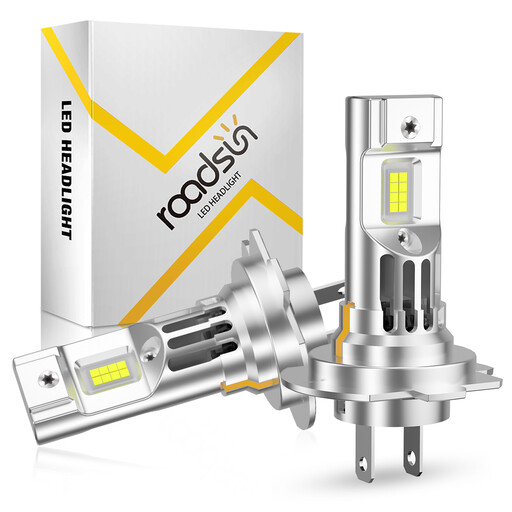
Key Feature: The knockout feature of this model is its incredibly simple installation. Its adapter-free design allows you to replace the H7 halogen bulb in seconds. The manufacturer promises up to 500% more brightness than a halogen, with a cool white light of 6500K for maximum clarity.
Advantages:
Who it's for: The driver who wants a spectacular boost in brightness and a completely hassle-free installation.
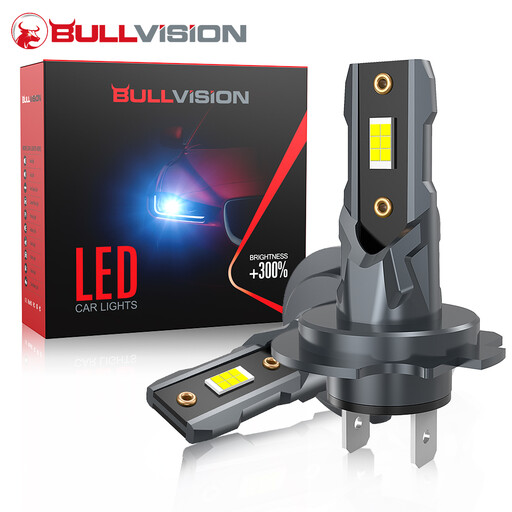
Key Feature: Preserving the original beam pattern. Thanks to its 1:1 design, its dimensions are strictly identical to those of an H7 halogen bulb. The result: the light beam is projected with precision, without dark spots or the risk of dazzling other road users.
Advantages:
Who it's for: The meticulous driver who wants the benefits of LED while maintaining a clean, factory-compliant beam pattern. Manufacturer's note: an external CANbus decoder may be necessary for certain vehicles (Volkswagen, Mercedes-Benz, BMW).
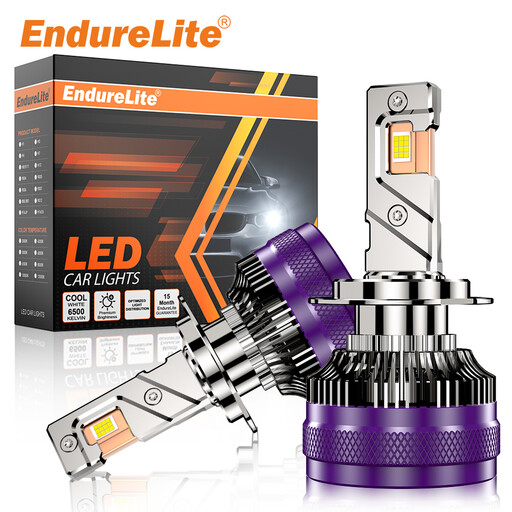
Key Feature: Raw power. This kit combines a 1:1 size design with impressive light output, advertised at 25,000 lumens per pair. It seeks the perfect balance between easy installation, a precise beam, and maximum intensity.
Advantages:
Who it's for: The user whose number one priority is light output to tackle the darkest roads, without sacrificing ease of installation.
Now that your nighttime visibility is sorted, why not think about other aspects of driving comfort? A well-ventilated cabin is just as crucial for staying focused and calm at the wheel, especially on long trips or in hot weather.
Discover our selection of solutions to improve air circulation in your car. ? Explore our range of car ventilation fans
This is a tricky subject, and laws vary by country and region. In France, for example, the regulations are strict: to be 100% legal, replacing halogen bulbs with an H7 LED kit must be done with ECE R37-approved bulbs, installed in a headlight housing that is also approved for LEDs. In practice, as long as the light beam is correctly adjusted and does not cause any glare (the famous sharp "cut-off"), technical inspections generally pass without issue. As a precaution, always keep your original bulbs.
For most plug-and-play models, it's a breeze:
If your car was manufactured after 2000, there's a high chance it's equipped with a CANbus system. This system monitors the electrical consumption of the bulbs. Since an LED consumes much less power than a halogen, the onboard computer may think the bulb is burnt out and display an alert. An error-free H7 LED bulb (or "CANbus Ready") is therefore highly recommended to avoid error messages and flickering issues.