
Livraison le jour même ou le lendemain

Qualité garantie

Débloquez vos offres de bienvenue: Livraison GRATUITE | Jusqu'à -80 % | 30 jours d'essai gratuits à JoyPlus
Téléchargez l'application
Reduced visibility, driver fatigue, a dated look... Your car's factory-fitted halogen lighting is showing its age, especially at night on country roads. That yellowish glow sorely lacks range and clarity. It's no wonder that more and more car and motorcycle owners are deciding to upgrade by replacing their H7 halogen bulbs with an LED alternative.
Our goal: to help you see things more clearly. As the Head of Product Recommendations at Joybuy, my mission is simple: to give you the tools to make the right choice, without drowning you in technical jargon. Together, we'll break down the essential criteria before unveiling our selection of the best H7 LED bulbs on the market, helping you find the perfect match for your needs and your vehicle.
Switching to LED means an immediate boost in visibility, durability, and style. But to ensure you make the right decision, three essential criteria must be closely examined.
The performance of a powerful H7 LED bulb is measured using two key units: lumens (lm) for brightness and kelvins (K) for colour.
In modern cars, particularly European models, the onboard computer (OBC) monitors everything, including your headlights. This is the well-known CANbus (Controller Area Network bus) system.
The problem? A halogen bulb consumes about 55W, whereas an LED uses only 20 to 35W. To the onboard computer, this low power draw is suspicious: it may interpret it as a burnt-out bulb and trigger a dashboard warning. To avoid this headache, the solution is to choose a CANbus H7 LED or an error-free H7 LED, designed to be compatible with 98% to 99% of vehicles. For some highly sensitive models, an external CANbus decoder may still be necessary.
Gone are the days when installing an LED kit was a job for advanced DIYers. Today, simplicity is the standard. Look for models advertised as "1:1 mini size" or "plug-and-play." The concept is simple: their dimensions are nearly identical to a standard H7 halogen bulb.
The result: installation is done directly inside the headlight housing, with no adapters, no modifications to the socket, and no need to cut the dust cover. It's a quick and easy replacement that anyone can do in just a few minutes.
To help you take the next step, we've vetted the market's top options. Here are three models that stand out from the crowd, based on both their technical specifications and user reviews.
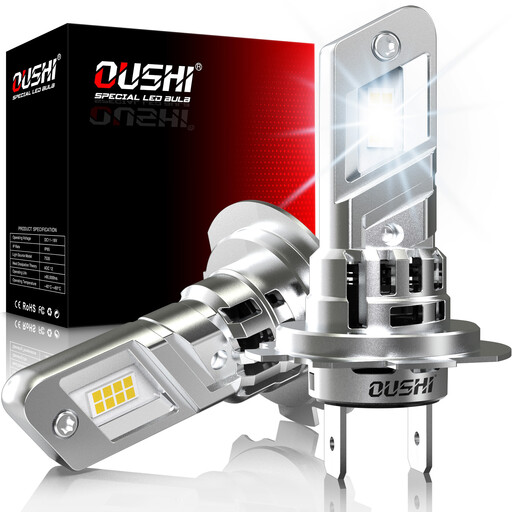
Why this model stands out: This OUSHI kit strikes an excellent balance between extremely high brightness and broad compatibility. The manufacturer promises up to 600% more brightness than halogens, delivering a spectacular improvement in visibility. Its active cooling system and built-in CANbus make it a reliable option for many vehicles, including European models.
Pros:
Who is it for? Ideal for drivers who want a radical performance boost without a complicated installation. The broad compatibility is a real bonus for avoiding dashboard errors.
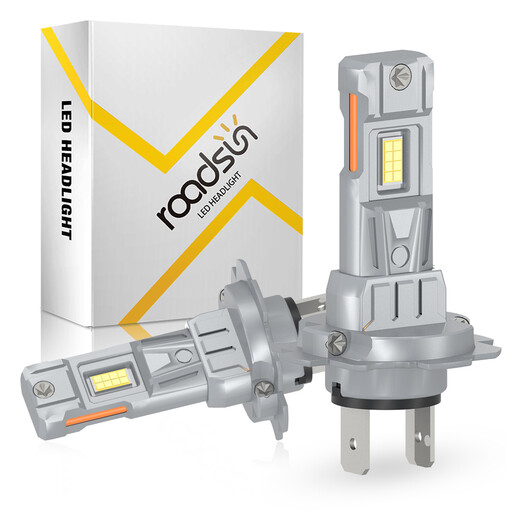
Why this model stands out: The Roadsun model focuses on effortless installation and extreme brightness, advertised as 800% brighter than halogen. Its "real 1:1 mini size" design is engineered to fit perfectly into original housings without any modifications. It's the ideal solution for those who want maximum results with minimum effort.
Pros:
Who is it for? For those who prioritise ease of installation but refuse to compromise on light output. Perfect for cars and two-wheelers alike.
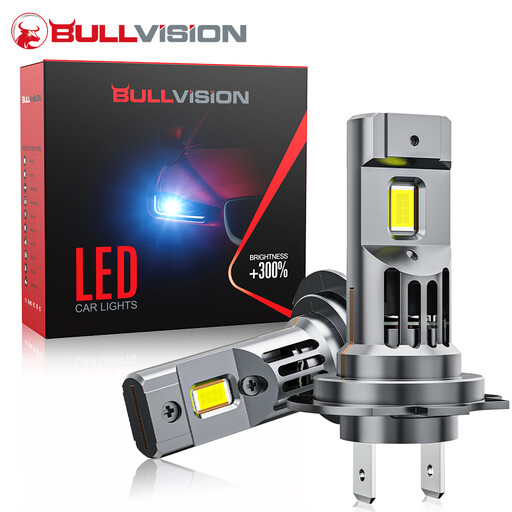
Why this model stands out: Bullvision focuses on a critical aspect: the quality of the beam pattern. While its advertised brightness is more moderate (300% brighter than halogen), this model is designed to perfectly simulate the original bulb's beam. This helps eliminate dark spots and, most importantly, prevents dazzling oncoming drivers.
Pros:
Who is it for? For drivers who prioritise a proper beam pattern and are looking for a significant yet balanced upgrade, without chasing the most extreme brightness on the market. Note: The manufacturer specifies that an additional CANbus decoder is required for some sensitive vehicles (including Volkswagen, Mercedes-Benz, BMW...).
Our selection highlights three excellent choices, but the LED bulb market is vast. To discover other models, compare power ratings, or explore different technologies, feel free to browse our complete catalogue.
? Discover All Our LED Headlight Replacement Bulbs
This is the sticking point. In many regions, including the EU, the legislation is very clear: to be used legally on public roads, an aftermarket H7 LED kit must have a specific ECE approval for your vehicle model. However, very few aftermarket kits currently hold this coveted certification for the majority of cars on the road. In practice, this means the use of most of these kits is restricted to track or private property use. Our advice: research the regulations in your area carefully and be sure to keep your original halogen bulbs just in case.
The symptoms are easy to spot: a "defective bulb" error message appears on your dashboard, your headlights start to flicker, or they turn off for no reason after a few seconds. If you experience any of these issues after installation, then yes, you need a CANbus decoder. This is a common issue with German cars (Audi, BMW, Mercedes, Volkswagen) and many other recent European brands.
Absolutely, and this is a critical point for everyone's safety. The risk of glare mainly comes from low-quality or poorly adjusted bulbs. The secret to a good H7 LED bulb lies in the positioning of its LED chips: they must be located in the exact same spot as the filament of the halogen bulb it replaces. This design recreates the original beam pattern, with its distinct, sharp cut-off line that directs light onto the road and not into the eyes of oncoming drivers. This is why it's essential to choose models known for their beam precision.