
Livraison le jour même ou le lendemain

Qualité garantie

Débloquez vos offres de bienvenue: Livraison GRATUITE | Jusqu'à -80 % | 30 jours d'essai gratuits à JoyPlus
Téléchargez l'application
Driving at night with old halogen headlights? A familiar route can quickly turn into a nightmare. Poor visibility, yellowish light, laughable range… these are very real anxieties for any safety-conscious driver. Upgrading to LEDs is the solution to modernise your car and, most importantly, finally see clearly.
The problem? The market is a jungle. Between lumens, kelvins, and the mysteries of CANBUS, it's hard to know where to start. As the head of product recommendations at Joybuy, my mission is to cut through the noise for you. This guide gives you everything you need to choose the perfect H7 LED bulb for your vehicle and presents our selection of the best models available today.
Before you check out, let's review the crucial points for a successful purchase with no unpleasant surprises.
The performance of an LED bulb comes down to two key indicators:
This is often THE classic pitfall when switching to LEDs: compatibility with your car's on-board computer. Modern cars, especially European ones, use a diagnostic system (CANBUS) that constantly checks if the bulbs are working.
Since an LED consumes far less power than a halogen bulb, your car might think it's burnt out and display a dashboard error. To avoid this issue, it is essential to choose a CANBUS H7 LED or "error-free" kit. These models integrate a resistor or decoder that mimics the power consumption of a standard bulb, ensuring compatibility with nearly all vehicles on the road.
An LED's longevity is directly linked to its cooling. If it overheats, goodbye performance and lifespan. Make sure the model you choose has an effective heat dissipation system:
A "1:1" or "mini size" design, which perfectly matches the dimensions of a halogen bulb, is a real advantage. It guarantees a "plug-and-play" installation, without needing adapters or modifications to the headlight housing.
Here are a few models that stand out from the crowd with their technical specifications and design, capable of meeting most needs.
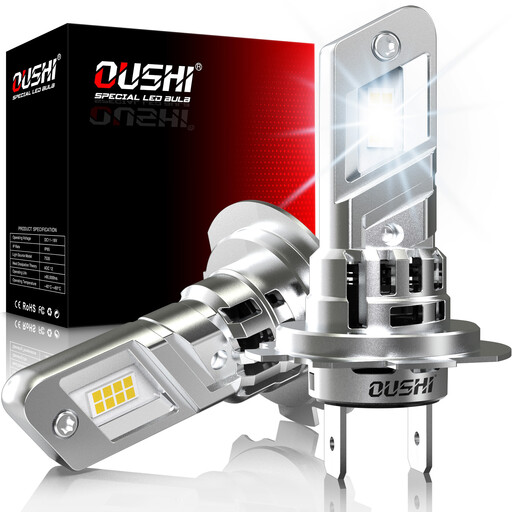
Its standout feature? This kit is all about raw power. It promises up to 600% more brightness than halogens, with a combined output of 30,000 lumens and a xenon white colour of 6500K. Its 1:1 design, modelled after the halogen bulb, ensures an installation that's as simple as it gets.
Pros:
Who is it for? For drivers who primarily want a dramatic increase in lighting power and an installation as simple as changing a standard bulb.
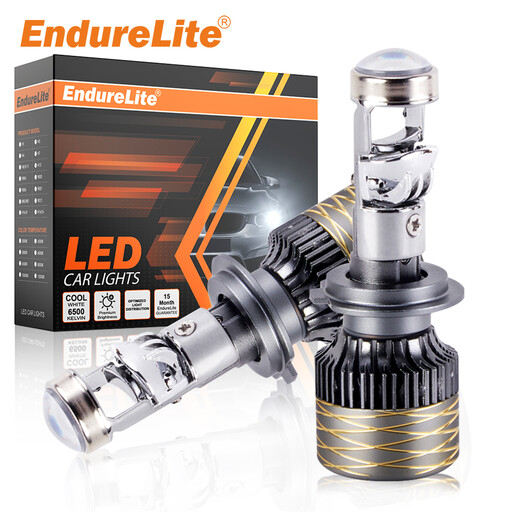
What makes it special? A projection lens is integrated directly into the bulb. This clever design creates an ultra-sharp, focused beam, mimicking that of high-end projector headlights. The result: maximum light on the road, without dazzling other drivers.
Pros:
Who is it for? Ideal for drivers who prioritise beam quality and precision to avoid dazzling others, while still enjoying an easy installation.
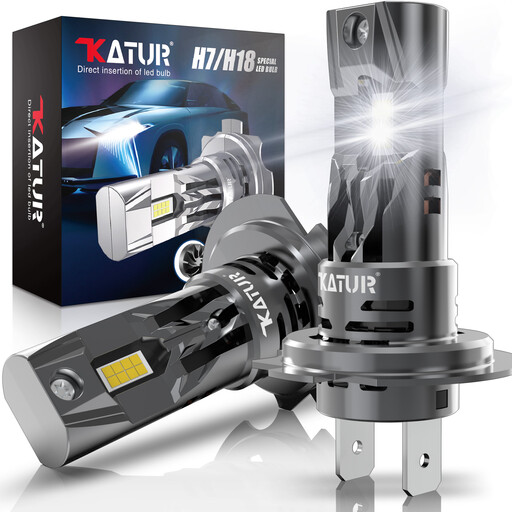
What sets it apart? This kit stands out with its 100W power per pair and its external CANBUS driver. This separate housing allows for better heat management and a more robust anti-interference function, a decisive advantage for electronically sensitive vehicles.
Pros:
Who is it for? Recommended for owners of vehicles known to be electronically "finicky," who are looking for a very powerful solution with the reliability of an external CANBUS system.
Does your car use a different base type? Are you looking to upgrade your interior lighting or tail lights? Our catalogue offers a wide range of solutions. For example, discover our selection of R7 LED Bulbs and many other formats.
1. Is it difficult to replace a halogen H7 bulb with an LED? No, most of the time, it's a breeze. "Plug-and-play" kits like the ones in our selection are designed to clip directly into the original socket. Just remove the old bulb and replace it with the new one. Still, it's a good idea to check your vehicle's manual to learn how to access the headlight assembly.
2. Will my dashboard show an error after installing an H7 LED kit? This is the main risk with newer cars equipped with a burnt-out bulb detection system (CANBUS). To avoid it, it's crucial to choose an H7 LED kit labelled "CANBUS Ready" or "error-free." The models in our selection are all designed with this in mind for maximum compatibility.
3. What's the difference between lumens and kelvins for a high-power H7 LED bulb? To put it simply: lumens (lm) measure brightness (the amount of light emitted). The more lumens, the brighter the bulb. Kelvins (K) measure the colour of the light. A low value (around 2700K) produces a warm, yellowish light. A high value (around 6500K) produces a cool, pure white light that is close to daylight.