
Livraison le jour même ou le lendemain

Qualité garantie

Débloquez vos offres de bienvenue: Livraison GRATUITE | Jusqu'à -80 % | 30 jours d'essai gratuits à JoyPlus
Téléchargez l'application
Replacing H4 halogen bulbs can give you a whiter light and reduce maintenance. But not all H4 LED car bulbs are compatible with every vehicle. A product listing that boasts several thousand lumens doesn't guarantee a well-distributed beam or the absence of a dashboard error message.
Before buying a set of LED car bulbs, check the base type, the space available inside the headlight housing, and the conditions for road use. This check will help you avoid three common mistakes.
Lumens often take centre stage in listings, but they aren't enough to judge lighting quality. A very powerful source that's poorly positioned can create dark spots, an uneven beam, or dazzle other road users.
For LED main beam and dipped beam bulbs, the chips need to be placed as close as possible to the original halogen filament position. A 1:1 design can help maintain a consistent geometry, but you should still check the beam pattern after installation.
A bulb might fit perfectly into its socket yet still cause flickering, an error message, or intermittent cut-outs. This risk is particularly high on vehicles with electronic lighting monitoring systems.
Models described as CANBUS LED bulbs include a decoding circuit designed to reduce these issues. However, this doesn't guarantee compatibility with every vehicle: the most sensitive systems may still need a separate decoder. Consult the manual and, if possible, check compatibility with your car's exact make, model, and year.
LEDs generally use less power than halogen bulbs, but their components still generate heat. An integrated fan helps expel it, while a fanless model eliminates noise and the risk of mechanical failure.
An IP67 or IP68 rating indicates resistance to water and dust under specific conditions. It doesn't replace the need to check the condition of the headlight seal, the rear cover, and the space available around the bulb.
An H4 combines dipped beam and main beam functions in a single bulb. The references 9003 and HB2 usually refer to the same format, but always check compatibility in your vehicle's manual or on the bulb you've removed.
Don't use an H4 to replace an H1, H7, H11, 9005, 9006, or 9012. These references differ in shape, fixing system, and function. An LED bulb intended for fog lights must also match the housing, connector, and applicable regulations.
6000 K cool white LED bulbs produce a light that looks whiter than a standard halogen. A temperature between 6000 and 6500 K can change the perceived contrast of signs and road markings, but the result varies with weather and how clean the lens is.
A very cool light isn't necessarily more effective in rain or fog. For everyday use, prioritise a uniform, correctly adjusted beam above all else.
Plug-and-play LED bulbs with an integrated module are handy when there's little space behind the headlight. Fanless models can reduce noise and simplify maintenance. Vented versions actively dissipate heat, but you'll need to carefully check the available space and exposure to dust.
Stated lifespans, such as 50,000 or 60,000 hours, come from data on some product listings. They don't guarantee performance in all driving, temperature, or voltage conditions.
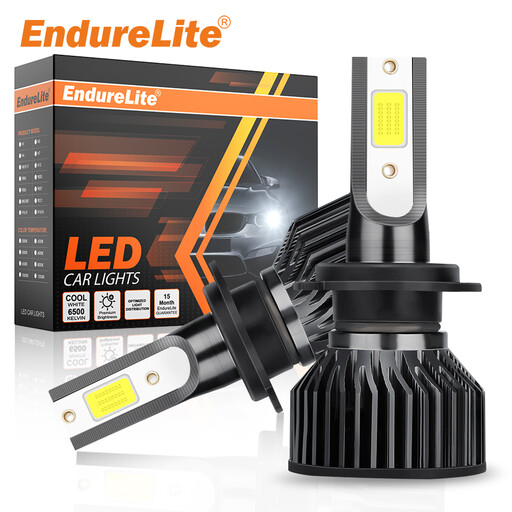
Why this choice suits this profile: Its design, said to match the original bulb, and its plug-and-play installation make it a simple option for a first conversion, subject to vehicle compatibility.
The listing mentions a 1:1 design, direct connection, and integrated cooling system – all features that prevent improvised adaptations.
Light stated at 6000 K, H4 main/dipped beam function, pair of two bulbs, and installation with no external wiring.
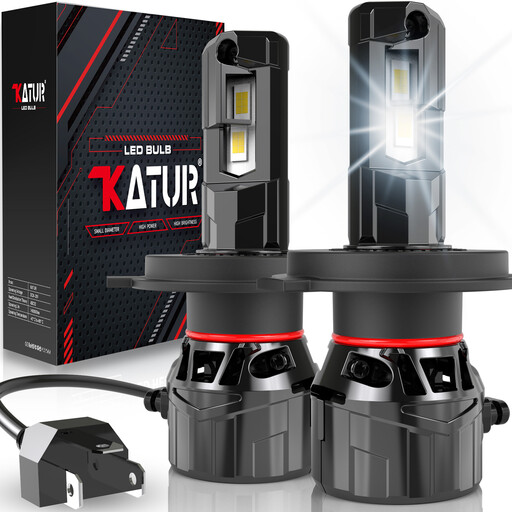
Why this choice suits this profile: This model targets drivers who want a detailed spec sheet, a compact format, and active cooling.
Its compact format and integrated module avoid the need for a bulky external box. You should still check the available space and headlight adjustment.
The listing states 30,000 lumens per pair, a high-speed fan, 9–32 V compatibility, and an integrated CANBUS system.
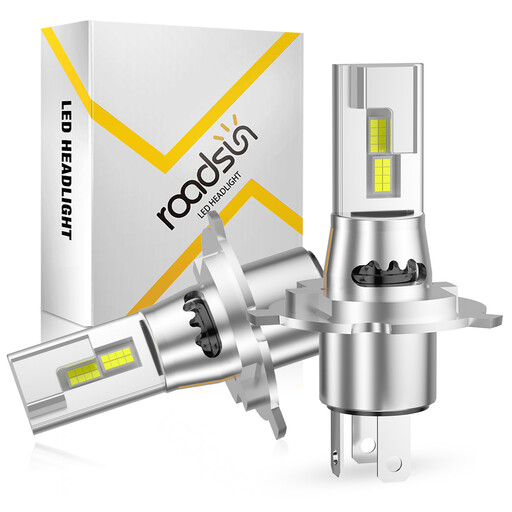
Why this choice suits this profile: Its design, built for frequent journeys, can suit a van, SUV, motorbike, or a vehicle regularly exposed to the elements.
The stated IP68 rating provides enhanced protection against water and dust, while the fan helps dissipate heat during prolonged use.
Main/dipped beam function, fan stated at 16,000 rpm, 1:1 design, and installation with no wiring modifications.
We've compiled a comprehensive, real-time selection of products that meet these strict criteria, as well as European safety requirements.
In the UK, mechanical compatibility alone doesn't guarantee road legality. Check the markings, the manual, the approval applicable to your vehicle, and the manufacturer's recommendations. Any change to the light distribution can dazzle other drivers and cause issues during an MOT.
These references generally belong to the same base family, but compatibility must be confirmed for your specific vehicle. Consult the manual, compare with the bulb you've removed, and check the connector shape before ordering.
Not necessarily. Some CANBUS LED bulbs have an integrated circuit that limits errors. On a particularly sensitive vehicle, a dashboard message, flickering, or intermittent cut-out may still require adding a decoder.
Product listings often state a high theoretical lifespan, sometimes up to 50,000 hours. In practice, longevity depends on cooling, voltage, vibration, headlight sealing, and frequency of use. The quality of the thermal system and installation matters at least as much as the stated figure.