
Livraison le jour même ou le lendemain

Qualité garantie

Débloquez vos offres de bienvenue: Livraison GRATUITE | Jusqu'à -80 % | 30 jours d'essai gratuits à JoyPlus
Téléchargez l'application
Driving at night with old, yellowish halogen headlights quickly turns any trip into an ordeal. Visibility is reduced, signs become blurry, and driver fatigue sets in much faster. To regain real driving comfort, improve your safety, and give your car a modern facelift, upgrading to an H4 LED kit is the most obvious solution.
But how do you navigate the jungle of options?? This guide is here to help you see things more clearly. We've broken down the essential criteria for choosing the right H4 LED bulb for you, without unnecessary technical jargon, focusing on what really matters: performance, compatibility, and ease of installation.
The market is flooded with options, and it's easy to get lost. Here are three key points to check before you decide.
A bulb's performance is primarily judged by its lumens (luminous flux) and kelvins (colour temperature).
The main advantage of a good H4 LED kit lies in its simplicity. The goal is to perform a direct replacement for H4 halogens, without any modifications to the vehicle.
An LED bulb gets hot. An effective heat dissipation system is therefore essential to guarantee its longevity and stable performance over time. The most common solutions include:
To guide you, our editors have selected products that meet the performance and reliability criteria most sought after by drivers.
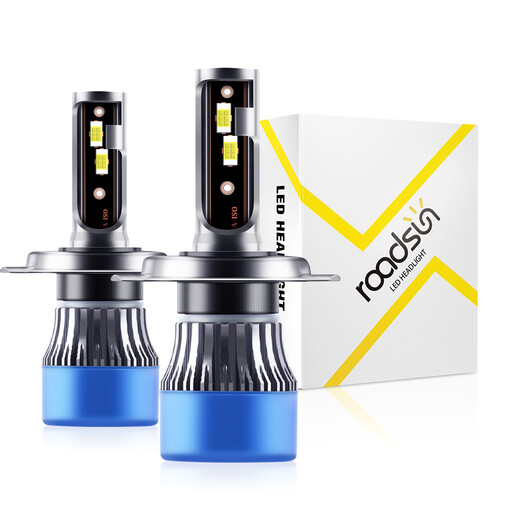
Why this kit stands out?: Designed for maximum simplicity, it handles both low and high beams in a single bulb and promises installation in under 5 minutes.
Pros?:
Who is it for?? Ideal for drivers who want a simple, fast, and effective first upgrade to replace their old halogen bulbs.
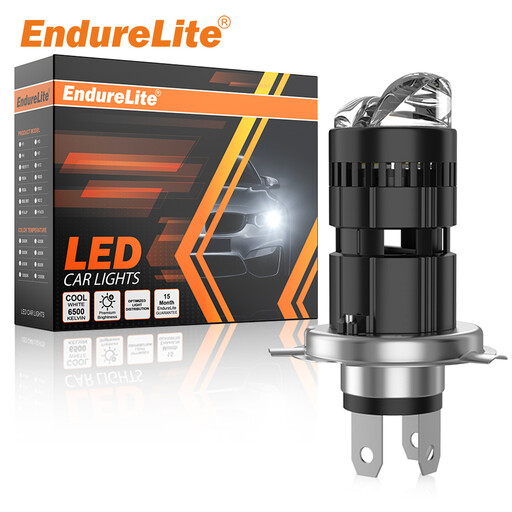
Why this kit stands out?: Its 1:1 design and integrated projector lens produce a perfect light beam, identical to the original, but with incomparable power and clarity.
Pros?:
Who is it for?? Demanding car and motorcycle owners who care about beam quality and want powerful lighting without the risk of dazzling others.
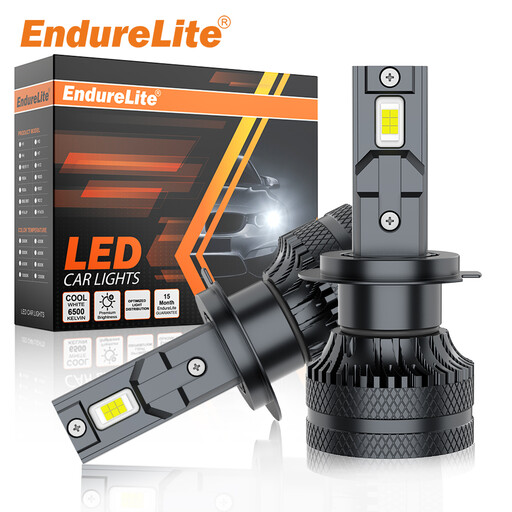
Why it stands out?: This kit focuses entirely on maximum brightness and an ultra-focused beam, achieved by positioning the chips to perfectly mimic a halogen bulb's filament.
Pros?:
Who is it for?? Users who are primarily looking for raw light output and a highly precise beam for optimal visibility in all conditions.
If the models presented don't match your vehicle or if you want to explore other lighting technologies, many other solutions are available. For a complete overview, check out our full category.
? Discover our selection of base-mounted lamps
French and European regulations are very strict on this point. To be used legally on public roads, replacement bulbs must have a specific ECE approval for your vehicle model. However, the vast majority of aftermarket LED kits do not have this certification. Their use is therefore, in principle, reserved for off-road or private track use. Before any purchase, it is imperative to check the current legislation and ensure the kit is approved for your car.
If your vehicle was manufactured after 2005, and especially if it is a European brand (Audi, BMW, Volkswagen, Peugeot, Renault, etc.), it is almost certain that it is equipped with a CANBUS system. The tell-tale signs after installing standard LEDs are: a "defective bulb" error message on the dashboard, flickering headlights, or them turning off completely after a few seconds. Opting for a kit with integrated CANBUS solves these problems from the start.
The H4 bulb is a so-called "dual-filament" bulb, which means it handles both low beams and high beams. A halogen H4 uses two tungsten filaments that light up one after the other. An H4 LED performs the same function but with distinct sets of electronic chips. The major differences are: