
Livraison le jour même ou le lendemain

Qualité garantie

Débloquez vos offres de bienvenue: Livraison GRATUITE | Jusqu'à -80 % | 30 jours d'essai gratuits à JoyPlus
Téléchargez l'application
Driving at night with stock halogen headlights is a bit like using a candle for light. The yellowish glow struggles to pierce the darkness, the range is disappointing, and visual fatigue quickly sets in on any long trip. Upgrading your H4 bulbs to LED technology is a simple and spectacular enhancement that transforms night driving for a huge gain in visibility and, therefore, safety.
But with a jungle of options on the market, how do you find your way? This guide is here to shed light on the criteria that truly matter and present our selection of the best kits to help you make the right choice.
Before you check out, here are the crucial points to verify to ensure your choice is compatible with your vehicle and your expectations.
Forget the faint glow of halogens. An LED's power is judged on two criteria: lumens (lm) for light intensity and kelvins (K) for its hue. A powerful H4 bulb delivers a light output that is incomparable to a halogen, projecting light much farther and wider.
Colour temperature, on the other hand, radically changes perception. The most common models range between 6000?K and 6500?K, producing a pure, even slightly bluish, white light. Close to daylight, this hue makes road markings and signs stand out perfectly—a major asset for reducing eye strain on long night drives.
The keyword is simplicity. The best LED kits are labelled "plug and play" and feature a 1:1 design. In practical terms, this means the bulb is exactly the same size as your original halogen. It clips into the headlight without any modifications, adapters, or cable tinkering. It's an operation anyone can perform in just a few minutes. For your information, H4 bulbs are also known as 9003 bulbs or HB2 bulbs; they all refer to the same dual-filament base that handles both low and high beams.
Public enemy #1 for modern drivers: the dashboard error message. Newer cars use an on-board diagnostics (OBD) system that constantly checks the status of the bulbs. Since an LED consumes much less power than a halogen, the on-board computer might think the bulb is burnt out and trigger a warning. To counter this issue, most kits integrate an error-free H4 LED system, also called "CANbus Ready". It simulates normal power consumption and ensures perfect compatibility with 99% of vehicles, with no warnings or radio interference.
Here are a few models that stand out for their performance and design, tailored for different uses.
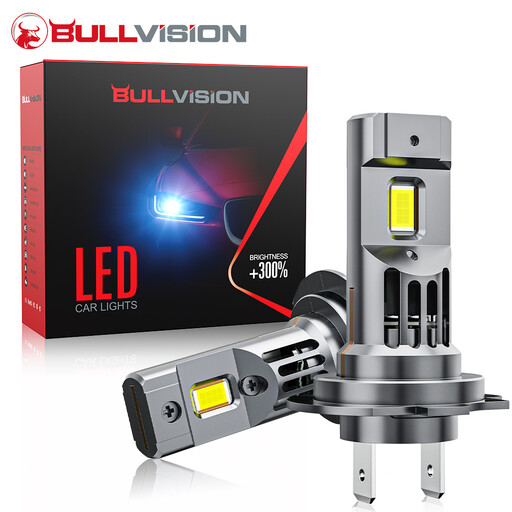
Its strong point?: This model focuses on a precise beam pattern, modelled after original halogens. The result: massively increased visibility, without ever dazzling other road users.
Advantages:
Who is it for? The driver looking for a radical improvement to their H4 LED low beams, with a super-simple installation and a clean beam pattern. Manufacturer's note: For Volkswagen, Mercedes-Benz, BMW, or similar vehicles, an external CANbus decoder may be necessary.
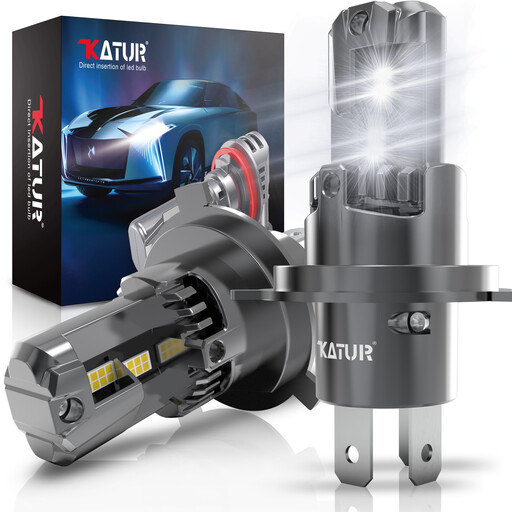
Its strong point?: Raw power. With 100W and 30,000 lm per pair, this kit is designed for those who want maximum visibility, even in the darkest conditions.
Advantages:
Who is it for? Ideal for those who often drive on unlit country roads and need maximum range to anticipate hazards from a distance.
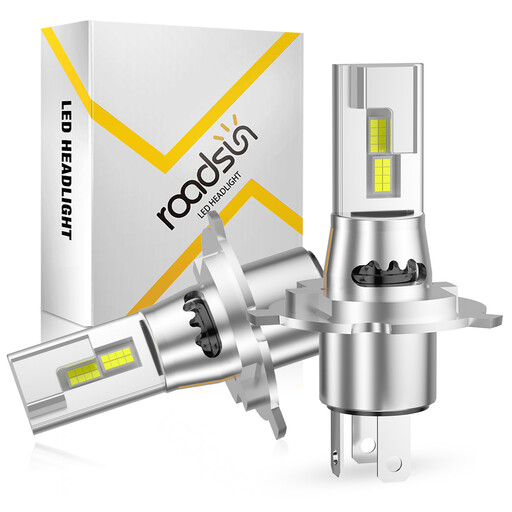
Its strong point?: An excellent balance of very high brightness and robustness, engineered for rock-solid reliability, whatever the weather.
Advantages:
Who is it for? The ultimate all-rounder, for daily drivers who want a high-performance, durable, and easy-to-install upgrade.
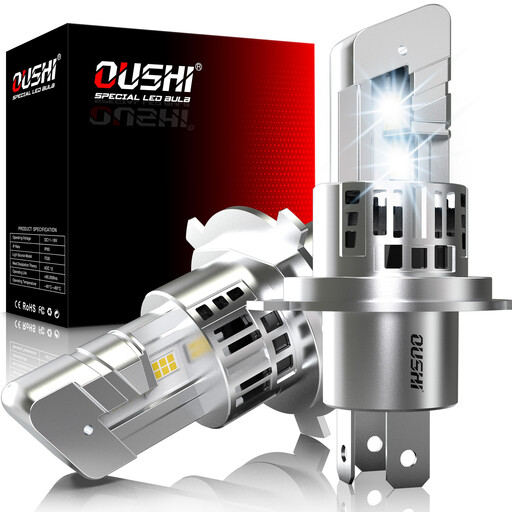
Its strong point?: Extreme brightness paired with a next-generation CANbus system, making it a prime choice for notoriously sensitive European vehicles.
Advantages:
Who is it for? Owners of recent or European vehicles who are wary of electronic glitches and are looking for a turnkey, error-free solution with top-tier light output.
Replacing an H4 bulb with an LED is an excellent first step, but automotive lighting is a vast world. If these models don't meet your needs or if you're looking for other types of bulbs (H1, H7, daytime running lights, etc.), our catalogue is full of alternatives.
Explore our full collection in the Lighting and Bulbs category.
1. Is it legal to install H4 LED bulbs instead of halogens in France?? French regulations are very clear: to be used on public roads, replacement bulbs must have European approval (ECE marking). However, the vast majority of aftermarket LED kits do not have this certification, so their use is theoretically restricted to private tracks. Before any purchase, it is crucial to check the product's compliance and inquire about current legislation, which is subject to change.
2. Is an anti-error (CANbus) system mandatory?? Not always. Most recent kits include sufficient CANbus compatibility for the majority of cars. However, some vehicles, particularly from the Volkswagen Group, BMW, or Mercedes, are more sensitive and may require an external decoder to guarantee a complete absence of errors or flickering.
3. What's the difference between an H4, 9003, and HB2 bulb?? None. These three references designate the exact same bulb. H4 is the European designation, while HB2 and 9003 are the American standards. In all cases, it is a dual-filament bulb that manages both low and high beams. They are perfectly interchangeable.