
Livraison le jour même ou le lendemain

Qualité garantie

Débloquez vos offres de bienvenue: Livraison GRATUITE | Jusqu'à -80 % | 30 jours d'essai gratuits à JoyPlus
Téléchargez l'application
Driving at night with yellowish halogen headlights guarantees a more tiring and potentially less safe journey. Between poor visibility on country roads and increased reaction times, the concern is valid. Switching to an H4 LED bulb is now the simplest and most effective solution to upgrade your vehicle, improve safety, and enjoy high-performance lighting.
The only problem: the market is a jungle of different models and confusing technical specifications. How do you choose the right H4 LED kit without making a mistake? This guide is here to cut through the noise, give you crystal-clear selection criteria, and introduce you to the models that are truly worth your attention. Our mission: to help you make an informed choice that's perfectly suited to your needs and your vehicle.
Before you jump on the first kit you see, a few technical criteria make all the difference. Here are the key points to check to successfully upgrade from your H4 halogen bulbs to LEDs.
A bulb's performance is judged on two aspects: the amount of light emitted (lumens) and its colour (kelvins).
The main advantage of modern LED kits? Their simple installation. The majority of models are "plug-and-play": you unplug the old bulb, clip the new one into the H4 headlight housing, and you're done. No modifications are necessary.
However, be careful with modern vehicles. They are often equipped with a multiplexing system (CANbus) that constantly checks if all bulbs are working. Since LEDs consume much less power than halogens, the onboard computer can panic, think a bulb is burnt out, and display an error on the dashboard. To avoid this minor hassle, opt for an error-free H4 LED bulb (or "CANbus ready"), which is designed to trick the system.
The lifespan of an LED bulb is directly linked to the quality of its cooling system. A powerful LED generates heat; if it's not dissipated, brightness decreases and wear accelerates. High-performance models combine two systems:
Good thermal management ensures a lifespan of 30,000 to 50,000 hours, which means years of peace of mind compared to halogen bulbs.
Based on these criteria, we have selected three kits that check all the boxes for performance, reliability, and ease of installation.
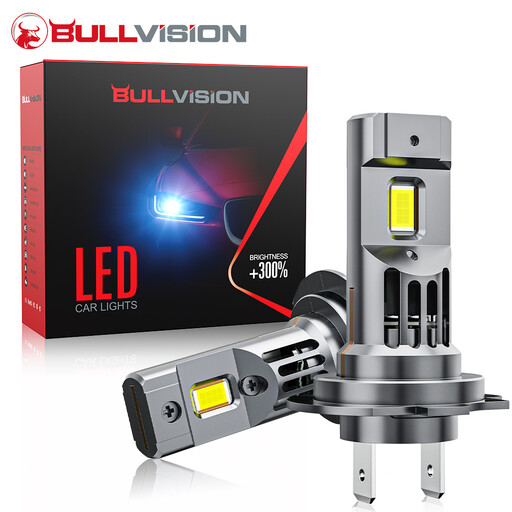
What makes it different: The Bullvision H4 kit gets straight to the point: simplicity and efficiency. Its 1:1 design, identical to a halogen bulb, ensures ultra-fast installation in almost all headlight housings. It's engineered to produce a clean beam pattern with no dark spots.
Key Features:
Who is it for? For those who want a reliable, hassle-free solution that can be installed without any modifications.

What makes it different: The ENdureLite kit is all about raw power, boasting 17,000 lumens. It's aimed at those who want to turn night into day on the most remote roads, without sacrificing simple installation or reliability.
Key Features:
Who is it for? Ideal for high-mileage drivers, including both car and motorcycle owners, who frequently travel on country or mountain roads and for whom lighting power is non-negotiable.
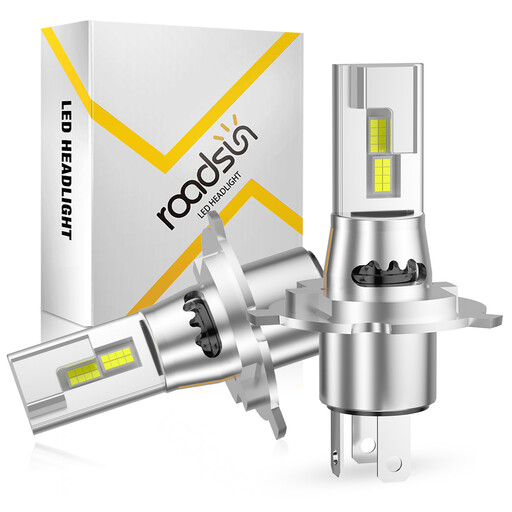
What makes it different: Roadsun is playing in the big leagues with this model focused on pure performance. The brand claims a brightness 500% greater than halogen, supported by an ultra-high-performance cooling system (16,000 RPM fan). Its slightly cooler 6500K colour temperature enhances contrast perception.
Key Features:
Who is it for? For car enthusiasts and the most demanding drivers who want zero compromise on lighting performance and long-term reliability.
If these three models don't perfectly match your vehicle or your expectations, don't worry. The choice of a bulb depends on many factors, starting with the exact model of your car or motorcycle.
Feel free to browse our complete category of low beam headlight bulbs to discover a much wider selection and find the perfect fit.
1. Is it complicated to replace an H4 halogen bulb with an LED? Not at all. The vast majority of current H4 LED kits are "plug-and-play." Installation simply involves unplugging the old bulb and clipping the new one in its place, with no modifications required. It's a matter of minutes, even for a beginner.
2. Is an error-free H4 LED bulb essential for my car? It all depends on your vehicle. Cars produced since the early 2000s, especially European models, almost all have a CANbus system. For these, a "CANbus ready" or "error-free" model is practically mandatory to avoid a dashboard warning light. For older vehicles, it's generally not necessary.
3. How can a single H4 LED bulb handle both low and high beams? That's the core principle of the H4 bulb. Originally, an H4 halogen bulb contains two separate filaments: one for the low beams and another for the high beams. An H4 LED bulb mimics this by using different sets of LED chips. Depending on whether you activate the low or high beams, one set or the other lights up, thus providing both functions with a single bulb.