
Livraison le jour même ou le lendemain

Qualité garantie

Débloquez vos offres de bienvenue: Livraison GRATUITE | Jusqu'à -80 % | 30 jours d'essai gratuits à JoyPlus
Téléchargez l'application
Driving at night or in bad weather with yellowish halogen headlights often leads to fatigue and a sense of insecurity. Visibility deteriorates, signs become blurry, and reaction time to obstacles decreases dangerously. If you want to upgrade your vehicle's lighting for a whiter, more powerful, and longer-lasting light, switching to an H4 LED bulb is undoubtedly the best solution.
As a product expert at Joybuy, my role is to guide you through the overwhelming number of options. This article gets straight to the point: practical advice to make the right choice and a selection of products that meet real-world needs, all without unnecessary marketing jargon.
Before you dive in, a few technical criteria should be checked to ensure compatibility and performance.
The main advantage of a good H4 LED conversion kit is its simple installation. Opt for models described as "?plug and play?". These bulbs are designed to connect directly to your vehicle's original connector, without any modification to the wiring or headlight housing. For your information, the H4 standard is also known as the 9003 bulb or HB2 bulb: these terms refer to the same dual-filament base for low and high beams.
On recent vehicles (generally post-2005), the presence of an error-free CANbus system is crucial. This small electronic module, either built into the bulb or its cable, prevents error messages from appearing on the dashboard and stops the headlights from flickering. These issues are common because the onboard computer interprets the low power consumption of LEDs as a bulb failure.
Performance isn't just about lumens. A good H4 LED bulb must, above all, produce a precise light beam that effectively illuminates the road without ever dazzling other drivers. A design that perfectly mimics the filament of a halogen bulb is key to achieving a sharp, well-defined beam.
Colour temperature is another essential point. A cool white light of 6000?K (Kelvins) is close to daylight. The result: contrasts and colour perception are improved, which significantly reduces eye strain on long night drives.
LEDs get hot! Good thermal management is therefore essential to ensure their longevity and stable performance. There are two main systems:
The choice between the two will depend on the bulb's power and, most importantly, the space available behind your headlight.
Here are three models that stand out for their design and performance, each meeting a specific need.
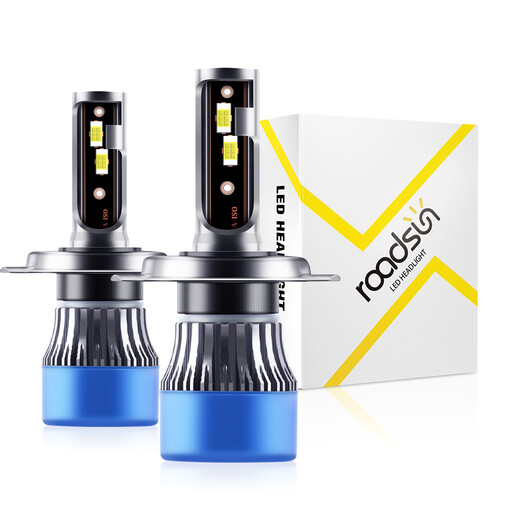
What sets it apart
This model is designed for those seeking the maximum brightness gain. According to the manufacturer, its LED chips provide a 6000?K cool white light that is up to 300% more intense than halogens. Its active cooling system, featuring a quiet, high-speed fan, ensures efficient heat dissipation—a key factor for maintaining stable performance over time.
Key features
Who is it for?
For drivers who prioritise maximum light output for perfect visibility on poorly lit roads and want a solution that is both high-performance and durable.
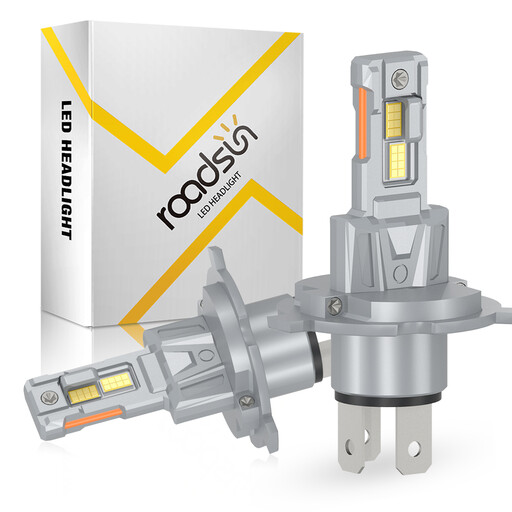
What sets it apart
This bulb takes a different approach with a fanless design. It relies on an aluminium alloy body to dissipate heat passively. The absence of moving parts makes it completely silent and eliminates the risk of mechanical failure, which can contribute to an even longer lifespan (stated at over 70,000 hours by Roadsun). Its very compact size is a real advantage for the tightest headlight housings.
Key features
Who is it for?
Ideal for those who want an ultra-reliable, completely silent, and long-lasting solution, or for installations where every millimetre counts.
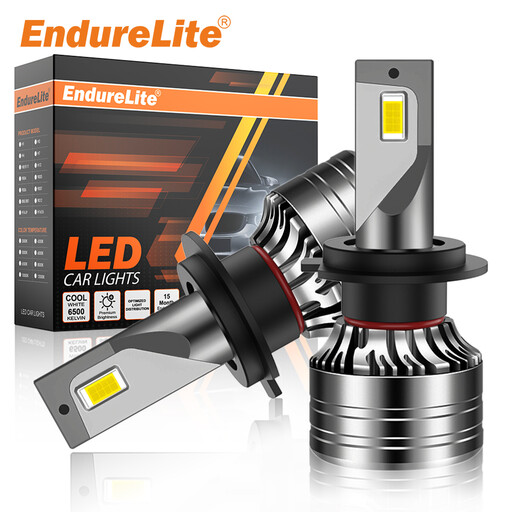
What sets it apart
The ENdureLite model focuses on a perfectly defined light beam. Thanks to a technology that replicates the size and spacing of a halogen bulb's filaments (1:1 design technology), it promises a focused light that maximises range without creating dark spots or dazzling oncoming drivers. The manufacturer claims a brightness of 20,000 lumens per pair and CANbus compatibility with 99% of vehicles.
Key features
Pour qui??
For drivers who are demanding about beam quality and want maximum lighting power while ensuring the safety of other road users.
Does your vehicle use a different type of bulb (H1, H7, H11, etc.)? Or do you simply want to explore more options? Many alternatives exist, with models suited to every need in terms of power, cooling, or budget.
? Discover our complete collection of ES Bulbs to find the perfect model for your vehicle.
French regulations regarding LED conversion kits are very strict. To be compliant for use on public roads, aftermarket LED bulbs must have ECE approval for the specific vehicle model on which they are installed. Without this approval, their use is theoretically restricted to closed circuits or private land. We advise you to always check the current legislation and the product's certifications before purchasing.
Technically, if your vehicle uses H4 bulbs, an H4 LED model will be physically compatible. However, electronic compatibility is another story. Modern vehicles equipped with a diagnostic system (onboard computer) can detect the low power consumption of LEDs and display an error code. That's why it's essential to choose models with a built-in error-free CANbus system.
The differences are major: