
Livraison le jour même ou le lendemain

Qualité garantie

Débloquez vos offres de bienvenue: Livraison GRATUITE | Jusqu'à -80 % | 30 jours d'essai gratuits à JoyPlus
Téléchargez l'application
Upgrading to LED lighting for your vehicle is undoubtedly one of the best decisions you can make to improve your safety and driving comfort. An H4 LED bulb promises a much whiter and more intense light than original halogens. The problem? The market is flooded with products featuring often misleading spec sheets. Our mission: to help you decipher the jargon and avoid the pitfalls to make the right choice.
Before you pull out your credit card, here are the three main pitfalls to avoid:
To avoid falling into these traps, forget the marketing hype and focus on these crucial technical points.
The quality of an H4 LED headlight depends less on its raw power (lumens) and more on the precision with which the light is projected. The goal of a good LED kit? To perfectly replicate the focal point and clean cutoff of the halogen beam.
Heat management is non-negotiable for the longevity of your bulbs. A controlled operating temperature ensures consistent brightness and preserves the components over the long term.
A good H4 LED kit should be simple to install.
Here are a few products that tick all the boxes, designed for different types of drivers.
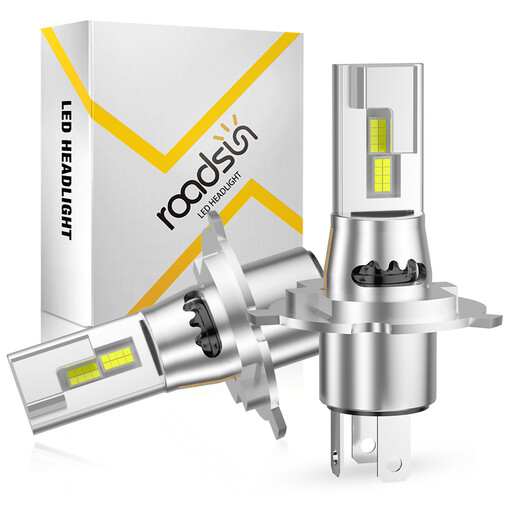
Why we chose it: Perfect for those seeking an immediate, hassle-free visibility boost for daily commutes. Its 1:1 design and "plug-and-play" installation ensure a quick setup with no modifications required.
Its 1:1 design, modelled after a halogen bulb, ensures a clean beam pattern, preventing glare. The 16,000 RPM fan efficiently dissipates heat, guaranteeing its longevity.
Ultra-fast installation without adapters, dual high/low beam function, and certified IP68 waterproof.
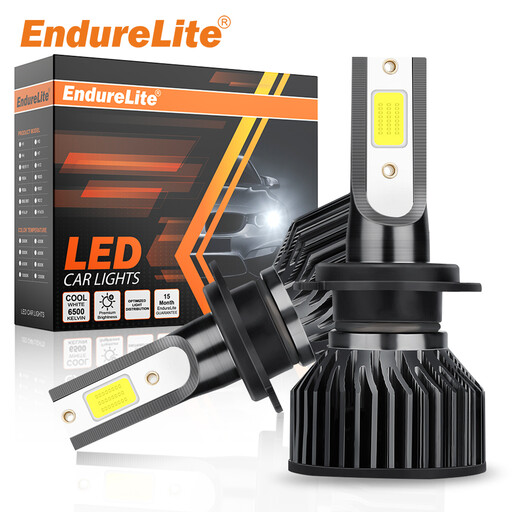
Why we chose it: For drivers who want a significant leap in brightness to better anticipate hazards, all while maintaining a perfectly controlled beam.
The halogen filament simulation technology guarantees a perfectly shaped beam with no dark spots. The integrated CAN bus system is designed for compatibility with 99% of vehicles, drastically reducing dashboard errors.
A precision beam pattern for maximum visibility without glare; a high-performance cooling system for rock-solid reliability.
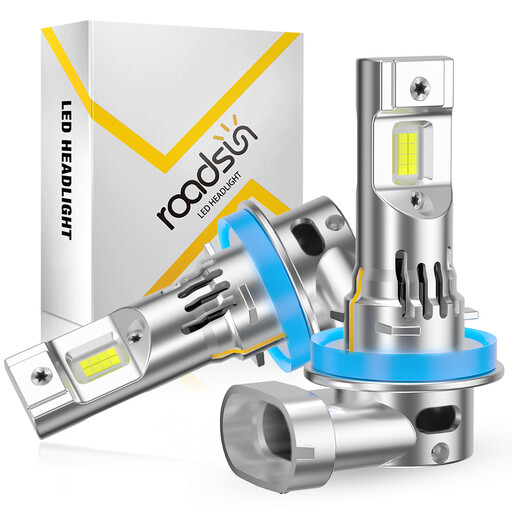
Why we chose it: This article focuses on H4, but we can't ignore fog lights, which often use H11/H9/H8 sockets. This model is an excellent example of a targeted upgrade for cutting through thick fog or seeing clearly when the weather turns bad.
Its compact size and non-polarised design make installation much easier, even in the tightest bumper housings. Active cooling ensures stable performance.
Specifically designed for headlights and fog lights (H11/H9/H8 socket), with an incredibly simple installation thanks to its 1:1 size and non-polarised design.
We have selected a full range of products for you that meet our strict quality criteria and current regulations.
Regulations on this are very strict. To be legal for public road use, replacement bulbs (known as "aftermarket" bulbs) must have a specific ECE approval, not just for the bulb, but also for the exact model of the headlight and vehicle. Most LED kits sold online are actually intended for "off-road" use only (on a track, private land, etc.). Before any purchase, it is therefore imperative to check that the kit is approved for your vehicle. Without this, you could be breaking the law and risk a fine, not to mention failing your vehicle inspection.
Yes, for most "plug-and-play" models, the process is as simple as changing a stock bulb. Their 1:1 design allows them to fit into the housing and connect to the existing socket without any modification. Be aware, however: on some cars, accessing the headlight can be a real challenge. A quick look at your vehicle's manual or a video tutorial before you start is never a bad idea.
Functionally, there is no difference. They are simply two names for the same bulb: H4 is the European designation (ECE), while 9003 (or HB2) is its American equivalent (SAE). They are therefore perfectly interchangeable. If you come across a 9003 LED bulb, an H4 LED model will work perfectly.