
Livraison le jour même ou le lendemain

Qualité garantie

Débloquez vos offres de bienvenue: Livraison GRATUITE | Jusqu'à -80 % | 30 jours d'essai gratuits à JoyPlus
Téléchargez l'application
Driving at night with dim lighting isn't just unpleasant: it's downright dangerous. Ageing or underpowered stock halogen headlights can drastically reduce your visibility and, consequently, your reaction time. Upgrading to an H4 LED bulb has become one of the most popular improvements for car and motorcycle owners looking to modernise their vehicles.
This guide is designed to shed light on the essential criteria to consider before making a purchase and to present our selection of the best models currently available, whether you're a weekend DIYer or a demanding driver. Our goal: to give you all the information you need to make an informed choice.
The market is flooded with so many options that it's easy to get lost. To ensure you make the right decision, here are the three crucial points to check.
Luminous output, often expressed in lumens, is an important indicator. However, be aware: a powerful H4 LED on paper doesn't guarantee good illumination on the road. What matters most is the bulb's design and its ability to mimic the beam pattern of an original halogen bulb. A poorly controlled beam not only risks dazzling other road users but can also create dangerous dark spots. Prioritise models where the size and position of the LED chips have been engineered to perfectly replicate the filament of a classic H4. This ensures you get a sharp cut-off line for H4 LED low beams and an effective range on high beams.
Replacing an H4 halogen bulb with an LED should be a breeze. So-called "plug-and-play" models with a 1:1 design (identical in size to halogen) are the top choice, as they can be installed without any modification to the headlight housing or wiring. Another technical point not to be underestimated is compatibility with your vehicle's on-board electronics. Most modern H4 LED kits include a driver or a CANbus system to prevent dashboard error messages and headlight flickering—a common bug on newer vehicles.
The lifespan of an LED bulb is directly linked to its ability to dissipate heat. Two main technologies compete:
The choice will depend on your priorities: the reliability and total silence of a passive system, or the raw performance of an active one.
We have selected a few models that stand out for their features and design, catering to different needs.
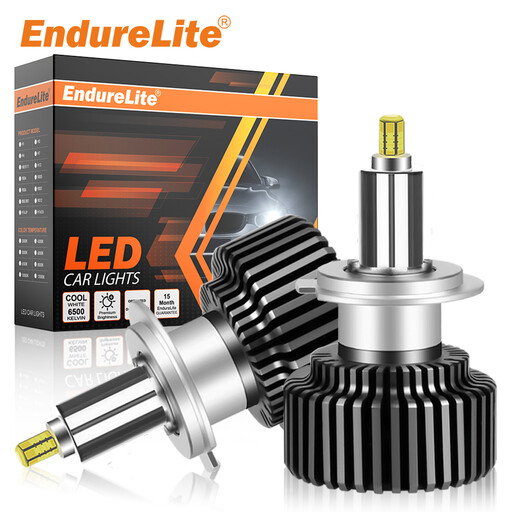
Why it stands out: This kit gets straight to the point: an ultra-simple installation and an immediate visibility boost. Its 1:1 design makes fitting it incredibly easy, even for beginners.
Advantages:
Who is it for? For those who want a simple and effective lighting upgrade, delivering a significant brightness increase with a hassle-free installation.
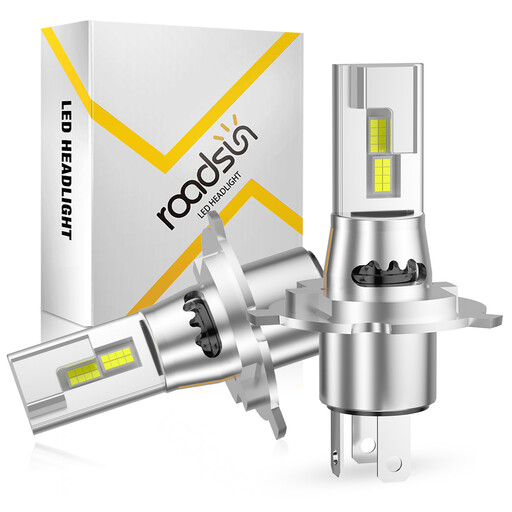
Why it stands out: This model from Roadsun is all about raw performance, with an advertised 500% brightness increase over halogen. Its active cooling system is also a major selling point.
Advantages:
Who is it for? For demanding drivers seeking maximum light output for perfect long-distance visibility, without sacrificing installation simplicity.
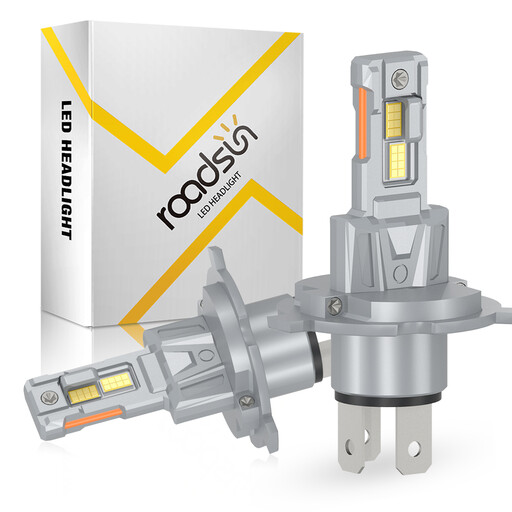
Why it stands out: Its key advantage: a fanless design. The result is completely silent operation and no risk of mechanical failure from a fan. It's the choice for long-term reliability.
Advantages:
Who is it for? The ideal choice for those who want a durable, completely silent, and "zero-hassle" solution, especially for vehicles subjected to harsh conditions (4x4s, utility vehicles) or for drivers who are averse to moving parts.
Not convinced by the models in our selection? Or simply want to explore other options? Our full catalogue is packed with alternatives. There you will find a wider choice of technologies and price points to equip your vehicle.
Discover our full range of exterior LED halogen bulb replacements
Legislation on this point is often strict and varies by region. To be street-legal, a lighting system must typically be certified (e.g., carry an ECE or DOT marking). However, most aftermarket LED kits do not have this specific certification for every vehicle model. In theory, their use may be restricted to off-road or private track use. It is crucial to check your local regulations and the product's specifications before you begin, especially if you plan on driving on public roads.
This is a real risk, but only with low-quality bulbs. A good H4 LED headlight isn't just about power, but precision. Well-designed models that respect the 1:1 format and the LED chip placement of a halogen bulb will maintain the original beam's sharp cut-off line. This ensures the light is projected where it's needed—on the road—without blinding oncoming drivers.
It all depends on the age of your vehicle. Older cars generally don't need one. However, modern models are equipped with an on-board computer (OBC) that constantly monitors the lighting circuit. Since an LED consumes much less power than a halogen, the OBC might interpret this as a burnt-out bulb and trigger a dashboard warning. Most modern H4 LED kits integrate a resistor or CANbus-ready system, but for the most sensitive vehicles, an external decoder may sometimes be necessary.