
Livraison le jour même ou le lendemain

Qualité garantie

Débloquez vos offres de bienvenue: Livraison GRATUITE | Jusqu'à -80 % | 30 jours d'essai gratuits à JoyPlus
Téléchargez l'application
Dust, pollen, cooking smoke, pet odours or PM2.5 fine particles: an air purifier can complement daily ventilation in a bedroom, living room or office. But you need to choose a device suited to the room size and your lifestyle.
The term H13 HEPA air purifier catches the eye, but it alone isn’t enough to compare models. Here are the criteria to examine, the pitfalls to avoid, and a selection of devices suited to different uses in the UK.
The H13 standard describes the filtration capability of an element under defined conditions. It doesn’t directly tell you how much air is actually treated in your room. A device with a very efficient filter but low airflow may refresh the air much more slowly in a large living area.
So you need to look at the whole system: filter type, CADR, stated coverage area and the actual volume of the room.
Manufacturers don’t always use the same methods to claim coverage of 20, 40 or 55 m². Ceiling height, how often windows are opened, room layout and the selected speed can all significantly affect results.
For a large open-plan room, it’s better to compare the CADR in m³/h with the volume of air to be treated. A closed 20 m² bedroom doesn’t have the same needs as a 40 m² living room open to a kitchen.
A HEPA filter mainly targets particles. For cooking smells, smoke or certain odorous compounds, look for an activated carbon filter. Its presence doesn’t guarantee all odours will disappear, though.
Noise level is just as important. A device marketed as quiet may be unobtrusive in night mode, but become noticeably louder at high speed. Check the stated noise levels for each mode rather than relying on the single highlighted value.
A multi-stage system is particularly practical for everyday use:
Product listings may claim filtration of up to 99.97% of particles at 0.3 microns. This figure corresponds to a stated characteristic for the filter or measured under specific conditions: it doesn’t guarantee the same result in every home. Even an air purifier designed for allergy sufferers doesn’t replace essential habits: regular maintenance, ventilation and reducing dust sources.
CADR, expressed in m³/h, indicates the purified airflow rate. The larger the room or the more exposed it is to particles, the more useful a higher flow rate can be.
To get your bearings, consider:
For an air purifier intended for a large room, a CADR of 450 to 550 m³/h offers a much greater flow reserve than a 150 m³/h model. That doesn’t mean you should always choose the most powerful one: power consumption, size and noise also need to fit into your daily life.
An air quality indicator or PM2.5 display can help you track changes after cooking, cleaning or opening windows. This sensor remains an indicator built into the device; it doesn’t constitute a regulatory measurement of indoor air quality.
Before placing an order, also check:
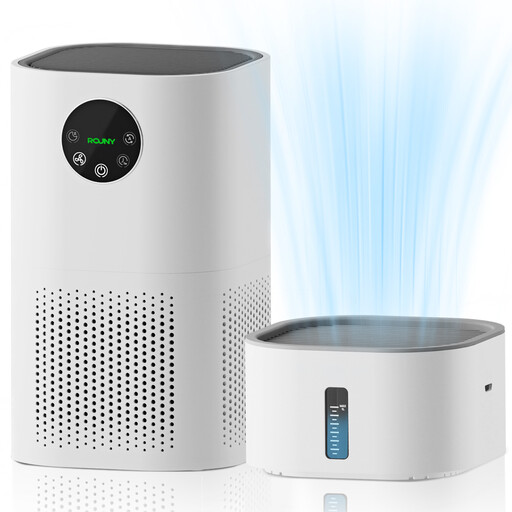
Why this choice suits this profile: Its 2-in-1 design appeals to those who want to combine air filtration and humidification in a bedroom or office, without cluttering the space with multiple devices.
The listing states a night mode at ≤25 dB, four speeds and timers of 2, 4 or 8 hours: you can avoid leaving it running at full power all the time.
Stated H13 filter, air quality display, CADR of 150 m³/h and stated coverage of 20 to 50 m².
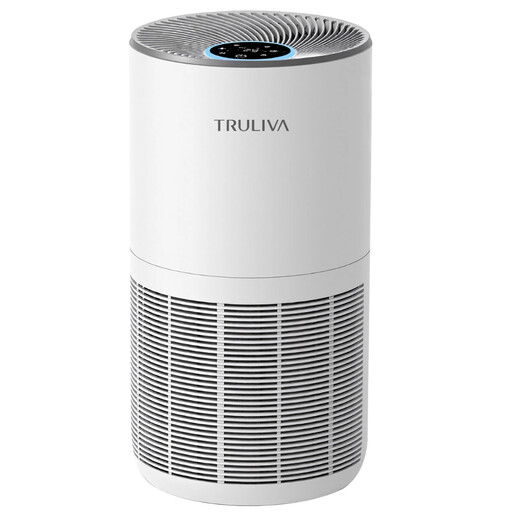
Why this choice suits this profile: This model suits users looking for a versatile device for a living room, family room or space occupied by pets.
Its stated CADR of 450 m³/h allows for a more concrete comparison of airflow, while the listing indicates a coverage of 32 to 55 m².
Pre-filter, H13 HEPA filter, activated carbon, 360° air intake, PM2.5 display, 24-hour timer and child lock.
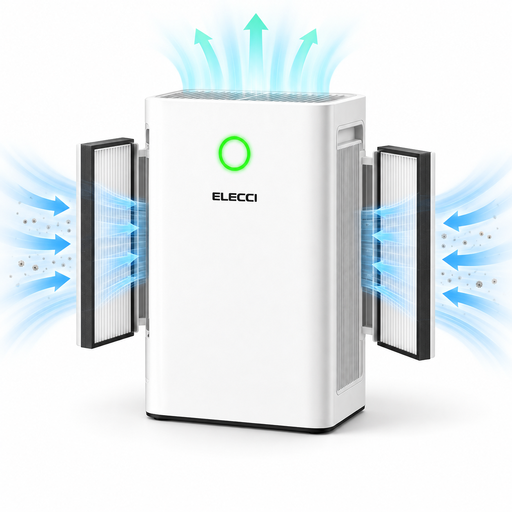
Why this choice suits this profile: Its stated airflow suits users who want sustained air circulation in a living room, workspace or room frequently exposed to dust and smoke.
The listing mentions a washable pre-filter, which simplifies routine maintenance. However, check the price and availability of the main filter before ordering.
Stated CADR of 550 m³/h, air quality indicator, 8-hour timer and night mode stated at 24 dB.
We’ve put together a comprehensive, real-time updated selection of products that meet these demanding criteria, while complying with European safety regulations.
Not necessarily. You can use it during periods when indoor pollution is highest, after cooking, or during the hours the room is occupied. A timer or automatic mode lets you adapt its operation. In a room heavily exposed to particles, a moderate speed maintained for longer can be more practical than a brief burst at full power.
It depends on usage, dust levels and whether you have pets or smokers. Some listings recommend replacement every 6 to 8 months, but the model’s manual remains the definitive guide. Only clean the parts designed for that purpose, and always unplug the device before any maintenance.
Power consumption depends on the wattage, the selected speed and the number of hours of use. To estimate it, multiply the power in kilowatts by the usage time, then by your electricity supplier’s rate. Also factor in the cost of replacement filters: this can be a bigger expense than electricity when the device runs at low speed.