
Livraison le jour même ou le lendemain

Qualité garantie

Débloquez vos offres de bienvenue: Livraison GRATUITE | Jusqu'à -80 % | 30 jours d'essai gratuits à JoyPlus
Téléchargez l'application
Upgrading to LED lighting is no longer a luxury, but an essential step for anyone looking to improve their safety and modernise their vehicle's look. Do your original halogen headlights feel dim on country roads or in rainy weather? You've come to the right place. Replacing your old bulbs with a modern H11 LED kit can completely transform your night driving experience.
The only problem? The market is flooded with options, and the technical specifications can be dizzying. Don't worry, this guide is here to cut through the noise and help you choose the perfect H11 LED bulb for your car, based on clear and objective criteria.
Before you jump on the first kit you see, let's review the key points that make all the difference.
The H11 base is one of the most common, and it's often compatible with H8 and H9 bases.
Visually, these three bases are nearly identical, and an H11 LED bulb can often be fitted into H8 and H9 sockets. The golden rule: always check your vehicle's manual to confirm the exact base type.
However, pay attention to the on-board electronics. Modern vehicles, through their OBC (On-Board Computer) error-free system, can detect the low power consumption of LEDs and mistake it for a burnt-out bulb, triggering a dashboard warning. Fortunately, modern "Canbus Ready" kits integrate a resistor to bypass this issue on most cars.
The power of an LED bulb is expressed in lumens (lm), which measure the total light output. But don't be blinded by the numbers: a very high lumen count doesn't guarantee effective lighting. The bulb's design is crucial for producing a precise beam pattern that illuminates the road where it's needed, without glaring other drivers.
Colour temperature, measured in kelvins (K), determines the hue of the light. The holy grail for many drivers is cool white 6000K. This daylight-like light offers a pure white output, striking contrast, and a decidedly modern look. Say goodbye to the yellowish, dated glow of halogens!
For DIY enthusiasts, ease of installation is a non-negotiable criterion. Prioritise "plug-and-play" models with a 1:1 design, meaning they are the same size as your original bulbs. This type of halogen replacement can be installed without any modification to the headlight housing or wiring.
When it comes to longevity, LEDs also outperform halogens. A quality LED bulb includes an efficient cooling system (fan, aluminium body) to dissipate heat and ensure tens of thousands of hours of reliable service.
Here are a few models that stand out for their design and performance, to guide you in your halogen replacement project.
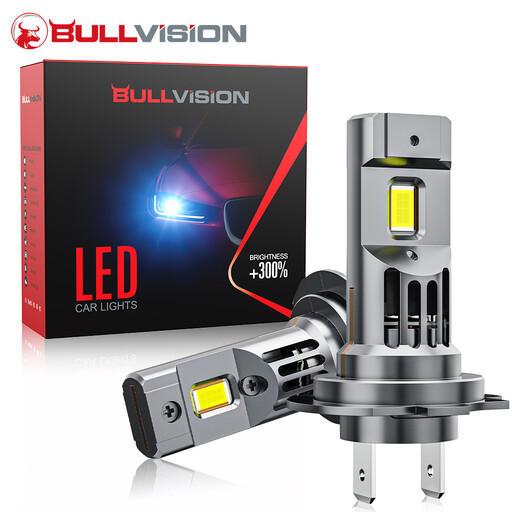
What sets it apart: This kit focuses on simplicity and efficiency. With its 1:1 design modelled after halogen bulbs, installation is a breeze.
Highlights:
Who is it for? The driver looking for a simple and reliable solution to upgrade to LED without the headache of adapters or modifications. An excellent choice for a first-time installation.
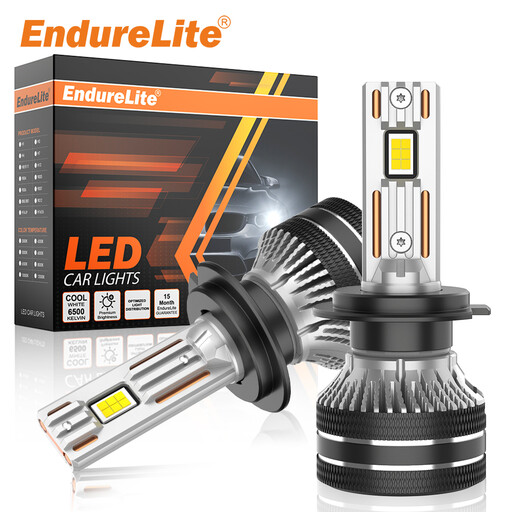
What sets it apart: Here, we step up in terms of power. With a claimed 20,000 lumens per pair, this kit is for those who want to see and be seen, without compromise.
Highlights:
Who is it for? The driver who clocks up miles on country roads or in difficult weather conditions, and for whom lighting power is the number one criterion.

What sets it apart: Note that this is a 9005/HB3 model (often for high beams), but it's an excellent example of a bulb designed for longevity, with a claimed lifespan of over 70,000 hours.
Highlights:
Who is it for? Drivers with 9005/HB3 fittings who are looking for a "fit and forget" solution that is ultra-durable and capable of withstanding heavy use.
Our selection highlights some top models, but the world of automotive lighting is vast. If you're looking for a different base, a different colour temperature, or just want to take a look at other technologies, explore our full category.
? Discover our wider range of cool white bulbs.
1. What is the difference between H8, H9, and H11 bulbs? Although their bases look similar, their use and wattage differ. The H11 is the standard for low beams (~55W). The H8, which is less powerful (~35W), is often used for fog lights. The H9, which is more powerful (~65W), is typically reserved for high beams. A good H11 LED kit is often designed to replace all three types, but checking your vehicle's manual is still essential.
2. Is an H11 LED kit difficult to install? For most "plug-and-play" models, installation is as simple as changing a standard bulb. You unplug the old one and connect the new one. Just remember to work with the engine off and the headlights cool. The only potential difficulty is accessing the bulb itself, which can be more or less straightforward depending on the vehicle.
3. Will my on-board computer show an error? This is a risk with modern cars. Because LEDs consume much less power, the on-board computer (OBC) might think a bulb has failed and display a warning. The solution? Most quality kits are "Canbus Ready" and include a built-in error-cancelling circuit. For the most sensitive vehicles (often German brands), an external Canbus decoder may be necessary.