
Livraison le jour même ou le lendemain

Qualité garantie

Débloquez vos offres de bienvenue: Livraison GRATUITE | Jusqu'à -80 % | 30 jours d'essai gratuits à JoyPlus
Téléchargez l'application
Seeing and being seen at the wheel is the cornerstone of safety. If the yellowish glow of your halogen headlights struggles to cut through the darkness, rain, or fog, you're not alone. Upgrading to an H11 LED bulb kit is now one of the most popular improvements for modernising a vehicle. And it's not just a cosmetic makeover for a whiter light?: it's above all a dramatic improvement in clarity and field of depth.
Faced with a jungle of part numbers and technical promises, it's hard to know where to start. As editorial experts, our mission is to clear the path for you. This guide gets straight to the point?: breaking down the criteria that truly matter and presenting a selection of tried-and-tested products suited for different uses and budgets.
Before taking the plunge, a few technical points deserve your attention. A good replacement for your halogen bulbs is about more than just the raw power displayed on the box.
Luminous output, expressed in lumens (lm), is often the first figure highlighted. The higher it is, the brighter the bulb shines. But be careful, an avalanche of lumens is useless if the light beam isn't perfectly controlled. The goal is to see better, not to blind oncoming drivers. The ideal is therefore a powerful car LED bulb, but with a precise and well-defined beam.
The colour temperature, measured in kelvins (K), determines the hue of the light. Around 6000K, you get a pure white light, very close to daylight. This shade is ideal for better distinguishing contrasts and colours, which significantly reduces eye strain on long night drives.
The H11 base is a standard, but it shares its shape with H8 and H9 bases. This is why many LED kits are marketed under the triple designation H8 LED bulb / H9 / H11, making them compatible with these three types of headlights.
One of the biggest advantages of a good H11 LED kit is its ease of installation. The best models are "plug-and-play"?: they replicate the exact dimensions of the original halogen bulbs, allowing for a direct fit without any modification to the headlight housing.
Another crucial point?: electronic compatibility. Modern cars are equipped with a monitoring system (the well-known CANbus) that checks if the bulbs are working correctly. Since an LED consumes much less power than a halogen, the onboard computer might think the bulb is burnt out and display an error message. To avoid this headache, opt for models certified as "CANbus Ready" or "error-free".
An LED's longevity is directly dependent on its heat management. Overheating guarantees a drop in performance and premature wear. Quality models incorporate an efficient cooling system, whether passive (aerospace-grade aluminium heatsink) or active (integrated mini-fan). Good cooling is the guarantee of consistent brightness and a lifespan that can exceed 50,000 hours.
After the theory, the practice. Here are the models that caught our attention, each meeting a specific need.
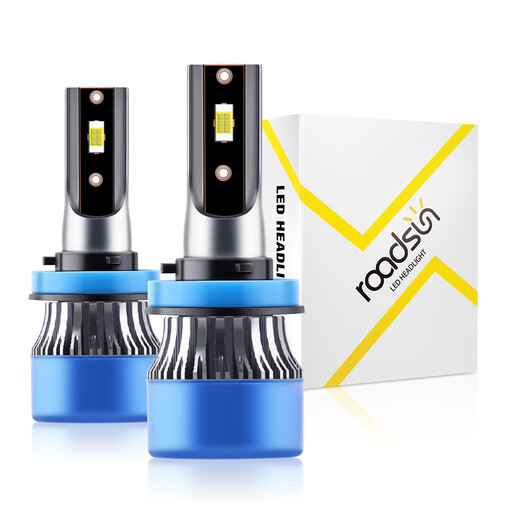
The Choice for Simplicity Roadsun makes its intentions clear?: up to 800% more brightness than a standard halogen bulb. Its real strength lies in its 1:1 design, which perfectly mimics the size of an original bulb. This makes installation a breeze, in pure and simple "plug-and-play" fashion. Ideal for those who want an immediate result without any hassle.
Key Features
Who is it for? For drivers who want to significantly boost the brightness of their LED fog lights or low beams, without worrying about a complex installation.
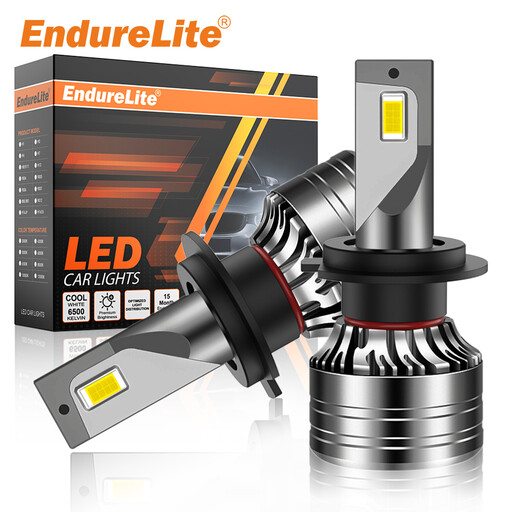
The Robust and Durable Solution This kit from ENdureLite focuses on durability and performance, even in the worst conditions. It features active cooling via a fan (10,000 RPM) and boasts an IP68 certification, a guarantee of perfect waterproofing and dustproofing. The manufacturer promises 300% more brightness and CANbus compatibility with 99% of vehicles on the road.
Key Features
Who is it for? For motorists seeking a reliable solution built to last, especially those who often face harsh weather conditions and want peace of mind for years to come.
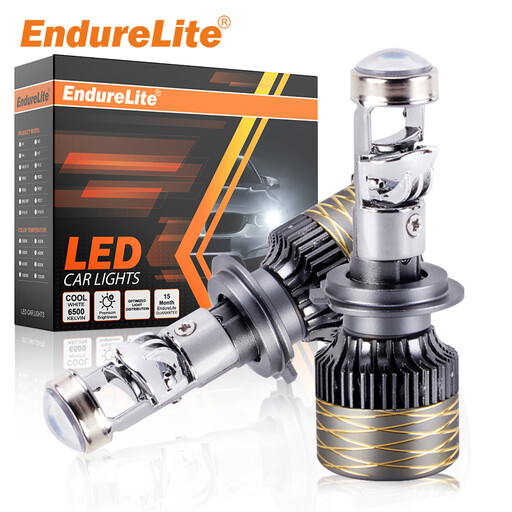
Maximum Power Here, ENdureLite caters to those who make no compromises on lighting power. With an impressive 20,000 lumens per pair and latest-generation CSP LED chips, this kit is designed to let you see farther and wider. Like the brand's previous model, it benefits from fan-based cooling and extensive CANbus compatibility.
Key Features
Who is it for? For automotive enthusiasts and frequent night drivers, for whom maximum light output means safety and better anticipation on the road.
The H11 base is just one facet of automotive lighting. If you need other types of bulbs, specific shades, or accessories, our complete catalogue will meet your needs.
? Discover our full range of automotive LED lighting
1. Can you really replace a halogen H11 bulb with an LED? Absolutely. It's actually one of the simplest and most popular upgrades. Most H11 LED bulb kits are designed to be "plug-and-play"?: they install in the original housing without any modification. The result?: much better brightness, a massively extended lifespan, and lower power consumption.
2. Are H8, H9, and H11 bulbs really interchangeable? Yes and no. Physically, the bases are nearly identical, which often allows them to be fitted in the same headlight. The difference lies in the original power and light output (in halogen, an H9 is brighter than an H11, which is brighter than an H8). This is why LED manufacturers offer a single product compatible with all three standards (H8 LED bulb, H9, and H11), which delivers a single, superior performance in all cases.
3. Do I need a CANbus adapter to install H11 LEDs? It all depends on your vehicle. Cars produced after 2007 (as a general rule) are equipped with an onboard computer (CANbus) which, upon detecting the low power consumption of an LED, may think there is a fault and display an error message. To work around this problem, simply choose "CANbus Ready" or "error-free" bulbs. They integrate a small module that simulates the consumption of a conventional bulb. Rest assured, most of the kits in our selection are equipped with this feature.