
Livraison le jour même ou le lendemain

Qualité garantie

Débloquez vos offres de bienvenue: Livraison GRATUITE | Jusqu'à -80 % | 30 jours d'essai gratuits à JoyPlus
Téléchargez l'application
Tired of the yellowish glow and limited range of your H1 halogen bulbs? Upgrading to LED technology is no longer a luxury, but a genuine investment in safety and comfort. A simple bulb change can transform your night-time driving, especially when the weather turns sour (rain, fog, etc.).
This guide breaks down the essential criteria and presents a selection of H1 LED kits that combine performance, reliability, and straightforward installation.
Before you make the switch, here are the key factors to check to ensure you make the right choice.
There are two numbers to remember: lumens (lm) for light intensity, and Kelvins (K) for the colour of the light. A powerful H1 LED ensures you see better, but be aware: the quality of its beam pattern is just as crucial to avoid dazzling other drivers.
The market benchmark? The 6000K H1 bulb, which emits a pure white light, very close to daylight. This xenon effect not only modernises your car's look but, more importantly, improves road visibility by enhancing contrasts and colours.
Installation is often the biggest deterrent. Fortunately, most modern LED kits are designed to be "plug and play." Replacing a halogen H1 bulb can be done in minutes, without any modifications. The secret? Look for "1:1 mini size" models, whose dimensions are an exact copy of the original bulbs. They fit effortlessly into your H1 LED headlight or H1 LED fog light housing, even in the tightest spaces. A model without an external driver is a major advantage for an even simpler connection.
An LED that overheats is an LED that wears out quickly. A good cooling system is therefore the key to its longevity. There are two main systems:
Effective thermal management can increase a bulb's lifespan to over 50,000 hours, literally dwarfing the mere 1,000 hours of a standard halogen.
We have selected three kits for you that stand out for their balance of performance, ease of installation, and reliability.
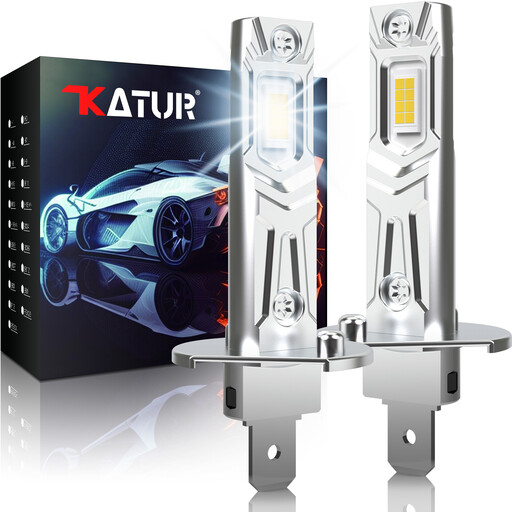
Key feature: An ultra-compact, fanless design. It's engineered for quick installation, even in headlight housings where every millimetre counts, especially around the dust cap.
Advantages:
Who is it for? For those who want the ultimate plug-and-play solution, especially if space behind the headlight is limited.
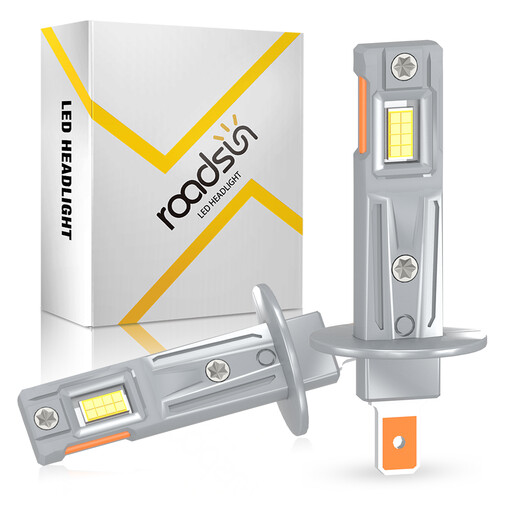
Key feature: Specially designed for harsh conditions, its powerful light cuts through harsh weather, making it an ideal candidate for an H1 LED fog light.
Advantages:
Who is it for? For drivers who regularly face fog, rain, or snow and for whom performance in extreme conditions is non-negotiable.
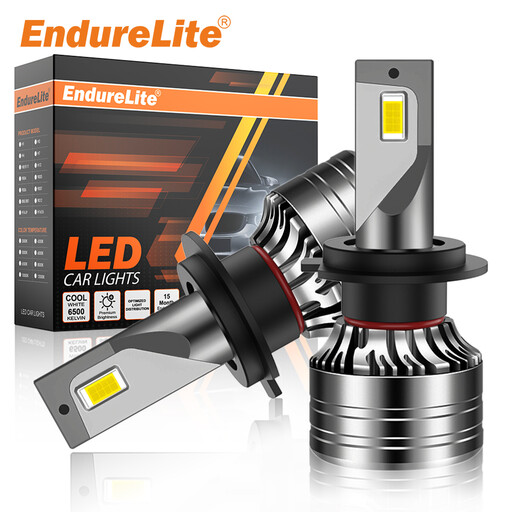
Key feature: This H1 LED kit is the best all-rounder. It combines power, durability, and compatibility, with active fan-based cooling that guarantees stable, long-term performance.
Advantages:
Who is it for? The sensible choice for those seeking a reliable and high-performing solution, with the peace of mind of broad compatibility and proven active cooling.
Our selection covers the most common needs, but the LED market is vast. To explore other power levels, light colours, or technologies, feel free to browse our full catalogue.
Explore our complete collection of Cool White LED Bulbs to find the model that perfectly matches your needs and your vehicle.
Not at all! The vast majority of modern H1 LED kits are "plug and play." The installation is as simple as unplugging the old bulb and clipping in the new one, without touching the wiring. Models with a 1:1 design make the process even easier.
Compatibility is excellent, but not yet universal. Two points to check are the space available in your headlight housing and the electronic compatibility (CANbus). To avoid error messages on the on-board computer of newer cars, many kits include a CANbus decoder. Be sure to check the compatibility rate listed on the product page.
Even though the H1 base is the same, their roles are fundamentally different. An H1 LED headlight (low beam) must illuminate far ahead, with a precise cut-off line to avoid blinding others. Conversely, an H1 LED fog light projects a wide, low beam to light up the sides of the road, just under the layer of fog. It is therefore crucial not to mix them up.