
Livraison le jour même ou le lendemain

Qualité garantie

Débloquez vos offres de bienvenue: Livraison GRATUITE | Jusqu'à -80 % | 30 jours d'essai gratuits à JoyPlus
Téléchargez l'application
Driving at night with stock halogen headlights is often a source of fatigue. Between the yellowish light and limited range, visibility of obstacles and road signs is reduced, making night-time journeys draining. Upgrading to LED lighting is therefore a popular solution for many drivers looking to improve safety and modernise their vehicle's appearance.
The only problem: the market is saturated with options and technical terms that can be confusing. Our goal is to arm you with clear information and concrete selection criteria to choose the perfect H1 LED bulb for your car, without getting lost in marketing jargon.
To ensure a successful purchase and a hassle-free installation, there are three key points to check before you commit.
A good modern H1 LED kit should, above all, be simple to install. Opt for "plug-and-play" models, designed with a 1:1 size ratio compared to a halogen bulb. This means the LED bulb has the exact same dimensions as the original model. It therefore fits directly into the headlight housing without any need to modify the housing or the dust cap. This is the number one criterion for a quick and easy H1 halogen bulb replacement that anyone can perform.
Modern vehicles, especially European ones, are equipped with an on-board diagnostic system (OBC) called CAN bus. This system monitors the proper functioning of electrical components, including the bulbs. Since an LED bulb consumes far less power than a halogen one, the on-board computer may interpret this as a fault (a burnt-out bulb) and display an error message. To prevent this, choose a CAN bus H1 LED. These bulbs integrate a resistor or decoder that simulates the power consumption of a standard bulb, ensuring compatibility with 98% to 99% of vehicles.
Two values should be considered when evaluating the performance of an H1 LED headlight bulb:
Here are three options that stand out for their design, performance, and compatibility.
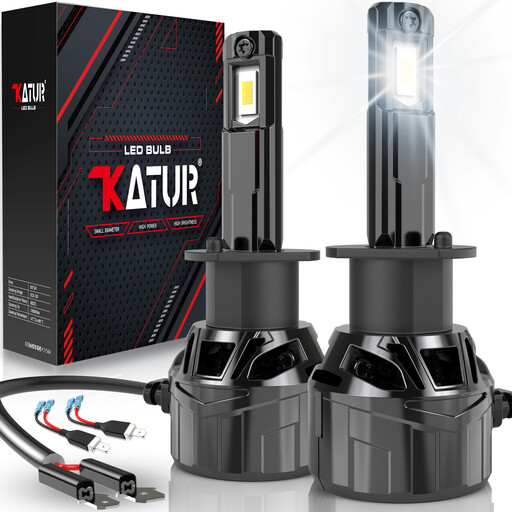
Why it stands out: This model is all about power: with 120W and 30,000 lumens per pair, it promises intense lighting for maximum visibility. Its 1:1 mini-size design ensures direct installation without modification, even in tight spaces.
Key features:
Who is it for? For drivers who are primarily looking for a powerful H1 LED to maximise visibility on poorly lit roads and who appreciate a quick and simple installation.
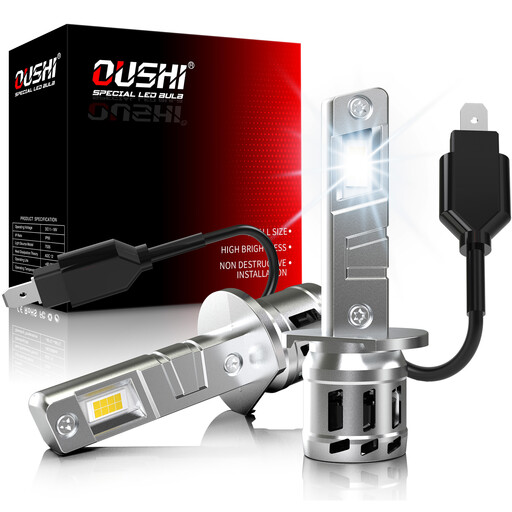
Why it stands out: OUSHI's strong point is its broad compatibility, designed especially for the most sensitive European vehicles. According to the brand, these bulbs offer 600% more brightness than halogens. The 6500K temperature produces a very crisp white light.
Key features:
Who is it for? Ideal for owners of European vehicles or models known to be sensitive to electrical modifications, who want a reliable and compatible solution without worrying about error messages.

Why it stands out: This model from KATUR offers an excellent compromise between performance and stability. With 100W and 30,000 lumens per pair, it provides powerful lighting. Its unique feature is its intelligent external driver, which helps regulate power for greater longevity and better CAN bus compatibility.
Key features:
Who is it for? For drivers seeking a high-performance, durable solution who aren't put off by the presence of a small external driver that needs to be housed near the headlight, which often ensures better stability.
Not convinced by our selection, or want to explore other technologies?
? Discover our full range of high-performance lighting, including Xenon bulbs.
Regulations regarding LED conversion kits are strict. To be used on public roads in France, bulbs must have ECE approval, which is rarely the case for aftermarket kits. In practice, many kits are sold for "off-road" or track use only. It is advisable to check the current regulations and the requirements for your vehicle's technical inspection before making any modifications.
Installing a "plug-and-play" kit is generally straightforward. It involves:
This is a risk on vehicles equipped with a CAN bus system. That's why it is highly recommended to choose a model explicitly marked as "CAN bus ready" or "error-free". These bulbs integrate a circuit that prevents the on-board computer from detecting an anomaly due to the LED's low power consumption. For some highly sensitive vehicles, an additional CAN bus decoder may sometimes be necessary.