
Livraison le jour même ou le lendemain

Qualité garantie

Débloquez vos offres de bienvenue: Livraison GRATUITE | Jusqu'à -80 % | 30 jours d'essai gratuits à JoyPlus
Téléchargez l'application
A guinea pig house with a ramp can turn a simple enclosure into a proper space for rest and exploration. But some models rely heavily on looks: multi-level castles, heaps of accessories, or panels described as modular. Before you place an order, it's worth checking that the structure really suits your pet's habits… and the space you have at home.
A ramp that is too steep, narrow or slippery can put a guinea pig off, especially if it's older, less agile, or used to moving around on a flat surface. Without enough grip, the risk of slipping also increases. So check:
The needs are not the same for a hamster or a mouse. A house designed for a hamster won't automatically suit a guinea pig.
A guinea pig hideout must let your pet enter, exit and turn around without difficulty. A single opening can also make it harder to escape when it feels threatened. Models with several access points make moving around easier and give your pet more options for finding shelter.
The wood should have carefully finished edges, with no splinters or protruding parts. Also think about cleaning: a very porous surface or a hard-to-reach roof can trap moisture and odours.
Before using an enclosure with a door or a mesh playpen for rabbits and guinea pigs, inspect its design carefully. The mesh must not let your pet put its head through or get a paw stuck. The door should stay securely closed, and the panels should keep their alignment when your pet pushes against them.
Outdoors, don't leave the structure unsupervised. Mesh doesn't necessarily protect against rain, cold, strong heat or predators.
The house needs to fit inside the enclosure without reducing the movement area too much. For a two-level model, measure the total height, the space under the platform, and the length your pet can actually access.
A product listed as Wooden Guinea Pig House… 38 x 25 x 18 cm gives dimensions of 38 × 25 × 18 cm. This helps you compare its footprint with your enclosure, but it doesn't replace checking the size of the openings and the usable surface area.
For a wooden guinea pig house, choose a construction with no sharp edges and, where the information is available, find out about any treatment or finish applied to the wood. Avoid surfaces that flake and any easily accessible parts your pet could chew.
A removable mat, a detachable ramp or an accessible roof makes cleaning much easier. Only use products suitable for animal surfaces and let the house dry completely before putting it back.
An indoor or outdoor enclosure should be set up on a stable, flat surface. For a play area for small pets, compare:
Versions with 12 or 24 panels don't meet the same needs. A large model isn't necessarily more practical in a flat, while a small playpen can restrict movement during daily use.
The products below are designed for different uses. The descriptions reflect the features shown on the product pages; always check the dimensions, materials and conditions of use before ordering.
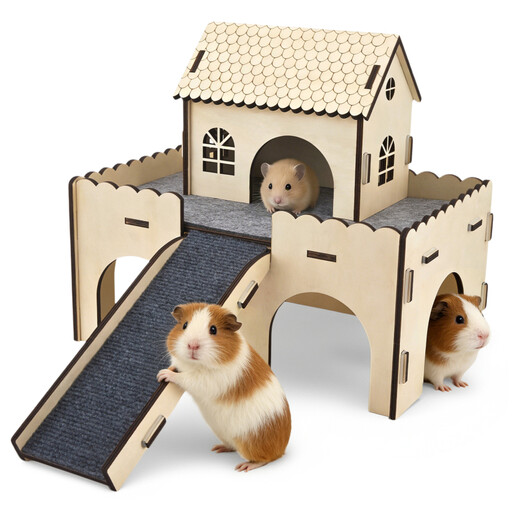
Why this suits this profile: Its two-level design combines a hiding space and a ramp. A good compromise for creating an activity area without adding lots of accessories.
The ramp and hiding area are clearly stated. So you can check these features before buying, rather than relying only on the photo.
Two levels, integrated ramp and concealed resting area; suitable for small pets, subject to confirming the dimensions on the product page.
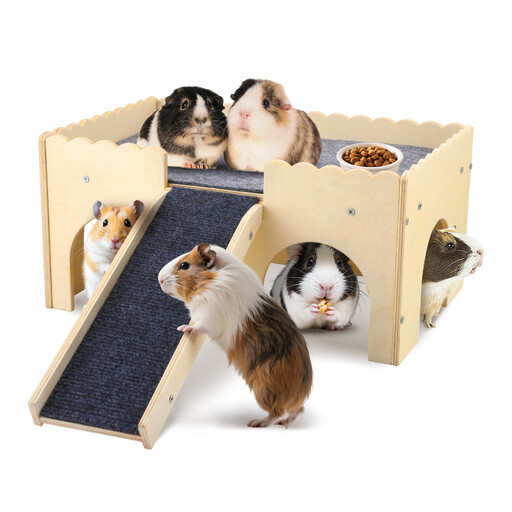
Why this suits this profile: This wooden castle combines a ramp, a removable ladder, a soft mat and four entrances. That means several routes in a well-designed resting space.
The four entrances reduce the risk of creating a dead-end hideout. The removable ladder also lets you adapt the layout based on how your pet uses it.
Stated dimensions of 38 × 25 × 18 cm, four openings, ramp and removable soft mat.
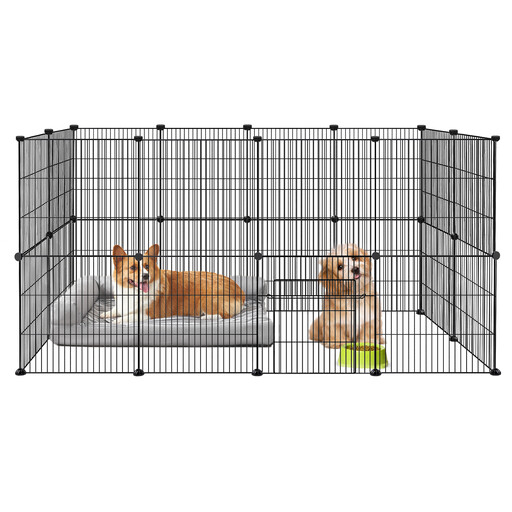
Why this suits this profile: Its 24 panels and door let you create a modular play area for several small pets or a more spacious set-up.
The door means you don't have to move a panel every time you need access. The many panels also let you adapt the shape of the playpen to the constraints of a room or a supervised outdoor space.
24 panels, dense mesh and integrated door; designed for indoor or supervised outdoor use.
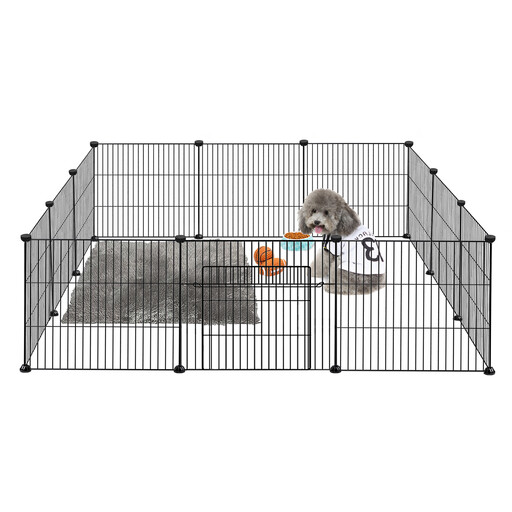
Why this suits this profile: This 12-panel version is ideal for anyone looking for a compact play area that's easy to fit into a living room or around a resting space.
The number of panels is clearly stated. So you can estimate the space needed before buying and avoid an oversized structure for your home.
12 panels, dense mesh and door; modular format for indoor or supervised outdoor use.
We've selected a complete, real-time updated list of products that meet these selection criteria and European safety requirements.
Place the small pet hideout in a quiet spot, away from draughts, radiators and direct sunlight. In a guinea pig enclosure, the house must not block access to water, hay or bedding.
For a set-up with a ramp:
A wooden house can wear out more quickly in a damp environment. Outdoors, provide a covered shelter and check the structure after every rainy spell. A play area doesn't replace supervision or a suitable resting space.
No. Your pet's size, age, agility and habits all play a part. A removable ramp lets you adapt the house, but a ground-level set-up will still be better for some guinea pigs.
It depends on the quality of construction, chewing, humidity and how often you clean it. Regularly check the edges, screws, wood surface and any soft parts. Replace the hideout as soon as any part becomes sharp, unstable or hard to clean.
The main ongoing costs are bedding, suitable cleaning products and, if needed, replacing a worn mat or accessory. A structure that's easy to take apart and wipe down can reduce cleaning time, but it doesn't replace regular checks.