
Livraison le jour même ou le lendemain

Qualité garantie

Débloquez vos offres de bienvenue: Livraison GRATUITE | Jusqu'à -80 % | 30 jours d'essai gratuits à JoyPlus
Téléchargez l'application
Changing or installing spotlights can quickly become a headache. Faced with a jungle of GU10 LED bulb options, it's easy to feel lost and end up with buyer's remorse. A pale, washed-out light in the living room, a beam that leaves dark spots, or a bulb that buzzes with your dimmer switch: these common frustrations are surprisingly easy to avoid.
As a product expert for Joybuy, my mission is to help you see things more clearly. Let's cut through the marketing jargon and get straight to the point: the criteria that truly matter for making the right choice. This guide breaks down the pitfalls to avoid and the features to check to find the perfect GU10 LED bulb for every room.
To avoid falling into the same traps, let's review the most common mistakes.
To stop choosing your spotlights blindly, here are the three technical points you absolutely must check.
Colour temperature defines the lighting's mood. It has nothing to do with the heat emitted by the bulb.
The beam angle determines the width of the area illuminated by your GU10 spot.
If your system is equipped with a dimmer switch, you absolutely must choose a dimmable GU10 bulb. This label guarantees that the light intensity can be adjusted without flickering or risking damage to the electronics. Always look for the logo or text on the packaging. While the GU10 base (a two-pin, twist-and-lock fitting) is standard, dimmer compatibility is not.
To put theory into practice, here is a selection of models that meet specific needs, applying the criteria we've just covered.
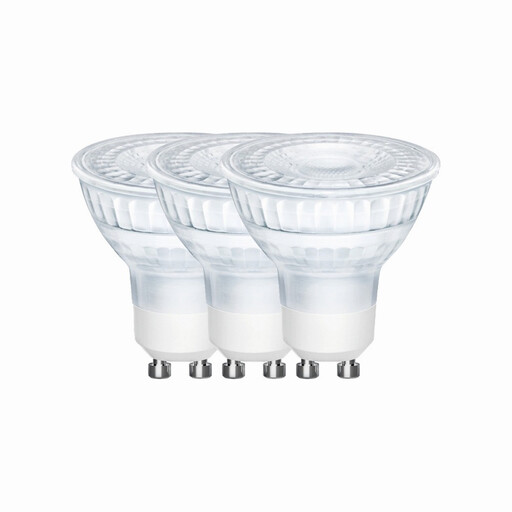
Why we chose it: Perfect for outfitting a living room or bedroom with warm, even light without breaking the bank, thanks to the GU10 bulb multi-pack format.
With its 2700 K temperature, it provides an authentic and cosy warm white ambience, far from the clinical effect of a poor colour choice.
Its three-pack format is highly economical. The 36° angle is an excellent compromise for recessed spotlights in most living areas.
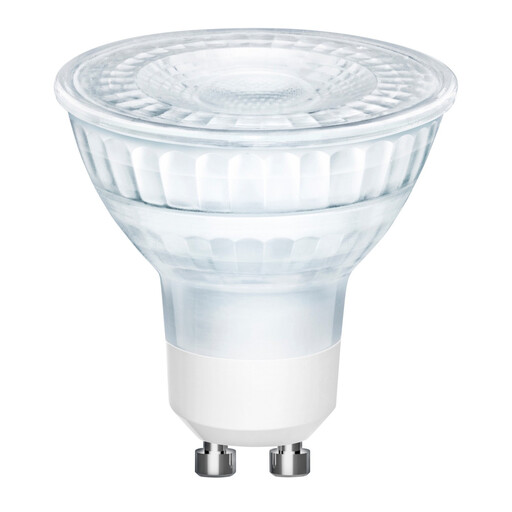
Why we chose it: Ideal for areas that demand clear, precise light: kitchen countertops, bathroom vanities, or home office corners.
Its 4000 K temperature offers a perfectly balanced neutral white. Visibility is optimal without resorting to the harsh, bluish light of a cool white bulb, which is often fatiguing for daily use.
Excellent colour rendering (CRI > 80) so it won't distort the appearance of food or makeup. A 36° beam provides targeted, high-performance lighting.
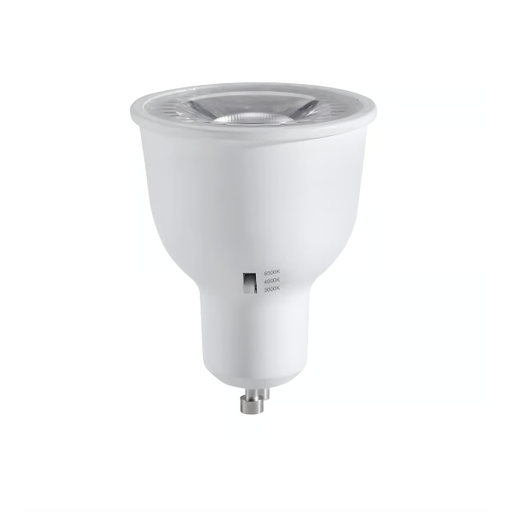
Why we chose it: The ultimate solution for the undecided or for multi-purpose rooms (like an office that doubles as a guest room). Switch from task lighting to a relaxing ambience with a simple flick of your existing switch.
It eliminates the risk of choosing the wrong colour temperature by integrating three options (3000 K, 4000 K, 6500 K) into a single bulb.
Unbeatable versatility. The colour temperature is changed by simply turning your existing wall switch off and on again quickly. No complex installation required.
Beyond GU10 spots, every project has its own unique requirements. Discover our other selections of lighting solutions, all tested for performance and reliability.
1. What is the lifespan of a GU10 LED bulb? A quality GU10 LED bulb has a lifespan of between 15,000 and 25,000 hours. In practical terms, this represents several years of normal use, making it a much more durable and cost-effective solution than old halogen bulbs.
2. How do I replace a GU10 base bulb? It's very simple. First, turn off the power at the circuit breaker. Once the bulb has cooled, gently push it upwards into its socket, then turn it a quarter-turn to the left (counter-clockwise) to release it. For the new one, align the two pins, insert, push, and turn a quarter-turn to the right until it clicks into place.
3. Does a GU10 LED bulb use a lot of energy? No, quite the opposite—that's their main advantage. A GU10 LED bulb consumes an average of 4 to 6 watts for an output equivalent to an old 50-watt halogen spot. That's nearly 90% in energy savings, a difference you'll see directly on your electricity bill.