
Livraison le jour même ou le lendemain

Qualité garantie

Débloquez vos offres de bienvenue: Livraison GRATUITE | Jusqu'à -80 % | 30 jours d'essai gratuits à JoyPlus
Téléchargez l'application
A growing tricycle for babies can accompany your child through several stages: first guided by a parent, it then helps them gradually gain independence. In photos, the models may look very similar. In reality, their features, adjustments and true versatility can vary enormously.
Before placing your order, take the time to avoid the most common pitfalls: a minimum age that does not take your child’s build into account, a parent handle that is awkward to use, or a product presented as adaptable when only a few accessories can be removed. Here are the criteria to consider when choosing a tricycle that is genuinely suited to your daily life.
A baby tricycle from 10 months will not necessarily suit every child of that age. Also check for a harness, footrest, sufficiently supportive seat and a system that allows the parent to steer the tricycle easily.
Conversely, a model advertised as suitable from 2 or 3 years old may be too large for a very young child, even if its adaptable design sounds appealing. Always check the minimum age, maximum permitted weight and seat dimensions.
A 3-in-1 or 4-in-1 tricycle may offer several configurations. They still need to be genuinely useful and easy to set up. In particular, check whether the pedals, handlebars, safety bar and parent push handle can be removed or disengaged.
A model with lots of features may also take up more space in the boot or at home. Weight, folding and ease of storage are at least as important as the list of accessories.
A sunshade, basket or padded seat is always useful, but the design needs to match how you intend to use the product. An adjustable canopy does not replace the usual precautions against the sun. Similarly, a tilting rear basket can carry toys, but certainly not a child.
The parking brake is particularly useful when placing your child in the tricycle, stopping near a kerb or taking a break.
When choosing a safe tricycle for a baby, look for at least:
The Smoby Baby Driver model is indicated as suitable from 10 months and states compliance with EN 1888-1, a standard associated with safety requirements for pushchairs. This should be considered a declared product characteristic: it does not remove the need to follow the instructions and maximum weight limit, or to supervise your child at all times.
A growing tricycle with an adjustable seat should accommodate your child’s growth without forcing them into an uncomfortable position. Two seat positions may be sufficient for use from 10 months to over 3 years, provided your child’s build matches the manufacturer’s guidance.
The height of the parent push handle also deserves your attention. An adjustable handle reaching 95 or 98 cm may suit several adults, but make sure the steering remains intuitive and that the handle does not make storage more difficult.
EVA wheels, often described as puncture-proof, reduce the risk of punctures and require little maintenance. However, they do not turn the tricycle into an all-terrain vehicle: particularly uneven pavements, gravel and slopes require extra care.
A metal frame can provide greater robustness, while a plastic ride-on will generally be lighter and easier to handle at home. In both cases, regularly check the screws, locking systems and condition of the wheels.
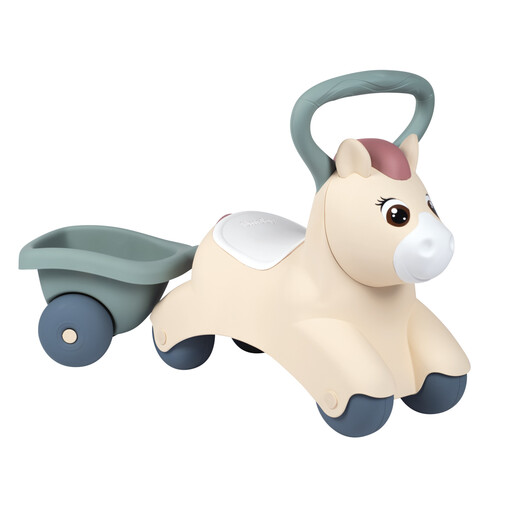
Why this choice suits this profile : This ride-on is suitable for first adventures from 12 months, both at home and in a calm outdoor space. Its deliberately simple design means you do not pay for features your child does not yet need.
It is not presented as a tricycle for outings: its role is clearly that of a ride-on designed for early balance and movement practice.
Wide handle, removable trailer, made in France and battery-free operation.
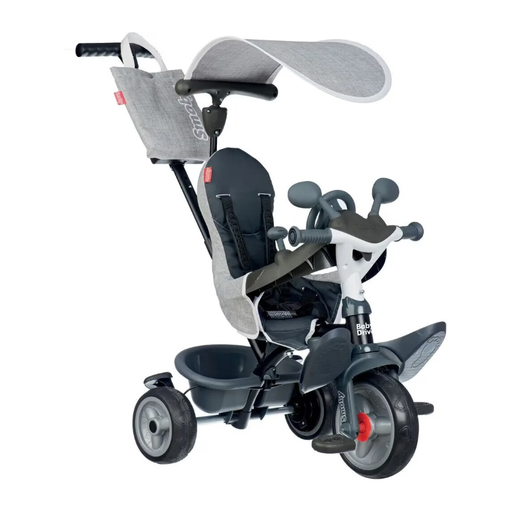
Why this choice suits this profile : It is designed for families who want a complete set-up for outings, with a gradual transition from parental steering to independent pedalling.
Its development is based on three clearly defined stages: parent-steered pushchair mode, assisted pedalling and then independent use.
Three-level adjustable handle reaching 98 cm, parking brake, seat adjustable to two positions, adjustable UV-protective canopy and washable cover.
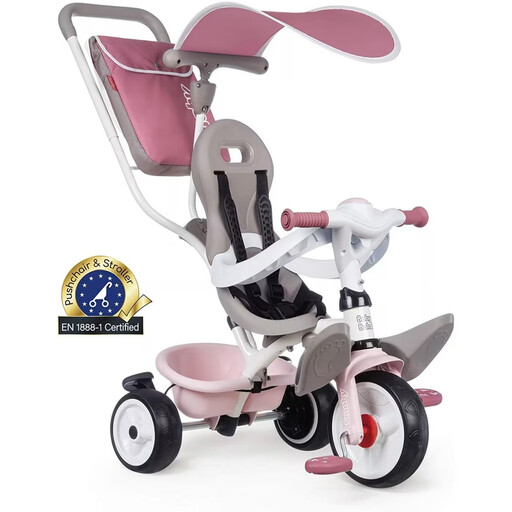
Why this choice suits this profile : This model is suitable for regular trips to the park, garden or on routes where the parent needs to maintain precise control of the direction.
A freewheel front wheel, handlebar lock and removable parent push handle let you adjust the level of control at every stage.
Harness, safety bar, parking brake, quiet EVA wheels, adjustable canopy and seat adjustable to two positions.
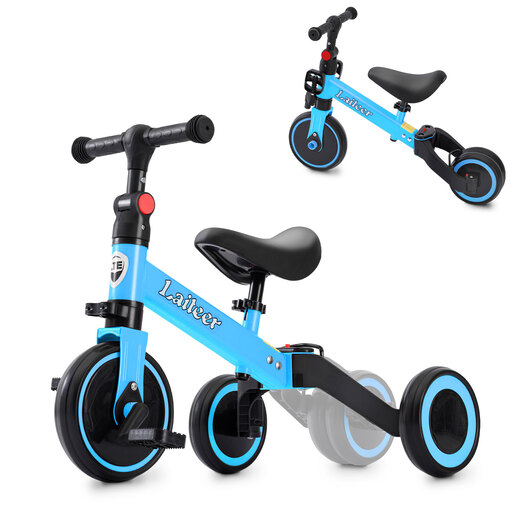
Why this choice suits this profile : It is designed for children aged 2 to 5 who are gradually moving from a tricycle to a balance bike and need a model that is easy to transport.
The removable pedals and adjustable seat make the change of configuration genuinely practical, rather than merely promised in the product listing.
Seat adjustable from 15.7 to 18.5 inches, puncture-resistant EVA wheels, carbon steel frame and foldable design.
We have put together a complete, real-time-updated list of products that meet these strict selection criteria as well as European safety regulations.
For a scooter, check the maximum supported weight, handlebar height and stability of the three wheels. The Smoby Iron Man model, for example, is indicated as suitable from 3 years old. It has handlebars adjustable up to 67 cm, a non-slip footboard and a stated maximum load of 20 kg. It must not be used on public roads.
Choose a model specifically indicated as suitable from 10 months, equipped with a harness, footrest, supportive seat, parental control system and parking brake. Your child must be supervised constantly and secured in accordance with the instructions.
It depends on your child’s build, the maximum permitted weight and the quality of the adjustments. Models advertised for use from 10 months to over 3 years can support several stages, but they will not necessarily replace a balance bike or scooter once your child starts nursery school.
Yes. Before every outing, check that the screws are tight, the handlebars lock correctly, the harness is secure, the wheels are in good condition and the brake works properly. Clean the frame with a damp cloth and store the tricycle indoors when it is not in use.