
Livraison le jour même ou le lendemain

Qualité garantie

Débloquez vos offres de bienvenue: Livraison GRATUITE | Jusqu'à -80 % | 30 jours d'essai gratuits à JoyPlus
Téléchargez l'application
Children’s gross motor skills toys are appealing thanks to their bright colours, educational value and ability to evolve as children grow. But a product that looks attractive on paper can quickly become bulky, difficult to clean or unsuitable for the child’s age. At home, in a nursery or at pre-school, three common pitfalls regularly arise.
The first concerns true stability. A structure that slips on a smooth floor or whose components do not fit together properly limits play opportunities and fails to reassure adults. The second relates to maintenance: covers that cannot be removed, foam that retains odours or surfaces that are difficult to disinfect can make everyday use a chore. Finally, some pieces of equipment combine several functions without taking into account the space available, the child’s weight or the level of supervision required.
Here are the key points to check before choosing a Montessori climbing frame, foam gross motor skills blocks or an indoor gross motor skills course.
The manufacturer’s recommended age is a good starting point, but it does not replace observing your child. A children’s climbing toy indicated as suitable from age 3 may be perfectly suitable for a child who is already confident walking and climbing, while still requiring close supervision for a beginner.
Also remember to check the maximum load. The wooden model featured here supports up to 50 kg per component, while the electric ride-on excavator has a stated maximum load of 30 kg. This information helps you assess how long the equipment is likely to remain suitable and avoid choosing a model with overly limited capacity.
In a nursery or classroom, the number of children likely to use the toy should also be taken into account, even if activities are generally organised in turns.
A wooden Montessori climbing frame should have smooth surfaces, securely attached handles and edges without rough areas. The Costway wooden set combines solid beech wood and plywood, with side ramps and handles described as stable. Its foldable design makes it easy to store against a wall.
For foam gross motor skills blocks, examine the material density, whether there is a non-slip base and how the pieces are connected. According to their product listing, BanaSuper models use high-density foam, hook-and-loop strips and concealed fastenings. As the foam is vacuum-packed, it may take 24 to 48 hours to fully regain its volume.
The EN71 designation refers to a series of European toy safety standards covering mechanical and physical properties, flammability and the migration of certain elements. It should be considered alongside the recommended age, assembly instructions and the manufacturer’s warnings. A product listing that mentions EN71-1, EN71-2 and EN71-3 is a useful indication, but parents should still check the condition of the toy before every use.
For regular use, it is best to choose a removable, washable cover. BanaSuper sets are advertised with removable, machine-washable covers: a genuine advantage at home, with a childminder or in a group setting.
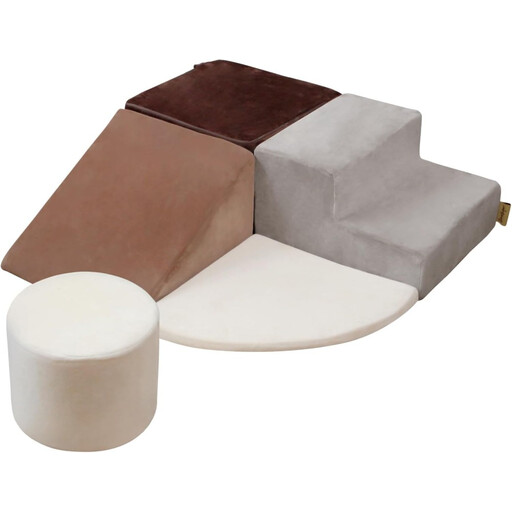
Why this choice suits this profile : This five-piece set lets you create a first modular indoor gross motor skills course, without permanent assembly or a large wooden structure.
The hook-and-loop fasteners and textured base on some pieces help limit slipping when the blocks are assembled. The removable covers also make maintenance easier.
Five blocks, high-density foam, washable covers and EN71 compliance stated on the product listing.
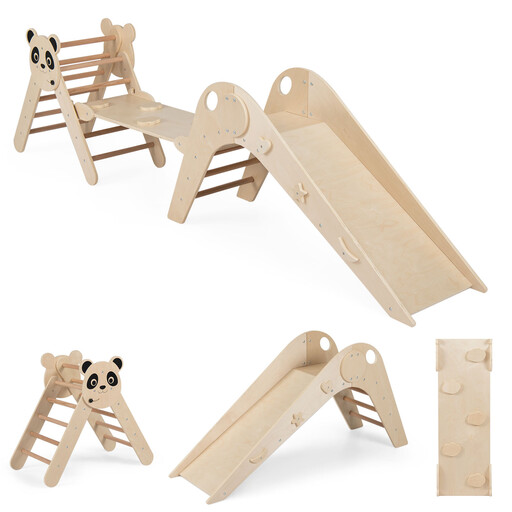
Why this choice suits this profile : This wooden solution combines a climbing triangle, slide, tunnel and balance bridge for families looking for durable, versatile equipment.
Once play is over, the foldable design lets you quickly free up the room. The description also mentions smooth edges and side ramps.
Beech wood and plywood, transformable components, stated capacity of 50 kg per component and upright storage.
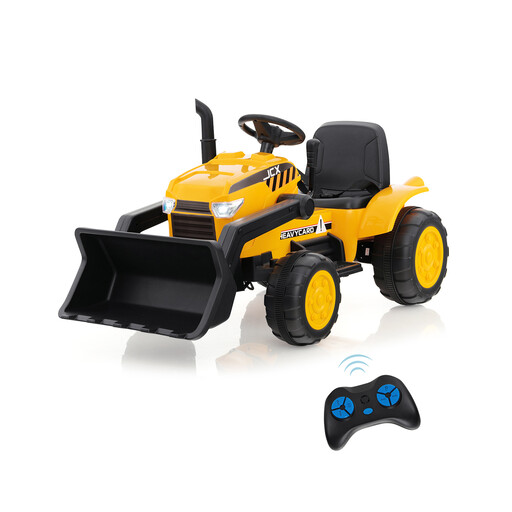
Why this choice suits this profile : This electric ride-on excavator is designed for children aged 3 to 8 who prefer moving around, imaginative play and handling objects.
The stated speed of 2.5 to 3.5 km/h, gradual start, emergency brake and remote control reserved for adults provide practical ways to maintain control.
Adjustable bucket, forward and reverse gears, seat belt, four non-slip wheels and a stated load capacity of up to 30 kg.
We have put together a comprehensive, real-time selection of products that meet these demanding criteria and European safety standards.
Before the first play session, clear enough space around the toy and move furniture with sharp corners out of the way. A suitable mat can improve comfort, but it never replaces adult supervision. With a wooden structure, regularly inspect the screws, handles and folding mechanisms. For foam blocks, wait until they have fully regained their shape after unpacking and check that the hook-and-loop strips adhere properly.
In group settings, organise a rotation of activities and clean the equipment in line with the manufacturer’s recommendations. Foam construction toys make it easy to refresh the courses: tunnel, slope, step or small balance area. This modularity encourages free play and imagination, without imposing a fixed layout.
A Montessori toy for 3-year-olds should suit the child’s abilities and offer gradually increasing difficulty. A foldable triangle with a ramp may suit a child who enjoys climbing. Soft blocks, meanwhile, can be rearranged more easily and used with close supervision.
It depends on the density of the foam, frequency of use, supported weight and maintenance. Washable covers help keep the play area clean, but any piece that has become misshapen or torn, or whose non-slip base no longer works properly, should be replaced.
No. Compliance with EN71, when stated by the manufacturer, does not eliminate the risks associated with a fall, incorrect installation or unsuitable use. Follow the recommended age, maximum load and assembly instructions, then always adapt your supervision to the child’s behaviour.