
Livraison le jour même ou le lendemain

Qualité garantie

Débloquez vos offres de bienvenue: Livraison GRATUITE | Jusqu'à -80 % | 30 jours d'essai gratuits à JoyPlus
Téléchargez l'application
Grooming our four-legged companions is an essential part of their care, but it often turns into an all-out battle against the pet hair that takes over the house. A dog and cat grooming vacuum kit is a game-changer, sucking up hair directly at the source. However, not all devices are created equal. As a Product Recommendation Manager at Joybuy, my mission is to guide you through this jungle of options to find the device that's truly right for you and, most importantly, help you avoid any unpleasant surprises.
The market is full of promises, but some devices have hidden flaws that only become apparent with use. Here are the red flags to watch out for to ensure you don't regret your purchase.
To be sure of your future device's performance and longevity, here are the three fundamental parameters you shouldn't overlook.
These two criteria are inseparable. Good power is necessary for an effective anti-hair vacuum, but it shouldn't come at the expense of your pet's well-being.
A good kit should adapt to different needs: daily brushing, seasonal shedding, and clipping. Make sure the kit includes at least:
The practical, everyday details make all the difference. A large-capacity dust cup (over 1.5 L) will save you from having to empty it every five minutes. Also, ensure that the bin and filters are easy to remove and clean. Some models, like the homerunPET HC15, offer replacement filters, a real bonus for maintaining the device's performance over time.
To illustrate these criteria in action, here is a selection of models suited to different needs.

Why it's a great choice: Ideal for those looking for a truly comprehensive solution. The integrated dryer function is a real asset after a bath, and the large 2.5 L bin is perfect for large dogs or multi-pet households.
It bypasses the trap of limited accessories by offering a 7-in-1 solution, including a drying function that eliminates the need to buy a separate device.
11,000 Pa suction power, large 2.5 L collection bin, and 3 temperature settings for drying.
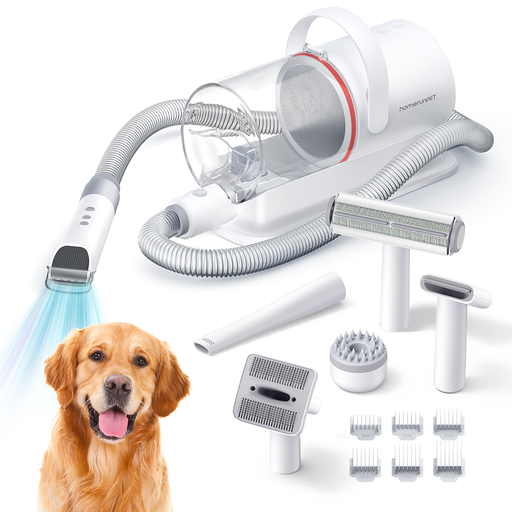
Why it's a great choice: Designed for owners of dogs or cats that shed heavily (like Golden Retrievers, German Shepherds, Maine Coons). Its high suction power is specifically engineered to handle large volumes of hair without losing power.
It directly addresses the pitfall of overstated power by delivering a true 12,000 Pa of suction, one of the highest in its class, ensuring effective capture of even the densest undercoats.
Powerful suction, a large 1.85 L bin, and a set of 6 brushes and clipper heads for maximum versatility.
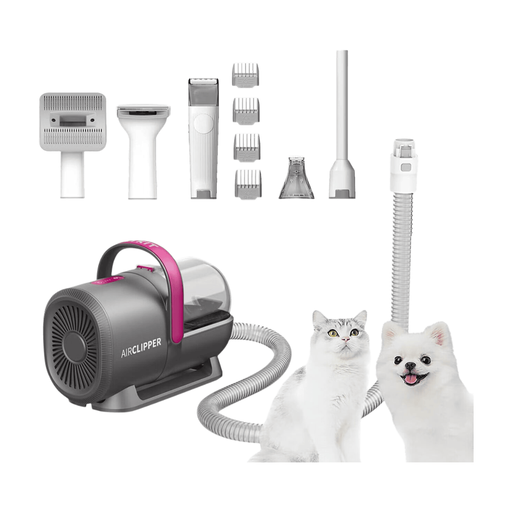
Why it's a great choice: Perfect for owners of skittish cats or small dogs. The focus is on a calming grooming experience, with a controlled noise level and a cordless clipper for greater freedom of movement.
It tackles the "false quiet" pitfall by guaranteeing a noise level of under 60 dB, which is truly reassuring for the most sensitive pets. The detachable cordless clipper also avoids the stress associated with a cord.
Very quiet operation, cordless clipper for enhanced manoeuvrability, and a set of 5 essential accessories for a complete grooming session.
Browse our full selection of grooming kits, all tested and approved according to our strict criteria.
It all depends on how often you use it and the amount of hair vacuumed. As a general rule, it's a good idea to check the filter after each session and clean it if necessary. A replacement is recommended every 3 to 6 months to ensure optimal suction power. Replacement packs, like the filter for the homerunPET HC15 kit, are available to make maintenance easy.
Absolutely. It's actually the ideal solution for clipping without turning your living room into a fur-covered battlefield. For clippers for long-haired cats, opt for a quiet model (under 65 dB) to avoid frightening them. Our tip: gradually acclimate your cat to the sound of the device, first while it's off, then on a low power setting, before you start clipping. Using the right guide comb is essential to avoid cutting the hair too short.
A noise level below 65 dB is generally considered comfortable for most pets. Some particularly discreet models go below 60 dB, which is equivalent to a quiet conversation. If you have an anxious companion, this criterion should be your number one priority.