
Livraison le jour même ou le lendemain

Qualité garantie

Débloquez vos offres de bienvenue: Livraison GRATUITE | Jusqu'à -80 % | 30 jours d'essai gratuits à JoyPlus
Téléchargez l'application
A grid notebook can be used for taking notes, sketching diagrams, working out calculations or keeping a travel journal. Yet two seemingly similar models can feel very different in practice. Size, ruling type, paper weight and binding all have a direct impact on readability, durability and writing comfort.
Before you place an order, it’s worth avoiding three common mistakes:
The small-square notebook, usually with a 5 × 5 mm grid, is ideal for calculations, tables, graphs, plans and structured note-taking. This grid also allows you to write in multiple directions, giving you more freedom than a standard ruled page.
Very common in French schools, Seyès ruling combines horizontal and vertical lines in a precise grid. It supports handwriting practice and remains the standard for many homework assignments, exercises and school tasks.
For professional, creative or university use, an A5 grid notebook offers a good balance between writing space and portability. If you need to draw plans, large tables or detailed diagrams, an A4 or 24 × 32 cm format will be more comfortable.
Expressed in g/m², the paper weight gives an indication of density, but it alone isn’t enough to judge quality. Paper of 70 to 80 g/m² generally works well with pen and pencil. At 90 g/m², the surface feels sturdier and is more pleasant for daily notes, diagrams and some felt-tip pens.
Product listings may also mention acid-free paper, neutral pH, recycled paper or PEFC certification. These details are worth paying attention to if you want to keep your notes for a long time, prevent yellowing, or choose paper made from sustainably managed forests.
Stapling is still common on standard school notebooks and keeps the whole thing lightweight. Spiral binding, on the other hand, makes it easy to lay flat and allows you to fold pages back for faster writing. However, it can be less practical in a small bag or with a ring binder.
A sewn or fully bound spine opens comfortably on both sides. A hard cover protects the contents better during travel, while a polypropylene cover is more resistant to moisture and scuffs. Also check the number of sheets, whether there are micro-perforations, a pocket or a bookmark.
The right choice really depends on what you plan to do with it. A student will probably want a compact notebook for taking notes, a teacher a structured support for preparing lessons, while a creative user will prefer a clear surface for drawing or sketching. For organising appointments and tasks, a school diary will meet a different need from a grid notebook.

Why this choice suits this profile: The A7 format slips easily into a pocket or small bag. The four notebooks let you separate lists, ideas, lessons or work tasks.
The pack saves you from buying several notebooks separately. The spiral binding, with top opening, makes one-handed writing easy.
Pack of 4, A7 format, grid paper, soft cover and matching colour palette.
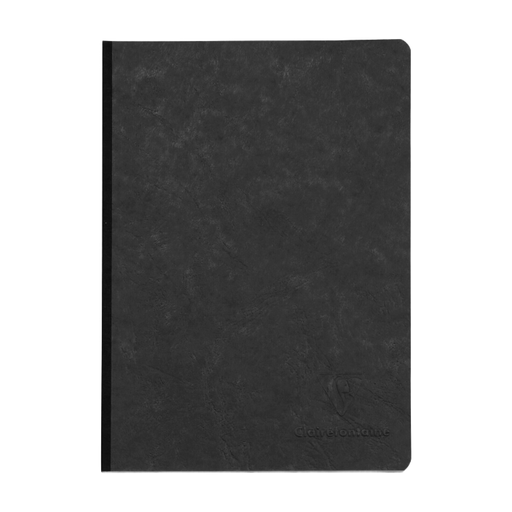
Why this choice suits this profile: This A5 grid notebook combines a portable size with 192 pages of Clairefontaine Vélin Velouté 90 g/m² paper. It works just as well at the office as on the go or at home.
The 5 × 5 mm grid is clearly stated, and the lay-flat binding minimises discomfort at the centre of the notebook while taking notes.
A5 format, 192 pages, 90 g/m² paper, colour-through cover and made in France.
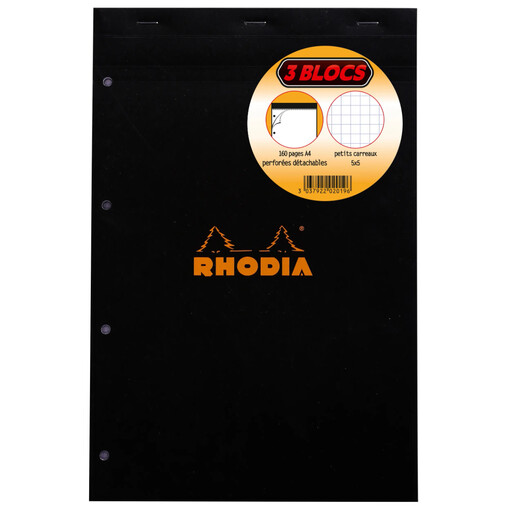
Why this choice suits this profile: The large format gives you all the space you need for plans, tables, technical diagrams and detailed notes.
The pack of three pads means you always have one to hand, while the micro-perforated sheets tear out cleanly when you need to file or share them.
Pack of 3, 5 × 5 mm ruling, A4+ format, card back and 80 micro-perforated sheets per pad.
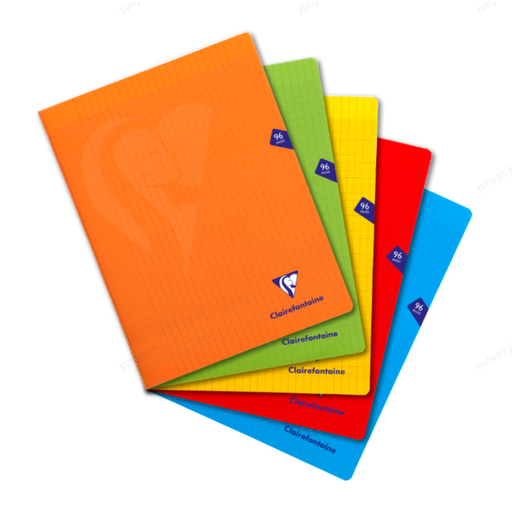
Why this choice suits this profile: This pack covers the needs of several subjects and saves you from having to buy notebooks separately throughout the school year.
The polypropylene cover protects the notebooks from splashes, and the matching colours make it easy to identify each subject quickly.
Five notebooks of 96 pages each, three-colour Seyès ruling, 90 g/m² paper, PEFC certification and made in France.
We’ve put together a complete selection, updated in real time, of products that meet these exacting criteria as well as European safety regulations.
The A5 format is ideal for personal notes, meetings and travel. For a schoolchild, a 17 × 22 cm notebook is easy to carry. For homework, tables and graphs, A4 or 24 × 32 cm formats offer a more generous surface.
Small squares form a regular grid, usually 5 × 5 mm, suitable for calculations and diagrams. Seyès ruling uses the line system found in French schools, with specific line spacing and a margin designed to guide and structure handwriting.
Keep it away from moisture and avoid squashing it in an overloaded bag. A hard cover protects the pages better, while a polypropylene cover can be wiped clean with a slightly damp cloth. If the notebook is spiral-bound, try not to twist the binding repeatedly.