Shoppers looking to keep their salt intake low
You want to compare the ingredients list with the ‘salt’ value, rather than assume that a tin of green beans is low in salt just because it looks simple.


If you want to cut down on salt, compare the ‘salt’ value per 100 g and the ingredients for each tin or frozen pack, rather than relying on the claim on the front of the pack alone. If you’re managing your weight, also consider the portion you serve and the nutritional values, along with any oil, sauces and side dishes added to the meal.
You want to compare the ingredients list with the ‘salt’ value, rather than assume that a tin of green beans is low in salt just because it looks simple.
You use green beans as a base or side and consider the amount served, the nutritional values and what you add during preparation.
You’re choosing between a small, ready-to-use tin and a frozen pack you can take the amount you need from, to help avoid leftovers.
Start by checking the salt per 100 g and the ingredients of the specific product. Then compare the energy, the portion you plan to serve and the format that suits your needs. ‘No added salt’ on its own doesn’t tell you what the prepared meal will contain.
| Criteria | What to check | Who is it for? |
|---|---|---|
| Salt | Compare the ‘salt’ value per 100 g and check whether salt is listed among the ingredients, even if the product title says ‘no added salt’. | When my main aim is to cut down on salt, I want to distinguish the declared value from a claim on the front of the pack; this would be the main concern for around 45% of shoppers. |
| Portion and preparation | Check the energy per 100 g, the amount actually served and any fat or sauces added. | When putting my meal together, the portion of beans alone doesn’t tell me what I’ll eat once the dressing has been added; around 33% of shoppers would prioritise the meal as a whole. |
| Format | Compare the drained weight of a tin with the number of useful portions, or consider how much you can take from a frozen pack. | If I’m cooking for a small number of people, I prefer a format that helps avoid leftovers that are difficult to use; format would be the priority for around 22% of shoppers. |
Values vary between products: E.Leclerc lists 0.0 g of salt per 100 g for Notre Jardin and Carrefour lists 0.02 g per 100 g for Jardin Bio Étic, while the Bonduelle tin reviewed lists 0.58 g per 100 g.
For the product you’re buying, compare the ‘salt’ value per 100 g with its ingredients list.
An Auchan listing titled ‘no added salt’ for a d’aucy jar also includes sea salt in the ingredients and lists 0.46 g of salt per 100 g. So the title alone isn’t enough to make a decision.
If the title, ingredients and nutritional information don’t match, check the packaging or ask the manufacturer to confirm before choosing this jar for its salt content.
The nutritional values for plain green beans don’t include any oil, butter, sauces or other foods served with them.
Decide how much seasoning to use and taste the beans before adding salt, especially if the tin already contains some.
An organic, no-added-salt jar with a drained weight of 345 g, listed by Carrefour and Auchan.
A tin of extra-fine cut green beans in a 225 g size.
The extra-fine frozen product and extra-fine tinned product reviewed have different declared compositions.
The extra-fine tin reviewed is available in a 440 g net drained size.
These green bean formats are worth considering if you’re comparing options to keep in the freezer. Check the ingredients and the ‘salt’ value for each variety, especially if you’re looking for plain green beans.
 Image unavailable
A frozen format to consider if you want to take out a portion before cooking. For this 750 g product, Bonduelle lists 0.01 g of salt and 32 kcal per 100 g. If you’re cutting down on salt, also consider any salt you might add to the cooking water.
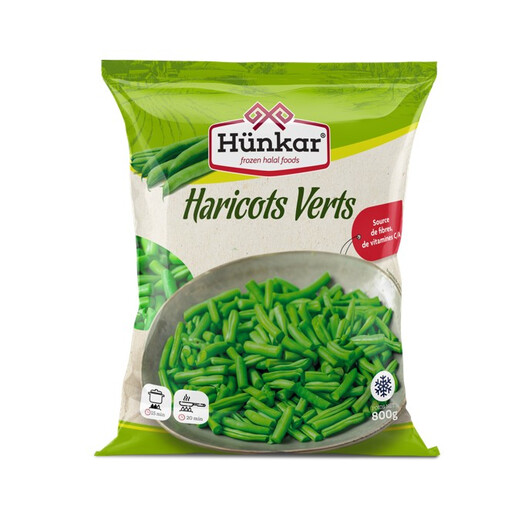 Image unavailable
This 800 g format could suit you if you’re planning to use it over several meals. Before choosing it to cut down on salt, compare its nutritional information and ingredients on the packaging, along with the preparation instructions.
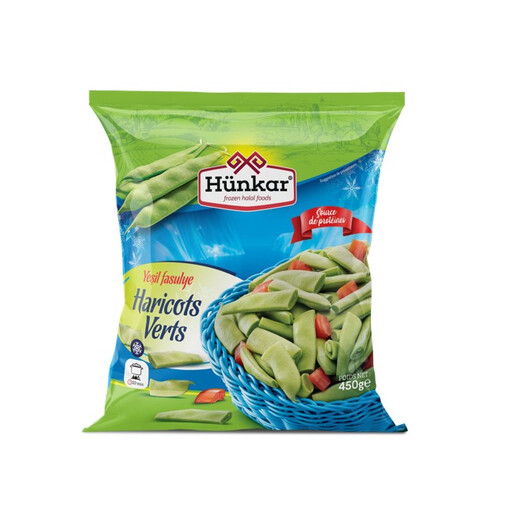 Image unavailable
The 450 g format may be more suitable if you want to prepare a smaller amount. This variety also contains 7% tomatoes, so it isn’t suitable if you’re looking for plain green beans. Check the ingredients, ‘salt’ value and preparation instructions on the packaging too.
No. It doesn’t replace checking the ingredients and the ‘salt’ value per 100 g for the specific product. The E.Leclerc and Carrefour listings show 0.0 g for Notre Jardin and 0.02 g for Jardin Bio Étic respectively, while a Bonduelle tin containing salt lists 0.58 g per 100 g.
Consider the portion you serve and the nutritional values, then check what else is added to the meal. Plain green beans don’t tell you how much oil, butter or sauce is used in preparation.
Taste them before adding salt and, depending on the recipe, use herbs, spices or aromatics. Manger Bouger recommends not automatically adding extra salt to tinned foods.
Follow the storage instructions on the packaging for your specific product. For the Bonduelle tin reviewed, the brand advises storing it at a maximum of 4 °C and eating it within 48 hours of opening. With a frozen pack, you can take out the amount you need without opening a tin.