Shoppers keeping an eye on sugars and salt
You want to choose a side dish whose ingredients and sugars and salt values per 100 g you can compare.


For a pancake night side, check the ingredients and the “of which sugars” and “salt” figures for the specific product, rather than relying on the “no added sugars” claim alone. A ready-cooked tin makes serving easier; a frozen bag works if you have freezer space and can cook it before serving. Compare the usable weight and nutritional values for each product.
You want to choose a side dish whose ingredients and sugars and salt values per 100 g you can compare.
You need to work out how much to serve and choose between tinned green beans that need draining and a frozen bag that needs cooking.
You’re looking for extra-fine beans or a product with a stated origin, without assuming these features apply to the whole range.
For a pancake night side, start with the ingredients and nutritional values, then choose a format that suits the number of guests and the time you have to prepare it.
| Criteria | What to check | Who it matters to |
|---|---|---|
| Sugars and ingredients | Compare the “of which sugars” figure per 100 g and the ingredients list. According to Anses, “no added sugars” does not mean that a product contains no sugars. | If I’m looking to keep track of the sugars in this side dish, I want to know the declared value for the product I’m buying. Around 42% of shoppers might put this need first. |
| Format and preparation | Check the drained net weight of a tin, or whether you have freezer space and can follow the cooking instructions for a frozen bag. | When I’m preparing several plates, I need a suitable quantity and a preparation method that fits the time available; this would be the priority for around 33% of shoppers. |
| Size and origin | Look for “extra-fine” and origin details on the specific product; a feature advertised for one product doesn’t apply to the whole brand. | I prioritise size or a stated origin before choosing between formats. Around 25% of shoppers might put these features first. |
As Anses points out, ingredients can contain naturally occurring sugars even when no sugar has been added.
Check the claim, ingredients and “of which sugars” value per 100 g on the same product. Don’t treat “reduced sugars” and “no added sugars” as equivalent claims.
The Notre Jardin tin listed by E.Leclerc contains 0.0 g of salt per 100 g, while the extra-fine tin described by Auchan contains salt and lists 0.41 g per 100 g.
If salt also matters to you, compare its value and the ingredients on each product you’re considering.
The liquid in the tin isn’t part of the green bean serving. For the product consulted, Auchan lists a drained net weight of 220 g.
When planning how much you’ll need for the evening, compare the drained net weight of the tins.
The product details for Bonduelle’s 750 g bag state that it should be stored at −18 °C, cooked from frozen and not refrozen after thawing.
Choose this format if you can transport and store it as directed, and cook it before serving.
Bonduelle offers extra-fine green beans in both tinned and frozen formats.
Carrefour offers extra-fine green beans in tins, as well as pre-steamed products in bags.
E.Leclerc lists a 225 g Notre Jardin tin labelled “extra-fine green beans with no added sugars or salt”.
Auchan lists a tin of extra-fine green beans with a drained net weight of 220 g.
Aldi offers Fleurs des Champs extra-fine green beans in a jar.
These products offer a range of green bean formats to consider as a side for pancake night. Compare their ingredients and preparation instructions on the packaging: their inclusion here is not a claim that they contain less sugar.
 Image unavailable
If you want a side that doesn’t need cooking as you would for frozen vegetables, check the preparation instructions for this product. Also compare its “of which sugars” and “salt” values with those of the other products you’re considering.
 Image unavailable
This frozen bag could work if you have freezer space and plan to cook the beans before the meal. The product details list 1.7 g of sugars per 100 g, storage at −18 °C and cooking from frozen; do not refreeze after thawing.
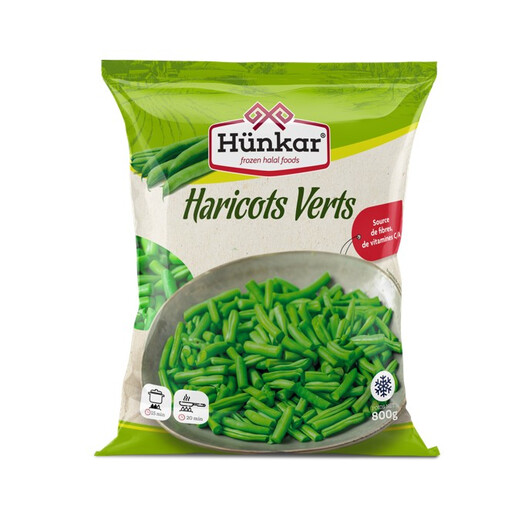 Image unavailable
If you’re considering this 800 g format for several plates, check the packaging for storage conditions and cooking instructions. Also check the sugars and salt values per 100 g before comparing it with other products.
 Image unavailable
Consider this product with onions if you’d prefer a seasoned side rather than plain green beans. Check the ingredients, sugars and salt values, and drained weight on the packaging you buy.
No. According to Anses, ingredients can contain naturally occurring sugars even when no sugar has been added. When comparing green beans, also check the “of which sugars” value per 100 g.
Yes. E.Leclerc lists a 225 g tin under the Notre Jardin brand with this claim. Its product details list green beans and water, as well as 0.8 g of sugars and 0.0 g of salt per 100 g; check availability and the label on the product you buy.
The product details for Auchan’s extra-fine tin say to drain and rinse the beans in cold water before serving them cold or reheating them. Follow the instructions on the packaging you choose, and plan portions using the drained net weight.
Plan to store them at −18 °C and cook them from frozen, as stated in the product details for this Bonduelle bag. Do not refreeze after thawing, and check the packaging for the cooking method and time.