Organisers who want to control the salt themselves
When cooking for a group, you may want to decide on the final seasoning yourself. Compare the ingredients and the ‘salt’ value per 100 g for the product you choose.


If you want to control the salt in a meal for a group, compare the ‘salt’ value per 100 g and the ingredients for each product, rather than relying on the brand or the word ‘natural’. A tin labelled ‘no added salt’ may be suitable if the information on the label checks out. For a standard tin containing salt, adjust the recipe’s seasoning accordingly. Frozen beans are another option, provided you can maintain the cold chain.
When cooking for a group, you may want to decide on the final seasoning yourself. Compare the ingredients and the ‘salt’ value per 100 g for the product you choose.
When serving a group, compare the net weight, the drained weight where stated, and the number of packs you’ll need. Check the salt content separately for each pack size.
If you can keep the food frozen until you’re ready to prepare it, frozen green beans are another option to compare with jars and tins.
For a festival meal, first decide how important control over salt is for your recipe. Then check the quantities and storage conditions your event set-up can accommodate.
Worth considering: if you want to season the meal yourself and the ingredients and ‘salt’ value confirm that the exact product is right for you.
Plan ahead: the Jardin Bio Étic and Notre Jardin products shown by Carrefour and E.Leclerc respectively come in 345 g and 225 g packs, so work out how many you’ll need.
Worth considering: if this product’s ingredients suit your recipe and you can take them into account when seasoning.
Bear in mind: the 440 g Notre Jardin tin shown by E.Leclerc lists salt among its ingredients. Its larger pack size does not make it equivalent to the brand’s no-added-salt product.
Worth considering: if you can arrange frozen storage and preparation at the event venue.
Practical consideration: you’ll need to plan for chilled transport and storage until preparation, unlike with a jar or tin that can be stored unopened.
| What matters | What to check | Shoppers concerned |
|---|---|---|
| Controlling salt | The ‘salt’ value per 100 g and whether salt is listed among the ingredients of the exact product. | I want to season the green beans myself when serving them with other dishes. Controlling salt would be the main priority for around 40% of shoppers concerned. |
| Quantity to serve | The stated net or drained weight and the number of packs needed for the portions planned. | I need enough to serve everyone without using more packaging than necessary. Around 30% of shoppers would prioritise planning portions first. |
| Storage | Storage conditions before use and the facilities available at the venue. | If the venue cannot keep food frozen, I need to choose a pack that suits the planned storage. This would be the main priority for around 20% of shoppers. |
| Origin or production | The origin and label shown on the exact product; check the salt content separately. | I want the menu to meet a particular origin or production requirement, without confusing it with salt content. This would be the main priority for around 10% of shoppers. |
The Notre Jardin product labelled ‘no added salt’ shows 0.0 g of salt per 100 g on its E.Leclerc product page, while the brand’s standard 440 g tin lists salt among its ingredients.
Check the full product name, ingredients and ‘salt’ line for each pack before adding it to your list.
An Auchan product page for d’aucy says ‘no added salt’, but also lists sea salt among the ingredients and gives a salt value of 0.46 g per 100 g.
If the title and detailed information don’t match, check the label on the jar you buy before choosing it for a recipe where salt content is crucial.
You may need several 225 g or 345 g packs to serve the number of people you’re catering for.
Work out the number of portions using the weight shown for each product. Don’t automatically replace a no-added-salt product with a larger pack that contains salt.
Whether frozen green beans are a suitable choice depends on your options for transport, storage and preparation during the event.
Make sure you can keep the products frozen until you’re ready to use them, and follow the storage instructions on the packaging.
Carrefour lists a 345 g jar of organic extra-fine green beans labelled ‘no added salt’.
E.Leclerc’s range includes a 225 g tin labelled ‘no added salt’, a standard 440 g tin and 1 kg of frozen green beans.
An Auchan product page features a jar of organic d’aucy green beans labelled ‘no added salt’, but the packaging should be checked to confirm the details.
These products give you a choice of pack sizes for cooking for a group, particularly if you’re considering frozen food. Before finalising your recipe, check the ingredients, ‘salt’ value and storage instructions on each pack.
 Image unavailable
The 750 g pack could work well when planning a meal for a group. If you want to control the salt yourself, check the ingredients, the ‘salt’ value per 100 g and the preparation instructions on the packaging.
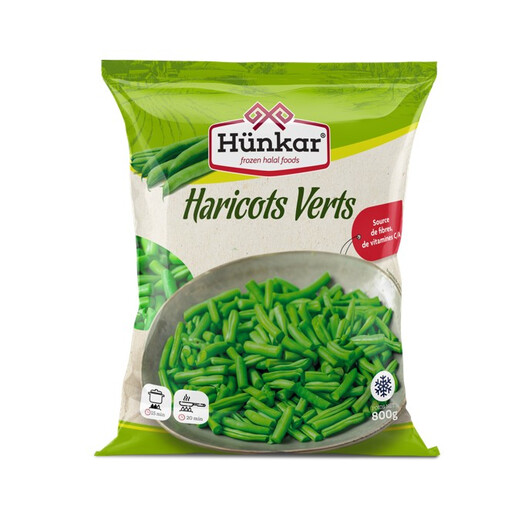 Image unavailable
Factor the 800 g pack into your serving quantities. Check the ingredients, the ‘salt’ value per 100 g and the storage conditions before planning transport.
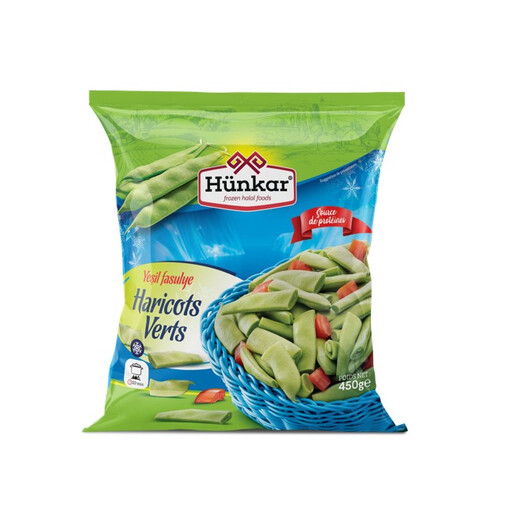 Image unavailable
This 450 g pack could suit a smaller quantity. If your recipe calls for green beans only, check the ingredients before buying, along with the ‘salt’ value and storage conditions.
No. This claim alone doesn’t confirm that a product contains 0 g per 100 g. Check the nutrition table and ingredients: the 225 g Notre Jardin product shown by E.Leclerc lists 0.0 g of salt per 100 g, while Carrefour’s product page for the Jardin Bio Étic jar lists green beans and water as ingredients.
No. Production method and salt content are separate considerations. An Auchan product page for an organic d’aucy jar says ‘no added salt’, but also lists sea salt among the ingredients and gives a salt value of 0.46 g per 100 g. Check the label on the product you buy before using it in your recipe.
Follow the instructions for each product, and plan for a cold chain if you choose frozen beans. For its jar, the Auchan product page for d’aucy says to store it unopened at room temperature, away from damp and temperature fluctuations. Once opened, it recommends transferring the contents to an airtight container, refrigerating them and preferably eating them within two days.
Yes, if you want to control the seasoning across the whole meal. Anses lists sauces, cured meats, cheeses and ready meals among the sources of salt in the diet, so consider what you’re serving alongside the green beans too.