Families keeping an eye on total sugars
You want to compare the ‘of which sugars’ figure per 100 g and distinguish a low-sugar product from one with no added sugars.


When shopping for a large family, start by deciding which of three distinct criteria matters most: the lowest possible sugar content, no added sugars, or a larger pack. Muesli with no added sugars can still contain naturally occurring sugars, and it isn’t a substitute for granola if texture matters to you. Before choosing a family-size pack, check the allergens in the exact recipe too.
You want to compare the ‘of which sugars’ figure per 100 g and distinguish a low-sugar product from one with no added sugars.
You’re shopping for several people and want a recipe with no added sugars, while being happy to include the sugars naturally present in its ingredients.
Before sharing a pack, you need to check whether the specific product contains cereals containing gluten, nuts, soya, sesame or milk.
To choose between granola and muesli, start with what matters most to your household. Then compare the nutritional values per 100 g and check the recipe on the pack you’re considering.
| Criteria | What to check | Who is it for? |
|---|---|---|
| Total sugar content | Check the ‘of which sugars’ figure per 100 g. For a ‘sugar-free’ claim, the EU regulation set out on EUR-Lex allows a maximum of 0.5 g of sugars per 100 g of solid food. | If total sugars matter more than anything else, ‘no added sugars’ isn’t enough to make your decision. Around 40% of consumers prioritise this sugar threshold. |
| Recipe and family-size pack | Tell ‘no added sugars’ apart from ‘sugar-free’, then compare the net weight and sugars per 100 g. Make sure the pack suits how much your household eats. | For several breakfasts, I’d choose a larger pack with no added sugars, even if the fruit in the recipe contributes sugars. This is the main priority for around 30% of consumers. |
| Allergens and ingredients | Check the ingredients list and allergen information on the pack you receive, especially if a different product was substituted when you shopped. | A pack to share must first be suitable for the people who’ll eat it; its sugar content or size comes second. Checking the recipe is therefore the priority for around 30% of consumers. |
The first claim doesn’t mean there are no sugars naturally present in the ingredients: Bjorg lists 14 g of sugars per 100 g for its 750 g muesli with no added sugars.
If you’re specifically looking for a food labelled ‘sugar-free’, compare the claim with the ‘of which sugars’ figure in the nutrition table. The EU regulation set out on EUR-Lex allows a maximum of 0.5 g per 100 g of solid food for this claim.
On its own, this doesn’t tell you about energy or fat. Auchan lists 441 kcal per 100 g for JORDANS dark chocolate granola, which is low in sugars.
Compare sugars, energy and fat per 100 g, then consider the portion you usually serve.
The Bjorg and JORDANS products described here have different ingredients or allergen information depending on the recipe. Online information may also temporarily differ from what’s shown on the pack.
Check the exact product when you order, then read the label on the item you receive, particularly if it has been substituted.
The listing for Carrefour Sensation red berry granola with no added sugars says it’s unavailable for drive collection.
Before adding a specific product to your list, check whether it’s available at your store or for your chosen collection method.
Two 400 g granolas marketed in France as low in sugars: dark chocolate, and almond, hazelnut and seed.
The brand offers a 750 g pack of organic muesli with no added sugars. It’s muesli, not crunchy granola.
A crunchy red berry granola labelled ‘no added sugars’. Check its recipe rather than assuming it’s available.
This 375 g Bjorg muesli may be worth considering if you’re thinking of having muesli for breakfast instead of crunchy granola. It isn’t the 750 g Bjorg pack mentioned for family shopping.
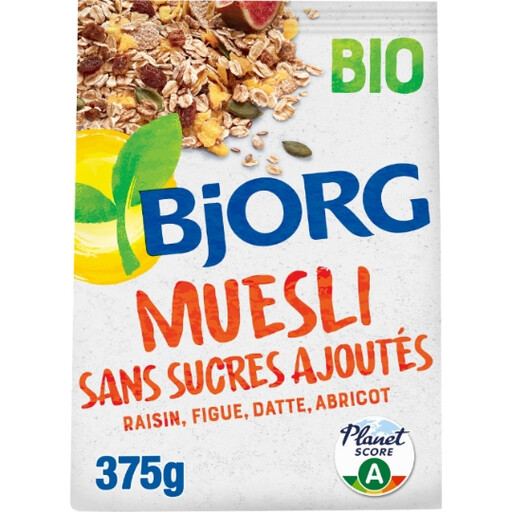 Image unavailable
Worth considering if muesli suits you and the 375 g pack is the right size for your household. If no added sugars is important to you, check this claim and the ‘of which sugars’ figure on the product you receive. Check the allergen information too before sharing it.
No. Ingredients can contain naturally occurring sugars: Bjorg lists 14 g of sugars per 100 g for its 750 g muesli with no added sugars. Check the ‘of which sugars’ value if total sugar content is what guides your choice.
For solid food, the EU regulation set out on EUR-Lex reserves this claim for products containing no more than 0.5 g of sugars per 100 g. Check the claim and nutrition table for the specific product you’re considering.
No. Sugar content alone isn’t enough to make this comparison. For JORDANS dark chocolate granola, which is low in sugars, Auchan lists 3.8 g of sugars and 441 kcal per 100 g. Compare energy and fat on the same basis too.
Reseal the pack securely and keep it in a dry place, following the storage instructions on the Joybuy listing for this muesli. Always follow the instructions on the packaging you receive.
Don’t assume they are: the recipes reviewed contain cereals containing gluten, the almond and hazelnut version contains nuts, and Carrefour lists soya in the dark chocolate version. Check the ingredients list and allergen information for the specific product you receive.