For a Sunday brunch, start by deciding what you mean by “sugar-free”: in the EU, a product can only make this claim if it contains no more than 0.5 g of sugars per 100 g. “No added sugars”, meanwhile, does not rule out naturally occurring sugars. If you want to keep the crunch of granola, Carrefour describes two Jordans recipes as “low in sugars”, but that doesn’t make them “sugar-free”. Bjorg’s muesli with no added sugars is a different type of cereal and, according to Bjorg, contains 14 g of sugars per 100 g.
Who are these options for?
If you’re looking for a “sugar-free” product
If this threshold is important to you, check the claim and the “of which sugars” line on the specific product you buy. The EU regulation published on EUR-Lex sets a maximum of 0.5 g of sugars per 100 g for a granola to be labelled “sugar-free”.
If you want to keep the crunch of granola
Carrefour describes Jordans Almond, Hazelnut & Seed and Dark Chocolate as “low in sugars”. To choose between them, check the ingredients and allergens too: this claim does not mean “sugar-free”.
If you’re avoiding added sugars
Muesli with dried fruit may meet this requirement without being sugar-free. Anses distinguishes between the two claims, while Bjorg states that its muesli with no added sugars contains 14 g of sugars per 100 g.
What should you look for when choosing brunch cereals?
Start with the claim that matches what you’re looking for, then compare the nutritional information per 100 g and the ingredients in each recipe.
| What to consider | What to check | Who is it for? |
|---|
| “Sugar-free” threshold |
The exact claim and the “of which sugars” value per 100 g: the EU threshold is no more than 0.5 g. |
If I’m looking for a genuinely “sugar-free” product, a simple “low in sugars” claim doesn’t meet my requirements. Around 33% of consumers put this threshold first. |
| Added sugars |
The “no added sugars” claim, the ingredients and the “of which sugars” value per 100 g. |
I’m happy to have naturally occurring sugars from dried fruit, but want to avoid added sugars. Around 27% of consumers prioritise this distinction. |
| Granola format |
The product category and, when comparing granola recipes, the ingredients and nutritional values per 100 g. |
I want the crunch of granola to top my brunch bowl, even if the recipe isn’t “sugar-free”. Around 20% of consumers put this first. |
| Ingredients to avoid |
Allergens, “may contain” warnings and whether the specific recipe includes a sweetener. |
Before choosing cereal for brunch, I need to rule out any ingredients that don’t suit my needs. Around 20% of consumers make this their priority. |
Common mix-ups to avoid
-
Taking “low in sugars” to mean “sugar-free”
These are two different claims. The EU regulation’s threshold of 0.5 g of sugars per 100 g for “sugar-free” does not follow from a “low in sugars” claim.
If this threshold matters to you, check the claim and the “of which sugars” value on the packaging of the product you choose.
-
Assuming “no added sugars” means sugar-free
Dried fruit can contain naturally occurring sugars. Bjorg, for example, states that its muesli with no added sugars contains 14 g of sugars per 100 g.
Read the claim, ingredients and nutritional information per 100 g together, and also consider the portion you plan to serve.
-
Focusing on sugars and overlooking the rest of the recipe
Cereals containing gluten, nuts, soya and “may contain” warnings vary from one product to another. Carrefour lists maltitol syrup in its Red Berry Crunchy Granola with no added sugars.
Check the label of the specific product if you need to avoid an allergen or prefer a recipe without sweeteners.
-
Planning brunch around a product without checking it’s available
Carrefour says its Red Berry Crunchy Granola with no added sugars has been discontinued and is unavailable for Click & Collect.
Before adding it to your menu, check availability with your chosen shop and have another recipe in mind whose label meets your requirements.
Brands and products to know
Jordans
Carrefour describes two 400 g Jordans granolas as “low in sugars”: Almond, Hazelnut & Seed and Dark Chocolate.
- Two recipes that keep the granola format: one contains almonds and hazelnuts, while the other contains dark chocolate and soya.
- Their “low in sugars” claim doesn’t show that they meet the “sugar-free” threshold. Check the allergens for each recipe.
Bjorg
Bjorg muesli with no added sugars comes in 375 g and 750 g packs. It’s a fruit muesli, not crunchy granola.
- Bjorg states that the 750 g pack contains 14 g of sugars per 100 g. This value helps distinguish the absence of added sugars from the absence of sugars altogether.
- The recipe contains gluten and may contain traces of milk, nuts, sesame and soya.
Carrefour Sensation
According to Carrefour, its 400 g Red Berry Crunchy Granola with no added sugars contains maltitol syrup.
- This product shows why it’s important to read the ingredients, even when a granola is labelled “no added sugars”.
- Carrefour says it has been discontinued and is unavailable for Click & Collect. Check with your local shop before counting on this product.
Auchan
Auchan’s 350 g plain granola is a useful point of comparison and a reminder that “plain” doesn’t mean “sugar-free”.
- Auchan’s product page lists 6.3 g of sugars per 100 g, a value you can compare with other recipes on the same basis.
- The ingredients list includes 8.3% coconut blossom sugar, so “plain” doesn’t mean “no added sugars” for this product.
A brunch option on Joybuy
If avoiding added sugars is your priority and you’re happy to choose muesli instead of crunchy granola, this product may be worth comparing. It isn’t suitable if you’re strictly looking for a “sugar-free” product.
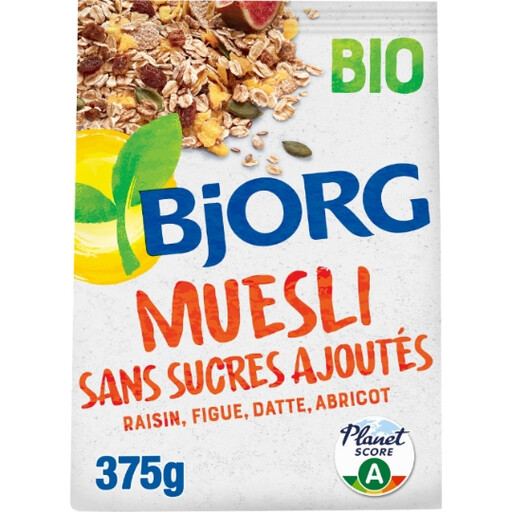 Image unavailable
BJORG Organic Muesli 375 g
If muesli can take the place of granola at your brunch, this recipe is labelled “no added sugars”. The Joybuy product page lists 23% fruit and 14 g of sugars per 100 g, so it isn’t suitable if you need a “sugar-free” product. It contains gluten and may contain traces of milk, nuts, sesame and soya. Check the pack label if any of these ingredients are a concern for you.
View on Joybuy
Frequently asked questions
Are “sugar-free” and “no added sugars” the same thing?
No. For granola, the EU regulation published on EUR-Lex sets a maximum of 0.5 g of sugars per 100 g for the “sugar-free” claim. As Anses points out, “no added sugars” doesn’t rule out naturally occurring sugars, particularly those in fruit.
Can fruit muesli with no added sugars replace “sugar-free” granola?
Not if you need a product labelled “sugar-free” or want the crunch of granola. Bjorg muesli with no added sugars contains dried fruit, and Bjorg states that it has 14 g of sugars per 100 g. It’s better suited to someone looking for no added sugars who is happy to have naturally occurring sugars.
Which allergens should you check before serving these cereals at brunch?
Check the recipe and any “may contain” warnings on each pack. The products mentioned include cereals containing gluten and, depending on the product, nuts or soya. The Jordans product pages published by Carrefour and the information from Bjorg show that ingredients vary between recipes.


