
Livraison le jour même ou le lendemain

Qualité garantie

Débloquez vos offres de bienvenue: Livraison GRATUITE | Jusqu'à -80 % | 30 jours d'essai gratuits à JoyPlus
Téléchargez l'application
Looking for a pack of 3 cartons of Grace 100% coconut water, 1 L each for sport, the office or your household supplies? At first glance, the choice seems simple. However, several details can affect the taste, storage and everyday convenience. A description such as “natural” does not necessarily mean that the drink is free from added sugar or not from concentrate.
Before placing your order, take the time to check the ingredients, the volume actually delivered and the storage conditions. These practical details help you compare offers, rather than relying solely on marketing claims.
Coconut water naturally contains sugars. A drink displaying 0 g of added sugar can therefore still show a value in the “of which sugars” section of its nutrition table. For the Grace product, the listing states 5 g of sugars per 100 ml, while also specifying that no sugar is added.
This distinction matters if you are looking for coconut water with no added sugar, rather than a drink with no carbohydrates. Always check the ingredients list: when it simply says “coconut water”, the information is much clearer.
Some drinks are reconstituted from concentrate, while others are marketed as not being made from concentrate. The Grace coconut water listing states 100% coconut water and not from concentrate. This information is worth checking both on the product listing and on the packaging, as the wording may vary between products.
A 1 L carton can accompany several servings, but it does not keep in the same way as an unopened container. For Grace, the recommendation is to refrigerate after opening and consume within two days. If your household drinks little coconut water, it is therefore best to plan around this time limit to avoid throwing part of the product away.
For ready-to-drink coconut water, check the following points in particular:
The description electrolyte-rich hydrating drink should nevertheless be viewed with some perspective. The listing refers to a natural source of electrolytes, particularly potassium. This provides information about the product’s composition, but it is neither a medical claim nor a guarantee of results after exercise.
The pack contains three 1 L cartons, giving 3 L in total. This format may suit:
The format is practical, provided you have enough room in the fridge once the carton has been opened. Before serving, the listing recommends gently shaking the carton, then drinking the coconut water well chilled.
The Grace product is advertised as being made in Thailand, using young green coconuts. It is presented as a vegetarian, gluten-free and dairy-free drink. These details may suit certain dietary requirements, but anyone with specific dietary restrictions should always check the labelling of the product received, particularly if the recipe or packaging has changed.
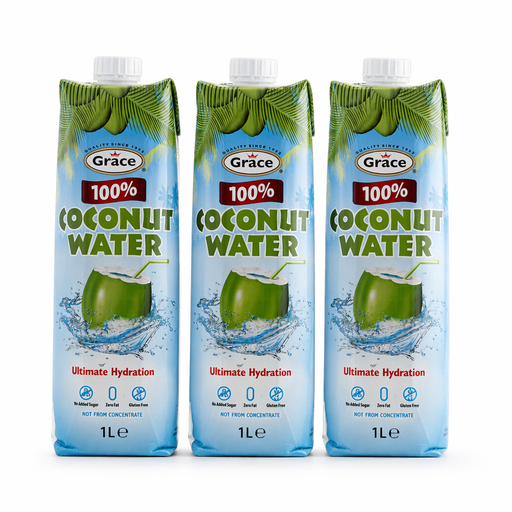
Why this is a sensible choice: The pack of 3 x 1 L cartons lets you build up a small supply without having to compare numerous different products. The listed ingredients are minimal, and the drink is ready to enjoy.
The listing specifies that there is no added sugar and that the coconut water is not from concentrate: two details that are often confused when shopping.
Three 1 L cartons, 22 kcal per 100 ml and 0 g of fat according to the nutritional information provided.
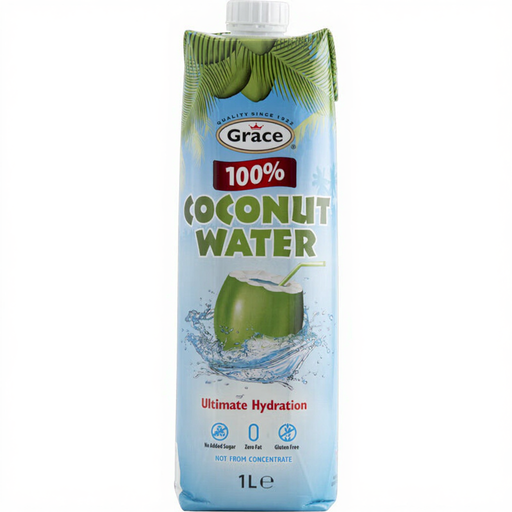
Why this is a sensible choice: Shoppers who value a simple recipe may prefer a product whose only listed ingredient is coconut water, with no added ingredients mentioned.
The description goes beyond attractive packaging: it details the Thai origin, the ingredients and the fact that the product is not made from concentrate.
100 % coconut water, no added sugar indicated, and suitable for a vegetarian and gluten-free diet according to the product listing.
Why this is a sensible choice: The total volume of 3 L is suitable for regular training, hot days or a shared space such as an office.
The pack size is clear: three 1 L cartons, rather than a single carton presented as a multipack. The storage period after opening is also specified.
The listing mentions a natural source of electrolytes, including potassium, and recommends serving the drink well chilled.
Before opening, store the cartons in a cool, dry place away from excessive heat. Once opened, place the carton in the fridge and follow the time limit stated on the listing. Serve the coconut water chilled, straight into a glass or a clean water bottle.
As part of a sporting activity, coconut water can complement your usual diet and hydration routine. It does not always replace water, particularly during prolonged exercise or in hot weather. Your needs depend on the activity, the temperature and your personal circumstances.
The information provided states that no sugar is added and lists only coconut water as an ingredient. However, the drink contains naturally occurring sugars: 5 g per 100 ml according to the nutrition table provided.
The recommendation is to keep the carton in the fridge and consume it within two days of opening. Also remember to check the instructions printed on the packaging you receive.
Yes, provided you can plan when to open each carton and have suitable storage space. If you drink coconut water very rarely, compare the total 3 L volume with your usual consumption to reduce the risk of waste.