People with coeliac disease
You need gluten-free information that applies to the specific fruit in syrup you plan to serve, rather than an assumption based solely on the brand name or type of fruit.


To serve fruit in syrup to someone with coeliac disease, choose a product that is specifically labelled “gluten-free”. Then compare the fruit, the liquid it comes in and the drained weight. “No added sugar” relates to a different requirement and does not prove that a product is gluten-free.
You need gluten-free information that applies to the specific fruit in syrup you plan to serve, rather than an assumption based solely on the brand name or type of fruit.
You compare ingredients and nutritional information to choose your dessert. This is separate from checking whether a product is gluten-free.
Choose between individual pots and a tin to share, depending on how many people you’re serving and how much fruit you’d like.
If the dessert is for someone with coeliac disease, first check that the specific product is labelled “gluten-free”, then compare its ingredients and format. Carrefour France displays this claim for the ST MAMET peaches in syrup we looked at; it does not automatically apply to other products from the brand.
| Criteria | What to check | Who it matters to |
|---|---|---|
| Gluten-free claim | Look for the claim on the packaging of the exact product, or ask for reliable confirmation that it applies to that product. | If I’m serving dessert to someone with coeliac disease, I want to check the product’s status before choosing it. Around 50% of consumers would prioritise this need. |
| Added sugar | Read the ingredients, check whether it says “no added sugar”, and look at the sugar content per 100 g. | When choosing what goes into my dessert, I distinguish added sugars from the sugars naturally present in fruit. This would be the top priority for around 30% of consumers. |
| Format and quantity | Compare the number of pots, the drained weight and the storage instructions after opening. | When serving dessert to several people, I want enough fruit without having to use lots of individual portions. Around 20% of consumers would put this need first. |
These claims describe two different properties. The Carrefour France listing for CARREFOUR CLASSIC' pineapple with no added sugar gives information about its ingredients, but this alone doesn’t meet the needs of someone with coeliac disease.
Check the gluten-free status of the specific product separately, then compare its ingredients and nutritional information.
Carrefour France displays “GLUTEN-FREE” for the ST MAMET peaches in syrup we looked at. This applies to that specific product, and not necessarily to other ST MAMET fruit or formats.
Check the product name, format and label on the pack you buy, even if you’re already familiar with the brand.
Carrefour France lists ST MAMET peaches in syrup bearing the claim “GLUTEN-FREE”.
The pineapple products listed by Carrefour France include tinned pieces and individual pots with no added sugar.
Carrefour France lists a ROCHEFONTAINE pineapple in juice product.
This jar of cherries in syrup can be used to put together a dessert after dinner. If it’s for someone with coeliac disease, check that the product you receive is labelled “gluten-free”.
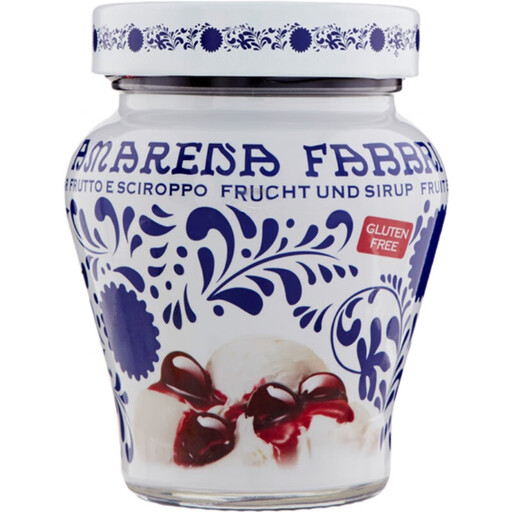 Image unavailable
For a fruit dessert after dinner, this product offers Amarena cherries in syrup in a 230 g jar. The description for this product says “Gluten free”. Before serving it to someone with coeliac disease, check that this information also appears on the product you receive.
In the European Union, Commission Implementing Regulation (EU) No 828/2014 reserves the claim “gluten-free” for foods that contain no more than 20 mg/kg of gluten as sold to the final consumer. When choosing dessert for someone with coeliac disease, check that the claim applies to the product you’re buying.
No. It doesn’t replace gluten-free information that applies to the specific product. Look for this claim on the product or ask the manufacturer for reliable confirmation before choosing it for someone with coeliac disease.
No. Fruit in syrup or juice labelled “no added sugar” may still contain the sugars naturally present in its ingredients. To compare two products, check the sugar content per 100 g in their nutritional information.
Compare the drained weight, number of portions and storage instructions after opening to choose a format that works for dinner. If the dessert is for someone with coeliac disease, check the ingredients, declared allergens and gluten-free status separately.