What should you check before buying?
Start by checking the label on the exact product. Then choose a format to suit how you plan to use it, and compare the nutritional information of products intended for the same purpose.
| What to consider |
What to check |
Who it matters to and why |
| ‘Gluten-free’ label |
Look for the claim on the packaging of the exact product. Implementing Regulation (EU) No 828/2014 sets a maximum of 20 mg of gluten per kg of finished product for this claim. |
If I’m buying for someone with coeliac disease, I need information about the crispbread itself, not an assumption based on its grain. Around 42% of consumers make this their top priority. |
| Regular availability |
Check that the product you’re looking for is available at your usual shop. Lidl France says its gluten-free range is available occasionally, rather than all year round. |
When I’m doing another food shop after moving in, I need to be able to find the products I plan my meals around. This is the top priority for around 25% of consumers. |
| How you’ll use it and how to store it |
Choose crispbreads for snacks or toast, or pancakes to fill for a meal; check the storage instructions on the pack. |
When I have little time to cook, I first look for a format that suits what I’m planning to make. Around 17% of consumers put convenience first. |
| Nutritional information |
When comparing products intended for the same purpose, check the salt, fibre, protein, sugars and fat per 100 g. |
When choosing between two products, I want to compare their values on the same basis rather than judge them by the packaging alone. This comes first for around 16% of consumers. |
Brands and ranges to know
These notes apply to the ranges and products mentioned, not every crispbread from each brand. If you have coeliac disease, the packaging of the product you choose is what matters.
Carrefour No Gluten
Carrefour describes No Gluten as a dedicated range for gluten-free shopping.
- Carrefour says its No Gluten range is approved by AFDIAG.
- This information about the range doesn’t apply to Carrefour products outside No Gluten; check the exact product.
Bjorg
Product listings consulted at Auchan describe some Bjorg crispbreads as gluten-free.
- The Auchan listing for the maize, amaranth and linseed crispbreads says this product is AFDIAG certified.
- Don’t assume that this certification or the nutritional information for one recipe applies to another Bjorg crispbread.
Chaque Jour Sans Gluten — Marque Repère / E.Leclerc
E.Leclerc describes this as a range of everyday gluten-free products.
- E.Leclerc says the crossed-ear-of-wheat logo on its range represents a guarantee issued by AFDIAG.
- Having a dedicated range doesn’t necessarily mean a particular crispbread format suits your needs. Check the product on offer.
Aglina
An Auchan product listing describes a 160 g organic buckwheat crispbread by Aglina as gluten-free.
- This product is worth considering if you’re looking for a buckwheat crispbread.
- Read the packaging for the exact product, especially the allergen and storage information.
Lidl
Lidl France describes its gluten-free range as occasional rather than permanent.
- You can check the label of any product you find while shopping, just as you would with any other crispbread.
- An occasional range is less suitable if you want to find the same product every time you restock.
A crispbread option on Joybuy
This selection features a crispbread product for snacks or toast. If you’re planning to make a meal with a filling, first choose a format designed for that purpose. If you’re buying for someone with coeliac disease, always check for the ‘gluten-free’ claim on the exact pack.
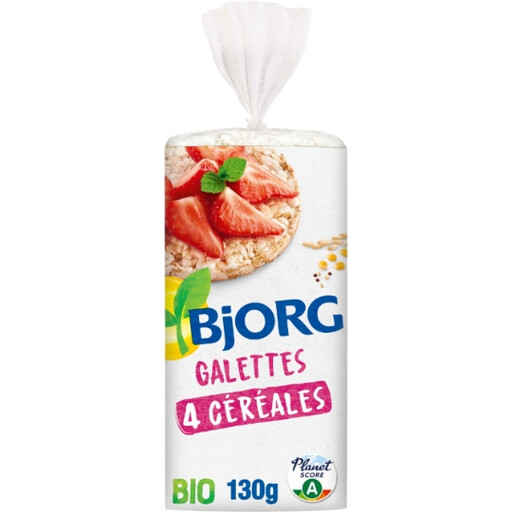 Image unavailable
BJORG 4-grain crispbreads 130 g
A crispbread option to consider for toast or a snack, in a 130 g pack. The product listing describes it as gluten-free; if you’re buying it for someone with coeliac disease, check this claim on the pack you receive. Also check the allergen information if soya is a concern for you.
View on Joybuy
Frequently asked questions
Is a rice or buckwheat crispbread automatically suitable for someone with coeliac disease?
No. Choose a product whose packaging carries the ‘gluten-free’ claim. Implementing Regulation (EU) No 828/2014 sets out the requirements for this claim on the finished product; the ingredient name alone isn’t enough.
Is Nutri-Score compulsory on crispbreads sold in France?
No. The DGCCRF explains that displaying it is voluntary. To compare prepacked crispbreads, check their nutritional information per 100 g, even if a Nutri-Score appears on the pack.
What should I look for if I want to use a crispbread as a meal base?
First choose a crispbread designed to be topped or filled, then check its nutritional information per 100 g, especially the salt, protein, fibre, sugars and fat. Also consider the filling you plan to add and the storage instructions for the product.
How should I store crispbreads after opening?
Follow the manufacturer’s instructions on the pack and reseal it as directed. If you only eat a few crispbreads at a time, check the pack size before buying.
Can I plan to restock gluten-free crispbreads at Lidl?
Don’t rely on a product being available all year round: Lidl France says its gluten-free range is sold through occasional promotions. Check what’s available when you shop, and consider another shop if you need to find the same crispbread regularly.


