People with coeliac disease on the go
You’re looking for a savoury snack with ‘gluten-free’ on the packaging, and want to pay particular attention to the ingredients, allergens and cross-contamination information.


If you have coeliac disease, first choose a product whose packaging says ‘gluten-free’, then check the ingredients and allergen information. According to AFDIAG, the crossed-grain logo provides an additional check, but it isn’t the only way to identify a product labelled ‘gluten-free’. For your journey, choose between individually wrapped portions and one larger pack depending on how you’ll use them, then compare the nutritional information per 100 g for similar products. Nutri-Score can be a useful extra guide when shown, but displaying it is voluntary in France, as the Ministry of the Economy explains.
You’re looking for a savoury snack with ‘gluten-free’ on the packaging, and want to pay particular attention to the ingredients, allergens and cross-contamination information.
You want to take enough for several breaks without opening the whole pack at once. Smaller individual packs may suit you.
You want to compare things such as salt and fat in products that already meet your gluten-free requirements, using the figures per 100 g.
When choosing a savoury snack to take with you, check the gluten-free labelling first. Then choose a pack size that suits your breaks before comparing nutritional values.
| What to check | What to look for | Who this matters to |
|---|---|---|
| Gluten and cross-contamination | The ‘gluten-free’ statement on the packaging you buy, plus the ingredients and allergen list. According to AFDIAG, the crossed-grain logo can provide an additional check. | When I choose a snack for someone with coeliac disease, I want to check the statement on the pack rather than relying only on its main ingredients; around 50% of consumers make this their top priority. |
| Pack size for your journey | The number of packs, the weight of each one and the total weight, depending on whether you’re planning several breaks or sharing. | If I’m making several stops, I prefer separate portions to a pack that’s open from the first break; for around 30% of consumers, this ease of carrying comes before other considerations. |
| Nutritional composition | Salt, fat and saturated fatty acids per 100 g; use Nutri-Score only if it’s shown, and compare similar products. | Once a product meets my gluten-free requirements, I want to compare similar products using their nutrition labels; this is the top priority for around 20% of consumers. |
The basic ingredients alone don’t tell you whether cross-contamination may have occurred during transport or packaging. According to AFDIAG, ‘gluten-free’ means a gluten content of less than 20 mg/kg.
If you have coeliac disease, look for this statement on the product you buy and read the allergen information. According to AFDIAG, the crossed-grain logo involves additional checks.
The Ministry of the Economy explains that displaying Nutri-Score is voluntary in France. So its absence alone doesn’t tell you how a biscuit is made up.
Compare the nutritional values per 100 g of similar products, and use Nutri-Score as an extra guide when it’s shown.
The Schär and TOOGOOD products described by Carrefour contain soya. N.A! warns that its paprika Rice Crackers may contain traces of several allergens.
If you need to avoid other allergens, check the ingredients and trace warnings on the specific pack you plan to eat.
A multipack of smaller bags lets you spread your snacks across several breaks; one larger pack is better suited to eating in one go or sharing.
Before you choose, check how many bags there are and how much each one contains, not just the total weight.
Carrefour describes a Schär gluten-free savoury cracker product in six 35 g packs, a format worth considering for several breaks.
N.A! makes rice-based Rice Crackers, including a paprika version in an 85 g pack labelled gluten-free.
Carrefour describes TOOGOOD Snack Poppé Salt & Pepper, made with soya and potato, in an 85 g pack labelled gluten-free.
These two LA VENEZIANE products are mini breadsticks labelled gluten-free, in 250 g packs. For a journey, the pack size suits a break or sharing if one larger pack meets your needs. Check the labelling on the product you receive before choosing it for someone with coeliac disease.
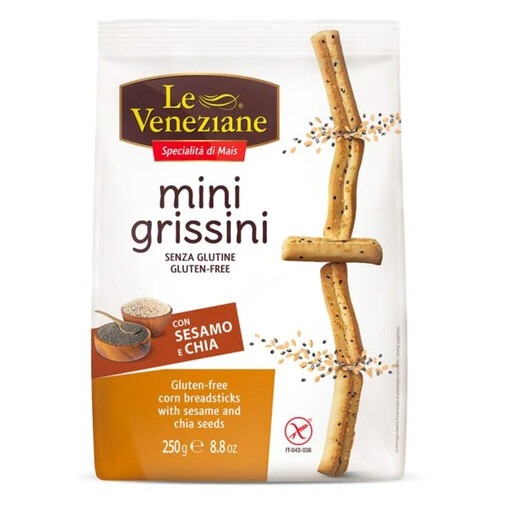 Image unavailable
These mini sesame breadsticks could be a handy option for a break or to share on your journey if you’d prefer a 250 g pack to individually wrapped portions.
The product name includes ‘Gluten-Free’. Sesame is listed in the ingredients, so check the gluten-free statement, allergens and any trace warnings on the packaging you buy.
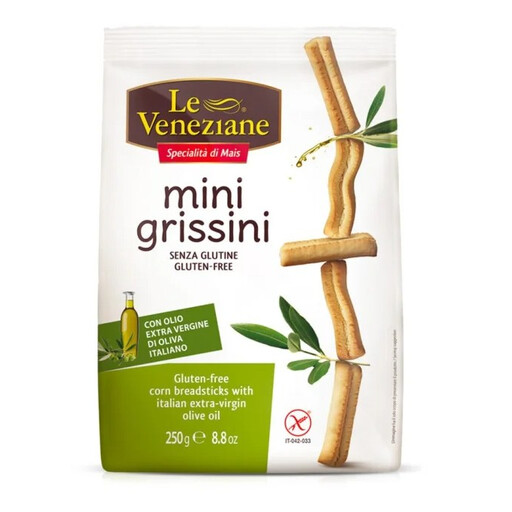 Image unavailable
This olive oil mini breadstick option could suit a break or sharing if you’re looking for a 250 g pack.
The product name includes ‘gluten-free’. If you’re buying it for someone with coeliac disease or other allergies, check the gluten-free statement and allergen or trace information on the packaging you buy.
No. The Ministry of the Economy says that displaying it on packaging is voluntary. If Nutri-Score isn’t shown, use the nutritional information to compare similar products.
According to AFDIAG, it means a gluten content of less than 20 mg/kg. If you have coeliac disease, look for this statement on the product packaging rather than relying only on its main ingredients.
Not necessarily. These ingredients alone don’t tell you whether cross-contamination may have occurred. Check the ‘gluten-free’ statement on the finished product, as well as its ingredients and allergen information.
Follow the product’s storage instructions. N.A! advises keeping its Rice Crackers away from heat and moisture; after opening, reseal the pack or put the remaining crackers in a clean, dry container.