When choosing a bar for a secondary school pupil’s lunchbox, start with the actual dietary restriction: ‘gluten-free’ does not guarantee that a product is free from peanuts, tree nuts, milk or soya. Check the ingredients and any ‘may contain’ warnings on the specific product, in line with the pupil’s requirements. Then compare the portion size and nutritional information of the bars that are suitable.
Who are these criteria for?
Families managing a specific allergy
Your choice depends on which allergen needs to be avoided and, depending on medical advice, whether ‘may contain’ warnings need to be taken into account. A bar labelled ‘gluten-free’ does not, by itself, make it suitable for someone avoiding peanuts, milk or tree nuts.
Secondary school pupils following a gluten-free diet
Look for a ‘gluten-free’ statement on the packaging first. If the crossed-grain logo appears on the product, it offers an additional indication recognised by AFDIAG. Check for other allergens separately.
Families comparing suitable snacks
Once you’ve checked the dietary restrictions, the bar size, sugars per portion, ingredients and Nutri-Score, if shown, can help you compare similar products for a lunchbox.
What should you check before choosing?
First rule out any bars that aren’t suitable for the pupil’s dietary restrictions. Only compare the size and nutritional profile of the bars that remain.
| What matters |
What to check |
Who is this for? |
| Known allergen |
Check for the allergen in the highlighted ingredients and any ‘may contain’ warnings, in line with medical advice. |
If my child needs to avoid a specific allergen, a ‘gluten-free’ statement isn’t enough to make the bar suitable. Around 34 % of consumers prioritise avoiding a specific allergen. |
| Gluten-free |
Look for a ‘gluten-free’ statement on the packaging and the crossed-grain logo, if present. |
For a lunchbox that needs to follow a gluten-free diet, I look for information about the specific product without assuming it is free from other allergens. This is the top priority for around 33 % of consumers. |
| Nutritional profile |
Check the portion size, sugars per 100 g and per portion where shown, and the Nutri-Score if displayed. |
When several bars already meet the pupil’s dietary requirements, I want to compare what one bar contributes to the snack. For around 20 % of consumers, the nutritional profile then becomes the main consideration. |
| Formulation preference |
Check for the specific claim you’re looking for and read the full ingredients list. A preference is not the same as a guarantee that a product is free from allergens. |
If I’m looking for a particular formulation for personal preference rather than medical need, I check that it actually meets that preference. Around 13 % of consumers put this choice of formulation first. |
Common mix-ups to avoid
-
Assuming ‘gluten-free’ means ‘free from allergens’
Some gluten-free products featured by Carrefour contain almonds or peanuts, or carry a warning that they’re made in a facility that handles other allergens. Avoiding gluten and avoiding a specific allergen are two separate checks.
Before adding your chosen bar to the lunchbox, read the ingredients list and any precautionary warnings again.
-
Relying only on the ingredients list when managing an allergy
According to Anses, a product may contain traces of peanuts even when peanuts haven’t been used as an ingredient. So, the fact that peanuts aren’t listed as an ingredient doesn’t, by itself, rule out the possibility of traces.
Check any precautionary warnings and follow the medical advice specific to the allergen in question.
-
Forgetting to check the nutritional profile after ruling out unsuitable products
A bar that meets a dietary restriction can still have a Nutri-Score of D, like the Chaque Jour Sans Gluten product featured by E.Leclerc. This score helps you compare nutritional profiles; it doesn’t tell you whether a product contains allergens.
When comparing suitable bars, look at equivalent portions, sugars and the Nutri-Score, if shown on the packaging.
-
Not planning for a medical diet at secondary school
The Ministry of National Education says that an individualised care plan (PAI) can be put in place for a pupil with a food allergy, among other reasons. It helps organise support at school, but doesn’t replace checking the food brought in.
If adjustments are needed, speak to the school and the relevant professionals, then check the labels of the products you put in the lunchbox.
Brands and ranges to consider
The details below apply to the specific products mentioned, not every bar from each brand. Check the label for each new flavour or recipe.
Auchan
Auchan offers gluten-free cereal bars in individual wrappers, among other products.
- The chocolate product featured by Auchan comes in a pack of six and is listed with AFDIAG.
- The almond and honey product warns that it may contain traces of milk, peanuts and other tree nuts. ‘Gluten-free’ doesn’t mean ‘free from these allergens’.
Chaque Jour Sans Gluten (Marque Repère E.Leclerc)
The range includes a gluten-free oat flake and chocolate bar, featured by E.Leclerc in a box of six.
- This product gives you the option of a bar labelled gluten-free in a pack containing several portions.
- E.Leclerc gives this bar a Nutri-Score of D. Compare its nutritional information with that of other suitable bars, but don’t use the score to assess allergens.
Gerblé
Carrefour features a gluten-free chocolate cereal bar from the range.
- The gluten-free statement addresses a separate consideration from the presence of other allergens.
- Carrefour says this product is made in a facility that handles peanuts, tree nuts and milk. Check whether it meets the pupil’s specific requirements.
Eat Natural
The range includes fruit and nut bars, including a gluten-free product featured by Carrefour.
- The almond, cranberry and coconut product is labelled gluten-free.
- The ingredients list published by Carrefour for this product includes almonds and peanuts. Don’t assume the same ingredients are used in other flavours.
Nature Valley
The brand also offers protein bars. These are a separate category from cereal bars as a whole.
- The peanut and chocolate product reviewed is labelled gluten-free and comes in individual wrappers.
- This product contains peanuts and soya, among other ingredients. Its gluten-free statement doesn’t make it suitable for someone avoiding these ingredients.
An option on Joybuy
This selection features an Eat Natural fruit and almond bar to consider for a lunchbox only after checking the label against the pupil’s dietary requirements.
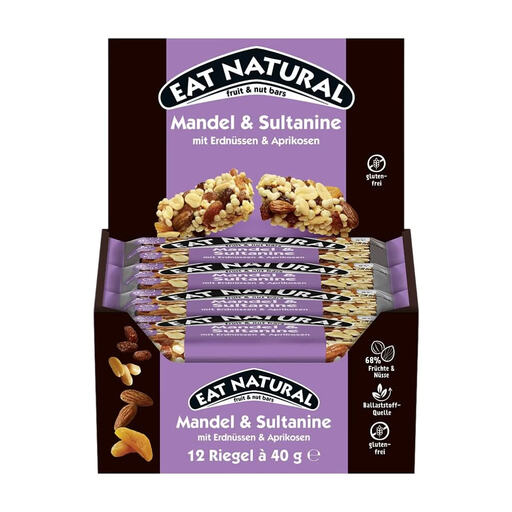 Image unavailable
Eat Natural Almond, Raisin & Apricot Fruit & Nut Bar, 40 g
For a lunchbox, this 40 g bar should only be considered after checking the ingredients and any ‘may contain’ warnings on the packaging. Information for this product mentions almonds and peanuts, so avoid it if the pupil needs to avoid either ingredient. If a gluten-free diet is required, also check for the relevant statement on the product you receive.
View on Joybuy
Frequently asked questions
Is a gluten-free bar always free from other allergens?
No. Some gluten-free bars featured by Carrefour or Auchan contain certain allergens or carry ‘may contain’ warnings. For the allergen the pupil needs to avoid, check the ingredients and precautionary warnings on the specific product.
What does the crossed-grain logo on a bar tell me?
AFDIAG describes the crossed-grain logo as a guide for people with coeliac disease. If it appears on your chosen bar, it relates to gluten; you still need to check separately for other allergens.
Can Nutri-Score help me choose a lunchbox bar?
Yes, it can help you compare the nutritional profiles of similar bars that already meet the pupil’s dietary requirements. Santé publique France says that displaying it is voluntary. Nutri-Score doesn’t tell you whether a product is free from an allergen.
How should I manage a medical diet at secondary school?
The Ministry of National Education says an individualised care plan can be put in place when a pupil needs adjustments, including because of a food allergy. Speak to the school and the relevant professionals, and check the current label of every bar brought in.
Is a bar labelled vegan suitable for someone with a tree nut allergy?
Not on the strength of that label alone. It doesn’t mean the bar is free from almonds, other tree nuts or peanuts. Check the ingredients and any ‘may contain’ warnings in line with the pupil’s medical advice.


