Who are these rice cakes for?

Active people with coeliac disease

When choosing a snack to take with you, portability isn’t enough: check that the specific product you’re buying is labelled “gluten-free”. According to AFDIAG, the crossed grain symbol indicates additional regular checks.

Sports enthusiasts looking for a plain or savoury snack

If you plan to eat the rice cakes on their own or with an accompaniment of your choice, check the pack size, ingredients and nutritional information for the specific product.

Consumers who use Nutri-Score

When displayed, Nutri-Score can help you compare similar rice cakes. Santé publique France recommends comparing products from the same aisle; if there’s no logo, you should still read the nutritional information.

What should you check first?

Criteria What to check Who it matters to
Gluten-free The “gluten-free” label on the specific product and, if you want this additional reassurance, the crossed grain symbol. If I’m choosing rice cakes for someone with coeliac disease, I want to be able to check this label on the packaging; around 46% of consumers would put this check first.
Portability The pack size and storage instructions; keep the pack intact while you’re on the move. When packing rice cakes in my bag, I look for packaging that suits the journey; almost 27% of consumers would make portability their main criterion.
Ingredients and nutrition The ingredients and nutritional values per 100 g, particularly sugars, salt, fibre and protein; and Nutri-Score, if displayed. When several products meet my requirements, I want to compare their ingredients and nutritional values; around 27% of consumers would make this their main concern.

What mistakes should you avoid?

  • Assuming a rice or buckwheat cake is automatically gluten-free

    The cereal highlighted on the pack doesn’t replace the “gluten-free” label on the specific product you’re buying. AFDIAG also distinguishes this label from the crossed grain symbol, which is associated with regular checks.

    If the snack is for someone with coeliac disease, check the packaging every time you buy it and make sure the pack is intact.

  • Thinking Nutri-Score has to appear on every pack

    The DGCCRF says that displaying it is optional. So you can’t assess a pack simply because it doesn’t show a Nutri-Score.

    If it is displayed, use it to compare similar rice cakes; also check the ingredients and nutrition declaration.

  • Choosing based solely on the “gluten-free” label

    This label addresses a different requirement from nutritional comparisons. For example, a plain rice cake and a coated one can’t be compared based on their names alone.

    Compare products intended for the same purpose, and check their nutritional values per 100 g.

Brands and retailers to know

AGLINA

Auchan lists an organic, gluten-free AGLINA buckwheat cake in a 160 g pack.

  • The Auchan product listing describes individually wrapped portions that are easy to carry.
  • Follow the storage instructions and check for the “gluten-free” label on the pack you buy; these details don’t apply to the whole brand.

BJORG

Auchan lists BJORG organic four-grain rice cakes and corn and lentil cakes, both described as gluten-free.

  • These two recipes give you the chance to compare different ingredient lists within the range.
  • Check the “gluten-free” label and nutritional information for the specific product rather than assuming they apply based on the brand.

Carrefour

Carrefour lists rice cakes and has a gluten-free snacks section.

  • Its product listings let you check the options available before making your choice.
  • The fact that rice cakes are part of its range doesn’t prove that a specific product is labelled “gluten-free”.

Lidl

Lidl France says that gluten-free products aren’t part of its permanent range.

  • You can check out a limited-time product if it’s available in your store.
  • If you want to buy the same rice cake regularly, don’t assume it will be available or have the same ingredients on your next visit.

A rice cake to consider on Joybuy

This 130 g BJORG product could suit anyone looking for a rice cake to take with them. If it’s for someone with coeliac disease, check the “gluten-free” label on the packaging before choosing it.
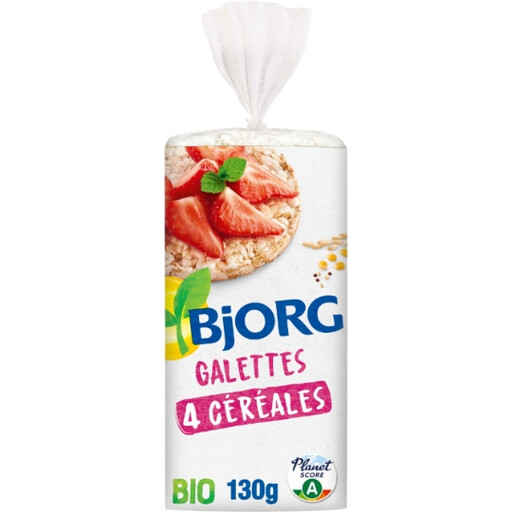
BJORG four-grain rice cakes, 130 g pack

BJORG four-grain rice cakes, 130 g

The 130 g pack could be a handy snack to take in your gym bag. If it’s for someone with coeliac disease, check for the “gluten-free” label on the exact product packaging. Also check that the pack is intact and follow its storage instructions.

View on Joybuy

Frequently asked questions

Is Nutri-Score compulsory on rice cakes sold in France?

No. According to the DGCCRF, displaying Nutri-Score is optional. It is separate from the nutrition declaration, which is generally compulsory for the pre-packed foods concerned. If Nutri-Score appears on the pack, compare it with that of rice cakes in the same category, but don’t use it instead of checking for the “gluten-free” label.

Is a rice or buckwheat cake automatically suitable for someone with coeliac disease?

No: check that the specific product is labelled “gluten-free”. The European Union implementing regulation on this claim sets a maximum of 20 mg/kg of gluten in the product sold to consumers; according to AFDIAG, the crossed grain symbol means there are additional regular checks.

How can you carry rice cakes in a gym bag?

Keep the pack intact and follow the storage instructions for the product you choose. For example, Auchan describes AGLINA buckwheat cakes as individually wrapped portions that should be stored in a cool, dry place; don’t assume all rice cakes come in this type of packaging.

How can you check a product before making a trip to the shop?

Check the listing for the specific product, then confirm its availability with the store in question. Carrefour and Auchan list products online, while Lidl France says its gluten-free range isn’t permanent; a product listing doesn’t replace checking the packaging.