People with coeliac disease who check labels carefully
An explicit “gluten-free” label comes before taste or nutritional values. The crossed-grain symbol can offer an additional indication of the checks described by AFDIAG.


If you have coeliac disease, start with a rice cake that is explicitly labelled “gluten-free”; the AFDIAG crossed-grain symbol offers an additional way to check. For a snack that needs no preparation, choose a ready-to-eat crispy rice cake; a fresh buckwheat pancake is better suited to a snack you can add toppings to. Nutri-Score is optional in France, so also compare the nutritional information on products that do not display it.
An explicit “gluten-free” label comes before taste or nutritional values. The crossed-grain symbol can offer an additional indication of the checks described by AFDIAG.
A ready-to-eat crispy rice cake is ideal for a break that needs no preparation. A fresh pancake to add toppings to calls for a little more planning.
The fibre and protein figures on the nutritional information help you compare products, but these figures alone do not tell you how filling they will be.
If you have coeliac disease, a “gluten-free” label is essential, whatever your main priority might be after that: extra reassurance, format, ingredients or nutritional comparison.
| What to consider | What to check | Who is it for? |
|---|---|---|
| Gluten checks | Look for the “gluten-free” label and, for an extra indication of checks, the crossed-grain symbol. | If coeliac disease means you want reassurance beyond checking the ingredients, the symbol described by AFDIAG is particularly useful; around 36% of consumers put this additional check at the top of their list. |
| Snack format | Distinguish ready-to-eat crispy rice cakes from fresh pancakes to add toppings to, and check the storage instructions. | When you’re revising away from home, preparing a topping between study sessions isn’t always practical: around 29% of consumers prioritise a format that’s ready to eat straight away. |
| What’s in the snack | Compare the fibre and protein per 100 g, then consider the portion you plan to eat. | For a long study session, some consumers want to distinguish a lentil recipe from a rice cake made mainly from grains; around 21% make this kind of comparison their priority. |
| Nutritional values | Compare the sugars, fat and salt per 100 g, even if there is no Nutri-Score. | When several packets look suitable, around 14% of consumers first want a consistent basis for comparing their nutritional values. |
AFDIAG points out that contamination can happen during transport or packaging. So the name of the main ingredient alone isn’t enough when choosing a rice cake for someone with coeliac disease.
Look for the “gluten-free” label on the product; if you want an extra indication of checks, also look for the crossed-grain symbol.
The DGCCRF explains that Nutri-Score is optional in France, while prepacked foods must carry a nutrition declaration, subject to certain exceptions.
To compare two products, read their nutritional information per 100 g, particularly the sugars, fat, fibre, protein and salt.
The Carrefour No Gluten buckwheat pancakes presented by Carrefour are a fresh product to add toppings to. They’re not intended for the same use as a packet of crispy rice cakes that you can open during a break.
Choose a dry format if you don’t plan to prepare anything; if you opt for fresh pancakes, plan for the toppings and check the storage instructions.
A “gluten-free” label on its own tells you nothing about sesame, soya or other allergens. Information for some Bjorg products presented by Auchan specifically warns that traces may be present.
If another allergen is a concern for you, check the ingredients and any trace warnings on the packaging of the product you choose.
These examples help you compare different types of rice cakes and how they’re used. The details apply to the specific products mentioned, not to every product in each range.
Auchan lists several gluten-free Bjorg rice cakes, including recipes made with maize, amaranth, linseed or lentils.
Carrefour lists fresh buckwheat pancakes labelled “gluten-free”, designed to be used as a base for toppings.
E.Leclerc lists a range dedicated to gluten-free products, including rice cakes and shortbread biscuits.
Lidl France says it offers gluten-free products as part of occasional promotions rather than its regular range.
This Bjorg product may be worth considering for a study break, but check the “gluten-free” label and the exact format on the packaging before choosing it as a crispy rice cake.
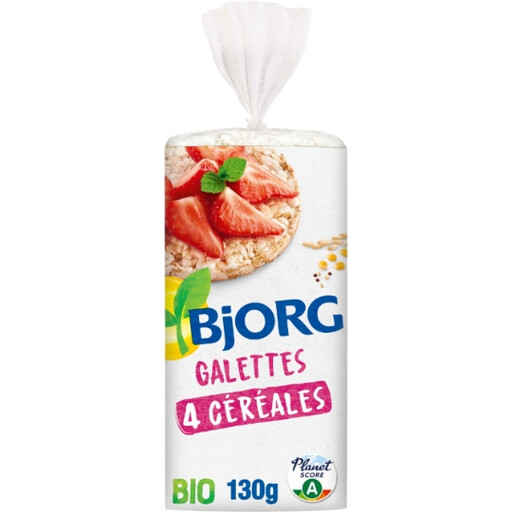 Image unavailable
If you want a snack that needs no preparation, check that this product is the crispy rice cake format you’re looking for: its packaging also uses the terms “pancake” and “waffle”. The pack is listed as 130 g. If you have coeliac disease, check the “gluten-free” label on the packaging; also check for trace warnings if soya is a concern for you.
No. The DGCCRF says displaying it is optional in France. If a rice cake doesn’t show a Nutri-Score, compare the nutritional information per 100 g; prepacked foods must carry a nutrition declaration, subject to certain exceptions.
No. According to AFDIAG, an ingredient that is naturally gluten-free can become contaminated during transport or packaging. Check for the “gluten-free” label on the rice cake you buy; the crossed-grain symbol offers an additional indication of checks.
Follow the instructions on the packet you buy. The Bjorg product information listed by Auchan recommends keeping its products in a cool, dry place to help them stay crisp; reseal the packaging after use.