People who need to avoid gluten strictly
You’re looking for a chocolatey post-workout snack, but the ‘gluten-free’ claim on the variant you buy matters more than its protein content. This claim is regulated by EU law.


If you need to avoid gluten strictly, first look for the ‘gluten-free’ claim on the variant you’re buying, then compare the protein, sugar and energy per bar. For a post-workout snack, a bar with 20 g of protein offers something quite different from one with around 10 g. The serving size and other nutritional values also matter when making your choice.
You’re looking for a chocolatey post-workout snack, but the ‘gluten-free’ claim on the variant you buy matters more than its protein content. This claim is regulated by EU law.
You want to know how much protein you’ll get from the portion you eat, then check the sugar, energy and allergens before choosing a snack.
You prefer a handy format that’s easy to take with you, while knowing the difference between a cereal bar and a protein bar. Check the ingredients and labelling for each flavour.
When comparing bars for a post-workout snack, start with your main requirement, then check the nutritional values for the whole bar.
| Criteria | What to check | Who is this for? |
|---|---|---|
| Avoiding gluten | The ‘gluten-free’ claim on the packaging for your chosen flavour, plus the allergen information. | If I need to avoid gluten strictly, an ingredient list with no obvious wheat isn’t enough to make my choice. Around 36% of consumers would put this claim at the top of their list of criteria. |
| Protein per serving | The grams of protein per bar and the bar’s weight. | After a workout, I want to know what I’ll get from the whole bar rather than relying on the word ‘protein’. This amount would be the main criterion for around 29% of consumers. |
| Sugar and energy | Sugar and energy per 100 g, then per serving. | A bar might offer an appealing amount of protein without matching what I’m looking for in terms of sugar or energy. Around 21% of consumers would check the nutritional information first. |
| Convenience when shopping | The format and labelling of the variant, and whether it’s available when you shop. | When I’m planning to take a snack with me, I want to find a convenient format without skipping the checks for my chosen flavour. Around 14% of consumers would put ease of purchase first. |
Not every recipe in a protein bar range necessarily carries a ‘gluten-free’ claim. Barebells, for example, says its bars may contain traces of gluten.
If you need to avoid gluten strictly, look for the claim on the packaging of the variant you buy, even when you switch flavours.
The product listing for the CLIF chocolate and peanut butter bar states that it contains 20 g of protein, as well as 17 g of sugar and 279 kcal per 68 g bar. A 40 g Nature Valley salted caramel and peanut bar contains 10.4 g of protein, 6.3 g of sugar and 198 kcal.
Check the serving size, protein, sugar, energy and allergens together for each recipe.
According to the DGCCRF, Nutri-Score is voluntary in France. For the relevant prepacked foods, the nutrition declaration provides the values even when no Nutri-Score is shown.
Use the score if it appears on the product, but don’t let it replace checking the nutritional information and ingredients.
Article 1613 ter of the French General Tax Code, published by Légifrance, applies to drinks and liquid preparations for drinks, not solid bars.
Compare sugar content when choosing a snack, but don’t treat this tax as something that applies to the bar.
The chocolate and peanut butter plant protein bar featured by Decathlon France carries a ‘gluten-free’ claim and contains 20 g of protein per 68 g bar.
The salted caramel and peanut protein variant featured on Joybuy contains 10.4 g of protein per 40 g bar.
Carrefour France lists a peanut and dark chocolate cereal bar with a ‘gluten-free’ claim.
The brand makes protein bars, but the range name alone isn’t enough to help you choose if you need to avoid gluten strictly.
These multipacks of four are worth considering if you’re looking for a snack to take with you. If you need to avoid gluten strictly, check the claim on the packaging of your chosen variant before buying.
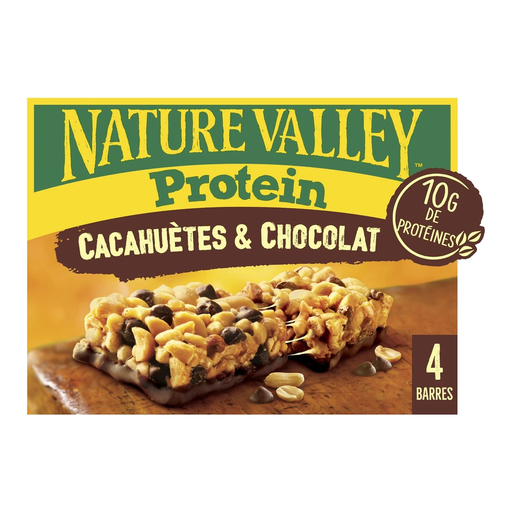 Image unavailable
Worth considering if you’re looking for a multipack to take with you for snacking. The pack contains four 40 g bars. If you need to avoid gluten strictly, check the claim and allergen information on the packaging for this variant.
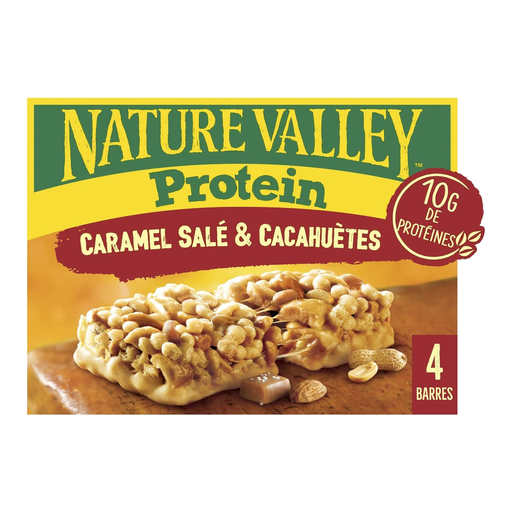 Image unavailable
Worth considering if you want to compare the nutritional values for a whole bar as a snack to take with you. The listing for this variant states that each 40 g bar contains 10.4 g of protein, 6.3 g of sugar and 198 kcal. It also lists peanuts, soya, milk and almonds. If you need to avoid gluten strictly, check for the ‘gluten-free’ claim on the packaging.
No. If you need to avoid gluten strictly, look for the ‘gluten-free’ claim on the variant you buy rather than relying on the apparent absence of wheat alone. The claim is regulated by European Union law.
No. The DGCCRF explains that Nutri-Score is voluntary. For the relevant prepacked foods, the nutrition declaration provides details such as energy, sugar and protein for you to compare.
No, not to a solid bar as such. Article 1613 ter of the French General Tax Code, published by Légifrance, applies to drinks and liquid preparations for drinks. The bar’s sugar content is separate nutritional information to check.
Don’t assume a bar is a meal replacement: E.Leclerc describes it as a snack, not a meal replacement. Compare the serving size and nutritional information with how you plan to use it.